この記事の要点
- 「ピックルボール」という名前を、テレビやSNSで耳にする機会が一気に増えました。
- 日本ではPickleball Japanが大会や普及活動を案内しており、2026年には国内主要団体が統合しました。
- この記事は、ルール・道具・始め方・上達のコツまで、初心者が最初に知りたいことを一気にまとめた「総合入門ハブ」です。
Chances to hear the name pickleball on television and social media have increased all at once. It is a U.S.-born racket sport that takes the best of tennis, table tennis, and badminton, and it is one of the most fast-rising sports in Japan right now.
日本ではPickleball Japanが大会や普及活動を案内しており、2026年には国内主要団体が統合しました。競技人口の民間推計は定義が異なるため、確定値としてではなく調査条件と合わせて見る必要があります。
This article is a comprehensive introduction hub that sums up all at once what beginners most want to know first, from rules, gear, and how to start to tips for improving. Each theme is explained while guiding you to specialist articles that dig deeper. By the time you finish reading, all the preparation to stand on a nearby court should be in order.
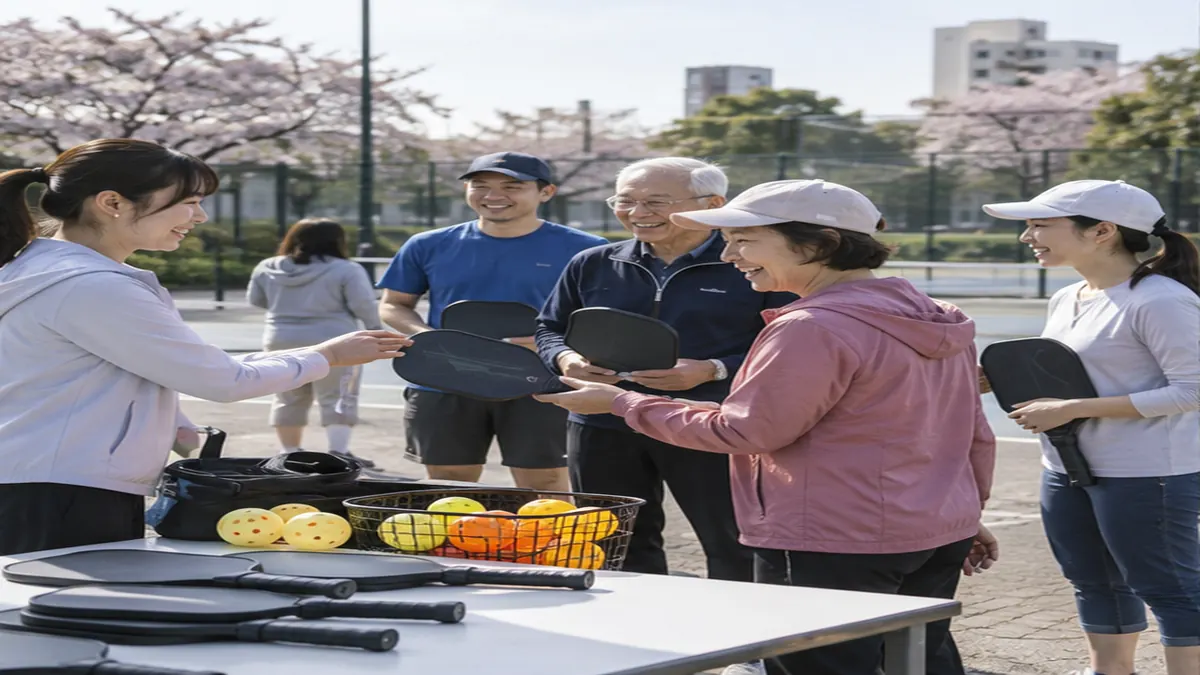
What is pickleball? The basic information to grasp first
Taking the best of tennis, table tennis, and badminton
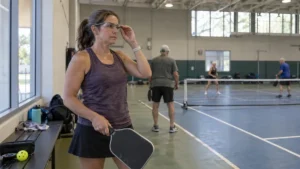
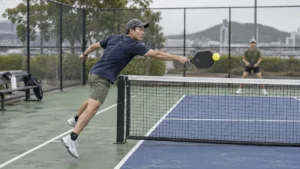
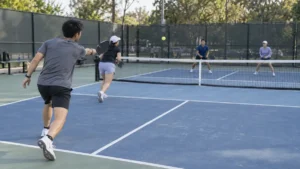
Pickleball istennis, badminton, and table tennisa racket sport combining these three elements. On a court the same size as badminton, you use a paddle like an enlarged table tennis paddle and hit a perforated plastic ball back and forth.
Its biggest feature is the balance of ease of starting and depth. The rules are simple and you can enjoy a rally from the day you grip a paddle, while if you aim higher the tactics are deep and you can keep at it for a long time. In the home country of America, a pro league has been launched, showing enthusiasm to the point that famous athletes and celebrities become team owners. For the differences from tennis and table tennis, seethe article comparing pickleball and tennis、The five differences from badmintonorganize each of them.
Why is the player population surging in Japan now?
There are three reasons behind pickleball's growth in Japan.
- The court is small at about a third of a tennis court, and the running distance is short, so it can be enjoyed regardless of age or fitness
- The gear is only a paddle and a ball, and you can start empty-handed with rentals and trial sessions
- Being doubles-centered, conversation arises easily, and the circle of making companions and community widens easily
In the aforementioned 2026 survey, of those who learned the rules,74.1%answered they were interested, and interest jumped more than fourfold from 16.9% before they knew about it. Especially the awareness rate among males in their teens is outstandingly high, and with 72.5% of those with tennis experience showing interest, the base of the group who will start next remains broad.
Pickleball's history and worldwide adoption
The birthplace and the origin of the name
Pickleball's history goes back to 1965, on Bainbridge Island, Washington, in the United States. It began when the founder Joel Pritchard (later a U.S. congressman) and his friends had bored children play using the backyard badminton court, table tennis paddles, and a plastic ball.
The leading theory for the origin of the name is that it was named after pickle boat, a boat race crewed by a scratch team of rowers. The story that it comes from the Pritchard family's pet dog Pickles is also well known, but that is considered a folk tale that spread in later years.
From a family game to a worldwide sport
This sport has developed while spreading from a home game to local communities.
- 1970s: Dedicated paddles and balls are sold, and it takes shape as a sport
- 1984: The USA Pickleball Association (USAPA) is founded, and an official rulebook is issued
- 2010s onward: It spreads centered on seniors, then expands all at once to younger generations, triggered by social media
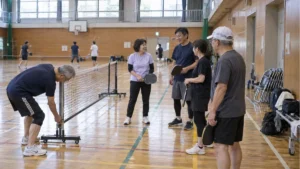
Now, associations have been founded in countries around the world including Japan, and the player population is surging. Scenes of children through the elderly interacting across the net on the same court are unique to this sport. For the spread in the home country of America, seethe state of pickleball in America.
The three basic rules beginners learn first
At first you can play with just these three
Pickleball's rules are designed to let you enjoy long rallies. A game is usually decided by first to 11 points by a 2-point margin. What you should learn first is just the following three.
- Serve:ボレーサーブとドロップサーブで要件が異なります。対角線のサービスコートへ入れ、公開時点の公式ルールを確認してください。詳しくはthe explainer on serve rules.
- Two-bounce ruleafter the serve, the receiver lets it bounce once before returning it, and the serving side also lets the return bounce once before hitting. From the third stroke onward, hitting without a bounce (a volley) is possible. Thanks to this mechanism, the serving side is not one-sidedly advantaged, and even beginners can keep a rally going. For common misconceptions, seethe explainer on the two-bounce rule.
- Non-volley zone (kitchen)within the 7-foot (about 2.13 m) area on both sides of the net, a volley without a bounce is prohibited. It keeps play from being all hard hits and makes delicate control matter. For the finer handling, seethe complete guide to the kitchen rule.
If you want to read through the whole picture of the rules once more, seerules and play guideThe faults beginners especially tend to stumble over can be supplemented withthe explainer on fault rulesyou can supplement.
Court size and layout
The court is 20 feet (about 6.1 m) by 44 feet (about 13.4 m), the same size as a badminton doubles court. The net height is about 91.4 cm at the ends and about 86.4 cm at the center, set a bit lower than in tennis.
The existence of this kitchen makes delicate techniques such as positioning and dinking important, not just power. Once you actually stand on the court, the back-and-forth near the lines comes into play. For the dimensions and setup tips, seethe complete guide to court size.
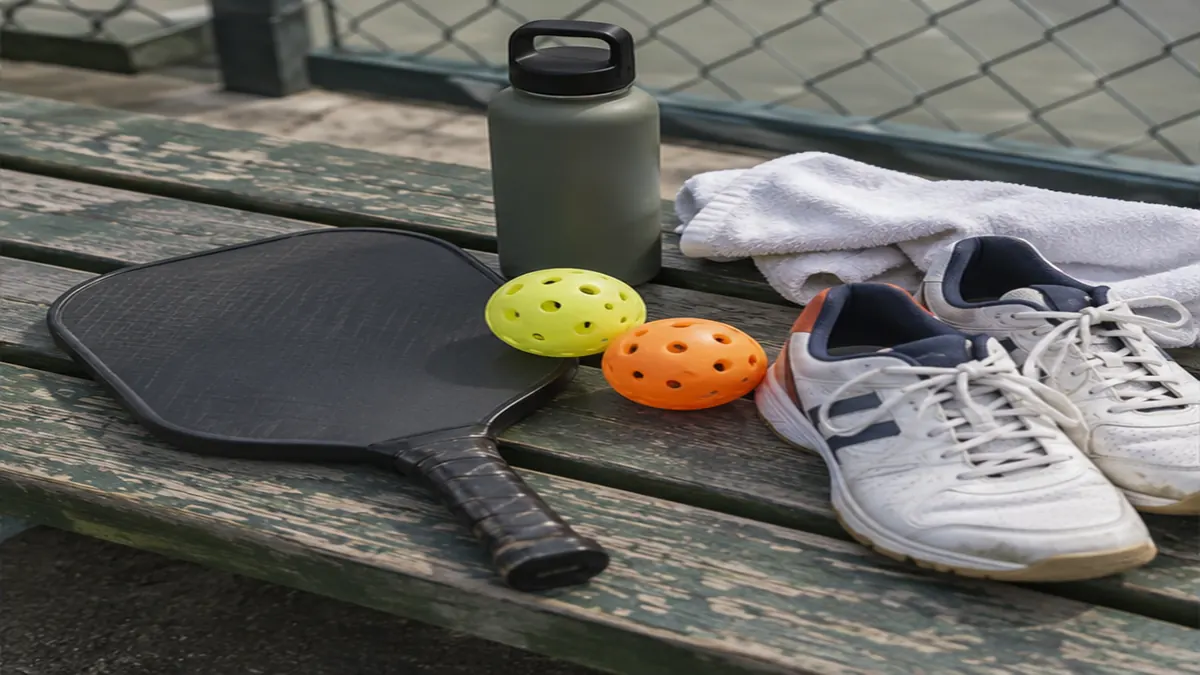
Pickleball gear: what to assemble first
The basics of the paddle
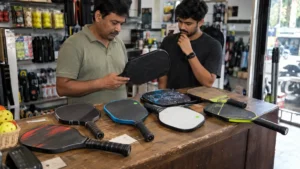
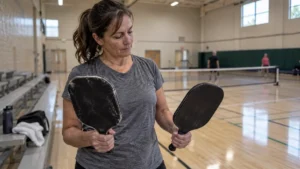
The pickleball racket is called aPaddlesand its feature is that it has no strings and is board-shaped. For your first one, grasping three points, material (composite is easy to handle), weight, and grip size, is enough. That said, there is no need to agonize too much from the start, and the trick to not going wrong is to borrow one at a rental or trial session and get a feel before choosing.
How to choose weight and grip, details of the initial cost, and concrete model comparisons are split by role into gear-specialist articles. For the big picture of what to assemble first, seethe guide to the first gear to getfor choosing a model,complete guide to choosing a paddleandthe popular paddle rankingand for a sense of the cost,the beginner's cost guideplease refer to.
Types of balls and their features
The ball is made of plastic, shaped like a Wiffle ball with many holes. You use two types depending on the playing environment.
- Indoor: larger holes and fewer of them (about 26). Soft, with a stable bounce on the floor
- Outdoor: smaller holes and more of them (about 40). On the hard side, less affected by wind, and highly durable
Highly visible yellow and neon green are standard. Even if they look the same, the bounce and flight distance change, so choose according to indoor or outdoor.
Where can you play? How to start pickleball in Japan
I'd like to try it, but where can I play? This is the first wall beginners hit. Places to play are increasing rapidly in Japan too. Let us look concretely at how to find them.
How to find courts and facilities nationwide
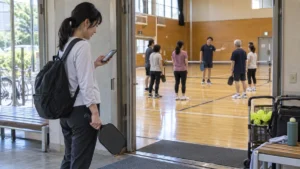
Places to play pickleball are spreading nationwide, such as gymnasiums, sports clubs, and facilities repurposing tennis courts. For regional facility information, starting froma summary of court information nationwideas a starting point,TokyoandOsakaandOkinawaand finding it from the article for your own area is the sure way. Rather than searching for pickleball court plus a place name, you can check things like the facility's operating style and whether beginners are welcome.
How to find trial sessions and companions
Many circles and clubs take an open play format in which individual participants gather and form pairs on the spot. Trial sessions with gear rental are also held in various places, and the appeal is that you can join empty-handed. The standard way to start is to try it with a rental first and, once you are hooked, assemble your own paddle. For concrete ways to make companions, seehow to find pickleball companionsand for the flow of people who actually started, seea beginner's accountis a good reference.
Entering tournaments and events
Once you have gotten used to it, try tournaments and events too.Pickleball Japan Federation (PICKLEBALL JAPAN)and other official sites post tournament information. Because slots for popular tournaments fill up quickly, early registration is reassuring. Beginner categories are also increasing, and you can get a sense of the atmosphere fromTournaments Even Beginners Can Enteranda list of international tournamentsyou can get a feel for the atmosphere.
Strategy and techniques for beginners to improve
Once you have learned the basic rules, next is strategy for winning matches. Pickleball is a sport that asks for control over power.
The third-shot drop
The third-shot dropis one of the most important shots. It is the technique of softly dropping the serving side's third stroke, which follows the serve (first stroke) and the return (second stroke), into the opponent's kitchen. Because hitting hard at an opponent already closed in at the net gets it slammed back, you deliberately send a slow ball that sinks to their feet and buy time for your own side to come up to the net.
dink
A rally in which both sides line up at the net and gently hit the ball back and forth near the kitchen line is a dink. Because hitting hard sends it out or floats it up and gets it smashed, you patiently keep sending it to the opponent's feet and wait for the moment they break down and float it up. The step up from beginner to intermediate hinges on mastering this rally of patience.
Positioning and basic practice
In doubles, the basic play is for the two to move together. Move left and right in sync as if tied together by a rope, and the basic play is to not create a gap between the two of you. If a chance comes, close in to the net right away. For repetitive practice to stabilize your serve, seea three-stage practice method to stabilize your serveis helpful.
Pickleball's health and fitness benefits
ピックルボールも身体活動の一つですが、運動強度や健康への影響はプレー形式と本人の状態で変わります。
Aerobic exercise and calorie burn
コートが狭く激しいダッシュは少ないものの、ラリーが続くため常に動き続けます。心拍数が上がることがありますが、消費エネルギーや運動強度には個人差があります。運動が苦手な人でも継続しやすいのが魅力です。
Reflexes and balance
Close-range volley battles train dynamic vision and reflexes. Stepping front, back, left, and right cultivates leg and hip strength, and for seniors it also helps prevent falls and maintain balance.
Effects on mental health
Enough to be called a social sport, another feature is that conversation between players arises easily. There is an atmosphere where you can laugh together even when you fail, tying into relieving loneliness and blowing off stress. For details, seepickleball and mental health.
No court, no problem: ways to enjoy it at home
Even those who say there is no court nearby can enjoy practice at home with a little ingenuity.
- Driveway or yard: if you have flat concrete or asphalt, you can draw a court with chalk or masking tape. Even a half-size one is enough to practice skinny singles
- Portable net: with an assemble-yourself net for a few thousand to about 10,000 yen, your home parking spot turns into a dedicated court in minutes
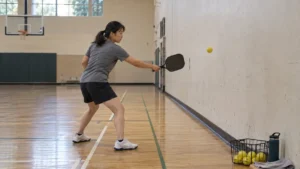
- Wall practice: tape a 34-to-36-inch line on a wall and repeat volleys and drops. The best solo practice for honing control
- Sponge ball: indoors, a sponge ball less likely to damage furniture keeps your feel even on rainy days
Pickleball has a low hurdle to start and reveals more tactical depth the more you keep at it. First take a step out at a trial session or with a rental, and hit at a nearby court or at home. It ties into a new hobby and exercise habit, and meeting companions who stand on the same court.
FAQ
- What kind of clothing and shoes should I play in?
-
For clothing, anything easy to move in, such as sportswear (a T-shirt, shorts, etc.), is fine. What matters is the shoes. Running shoes are made to move forward, and in pickleball, with its many sideways movements, they carry a sprain risk.Tennis shoesandBadminton shoesor shoes called court shoes that are strong on lateral movement are strongly recommended.
- How much does it cost to assemble the gear?
-
Pickleball is a sport with a relatively low initial cost.
- Paddle: beginner models can be bought for about 3,000 to 5,000 yen (advanced models from 20,000 yen).
- Ball: a few hundred yen each. On Amazon and elsewhere, a starter set with two paddles and balls is sold for around 5,000 yen, and that is plenty to enjoy at first.
- Is it all right even for those with no tennis experience or seniors not confident in their fitness?
-
運動経験が少なくても短時間から試せますが、誰にでも安全とは限りません。急停止や方向転換では転倒や関節への負担が生じます。持病や痛みがある場合は医療専門職へ相談し、準備運動、休憩、水分補給を行ってください。
- I heard pickleball is noisy; is that true?
-
Because you hit a plastic ball with a hard paddle, it makes a distinctive high sound, a kaan or pokon. Because the sound carries more than in tennis, in densely built residential areas abroad it sometimes causes noise trouble. In Japan it is often played in gymnasiums (indoors) so it does not become much of a problem, but if you play in a quiet place, consideration such as choosing quiet-designed balls and paddles may be needed.
- Can I start on my own even without a partner?
-
Yes, you can start. Because doubles is the mainstream in pickleball, many circles and clubs take an open play format in which individual participants gather, form pairs on the spot, and rotate through matches. If you join a local trial session or club, you will find companions on the spot. The community is very friendly, so do dive in with peace of mind even on your own.
確認した一次情報
- USA Pickleball 2026 Official Rulebook
- Pickleball Japan公式
- CDC・身体活動の健康効果
- AAOS・Pickleball Injury Prevention Tips
Related Articles Worth Reading
- Pickleball Glossary | 50 Essential Terms Worth Knowing
- How much does pickleball cost for beginners? A complete guide to initial and ongoing costs
- The Rules and Play Guide for Getting Started With Pickleball
- How to Keep Score in Pickleball | The Meaning of 0-0-2, Too
- What Is the Pickleball Two-Bounce Rule? The Basics and Common Misunderstandings
Related Articles