Your pickleball serve goes in during practice, but suddenly breaks down in a match — have you had that experience?
Players holding their heads and thinking "why doesn't it go in only when it counts" are actually incredibly common. But that's not because your serve is bad.You just haven't practiced making it consistent— that's almost always all it is.
This article introduces a three-stage practice method to keep your serve from breaking down in matches. By working in the order of solidifying form → placing to courses → pressure practice, you'll get a serve that doesn't flinch even when it counts.
In This Article
- The root causes of an inconsistent serve
- Concrete drills for solidifying your form (50 balls a day)
- Goal-setting methods for placing to different courses
- How to practice under pressure with a match in mind
- Pitfalls tennis and badminton players tend to fall into
Why does the serve break down in matches?
When your mental state wavers, the first thing to fall apart isform that isn't fully solidified.Rather than "breaking down from match pressure," the accurate way to put it is "pressure makes you unable to reproduce your usual self."
Ingraining a form that doesn't break down into your body is the number one shortcut to consistency.
Pickleball-specific rules can also be the cause
The pickleball serve hasunique rules different from tennis.Swinging with a tennis feel without knowing these becomes a cause of your form varying every time.
| Rules | Details |
|---|---|
| Swing direction | Underhand (from below) |
| Ball contact position | Below the waist, and hit with the paddle below the wrist |
| Stance | Both feet behind the baseline |
| Drop serve | Hitting after a bounce is also allowed |
Start by firmly understanding the "template of correct form" first.
Your body changes when under pressure
When people get nervous, their muscles stiffen and their shoulders and elbows rise higher than usual. This "tension" throws off your release point and swing size. To make the same movement even under pressure, there's no choice but to drill it into your body through repetition.
The overall picture of the three stages is as follows. Stepping through them in order looks like a detour but becomes the shortest route.
Without worrying about course or power, focus only on reproducing the same form. 50 balls of repetition a day is the foundation.
Once your form is consistent, be conscious of your target spot within the service area. Build control before speed.
Create match-like tension with a count system or theme-setting, and confirm whether you break down when it counts.
[Stage 1] Repetitive drills to solidify your form
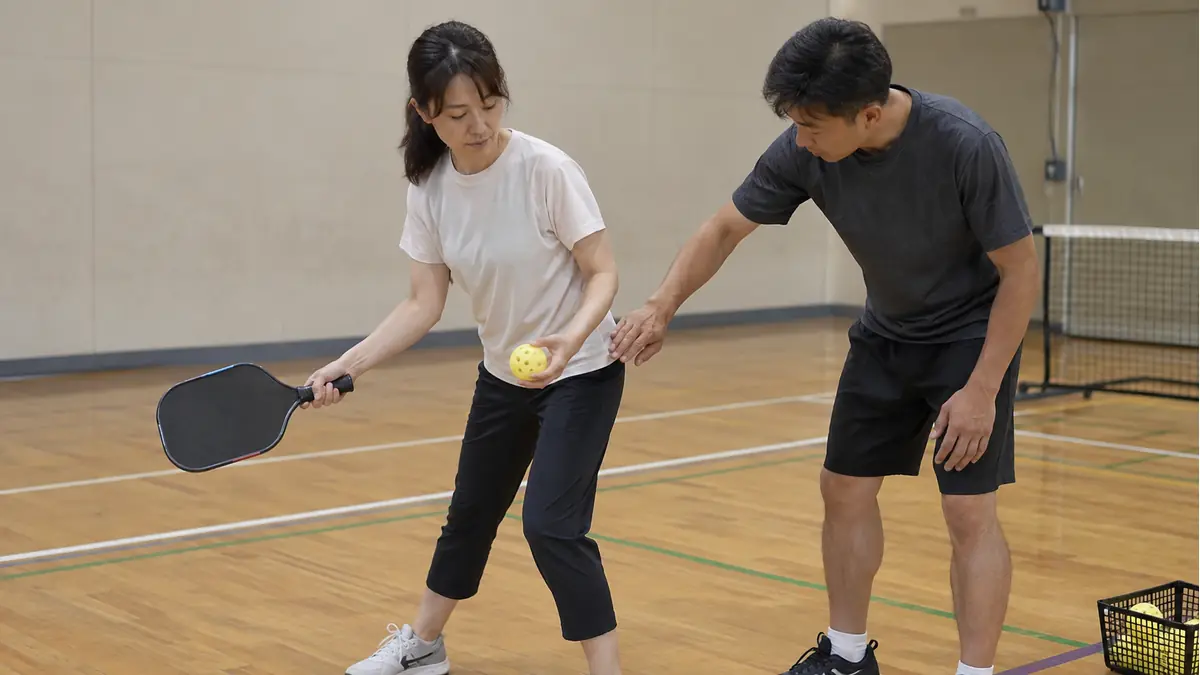
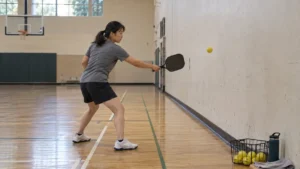
For the first two weeks, focus only on"reproducibility of form"rather than course or power. Rushing here will definitely make you break down later.
Checkpoints for basic form
The basic grip is the Continental grip (holding it like gripping a kitchen knife, with the face standing vertically). Don't grip too hard; it's about the feeling of "gently holding a towel."
For your standing position, draw your dominant foot back and open your body about 45 degrees to the court. The point is to move your swing from the shoulder and keep wrist snap to a minimum. Using your wrist too much makes your ball flight vary greatly with your form on a given day.
Another thing to be conscious of is the sense of "carrying" the ball rather than "swinging through" it. It's not that an underhand serve is more consistent the bigger and faster you swing — sending it forward compactly at a steady rhythm raises reproducibility. Practicing tracing the same trajectory every time while watching yourself in a mirror or reflected in glass is also effective.
50 balls a day: shadow-swing + hitting drill
| Step | Details | Number of balls |
|---|---|---|
| Shadow swing | Slowly, while checking your form | 20 times |
| Drop serve | Bounce it, then hit toward the net | 15 balls |
| Normal serve | Be conscious only of getting it in the court | 15 balls |
Keeping up this drill at 50 balls a day for two weeks will ingrain the form into your body. Working on it together with theoverall practice routinebeyond just the serve speeds up your improvement even more. You may think "just 50 balls?" but 50 high-quality balls improve you faster than 100 low-quality ones.
Do try filming video too. Comparing your form when it goes in and when it misses visualizes the difference and makes the point to fix clear at a glance.
Decide on a pre-serve routine
Just as important as form is going through the same preparatory motion (routine) every time. Pro players, without exception, have a set set of movements before serving. Deciding your own procedure, like "bounce the ball twice → deep breath → set up," and entering with the same flow every time means your body automatically recalls its usual rhythm even in tense situations.
A routine doesn't need to be complicated. The ideal is something short, simple, and doable every single time. Ingraining the whole routine into your body from the practice stage makes it easier to reproduce "business as usual" when it counts.
[Stage 2] Practice placing to different courses
Once your form becomes consistent, next move to control practice. This is finally the phase where you start being conscious of "where to hit."
Use different target spots within the service box
The pickleball serve has a rule that you must always hit to the diagonal service area. The way of thinking about courses also connects tosingles strategy.There's no choice of "cross or straight"; the diagonal direction is always the only target.
That's exactly why placement practice should be narrowed to "where within the service box to aim."
| Target spot | Effect | Point |
|---|---|---|
| Deep corner (back of the service area) | Push the opponent back and take kitchen control | Swing a bit bigger, conscious of depth |
| Near the T (toward the centerline) | Fix the opponent's body orientation to the center | Face your body forward, conscious of the center |
| Toward the opponent's body | Make the opponent's return motion cramped | Move your contact point slightly inside |
Slowing down at first is fine. Control comes first, and speed follows later.
Target practice using cones or objects
Placing a cone (or a plastic bottle if you don't have one) at the deep corner or toward the center of the service area and practicing aiming there is effective. Setting a goal of 7 or more out of 10 balls in lets you focus with a game-like feel.
Tennis and badminton players tend to rely on speed, but in pickleball control works far more effectively in matches. Prioritize "get it in first" above all.
Raising speed can come last
Once your control becomes consistent, add speed last. Reverse the order and even if the fast ball goes in, it won't fly to your target spot, so it ends up unusable in a match. After you can get 8 out of 10 balls into your target area, gradually raising ball speed is the safe way. Thinking of speed as "the final topping on top of control" keeps you from getting your practice priorities wrong.
[Stage 3] Practice under pressure
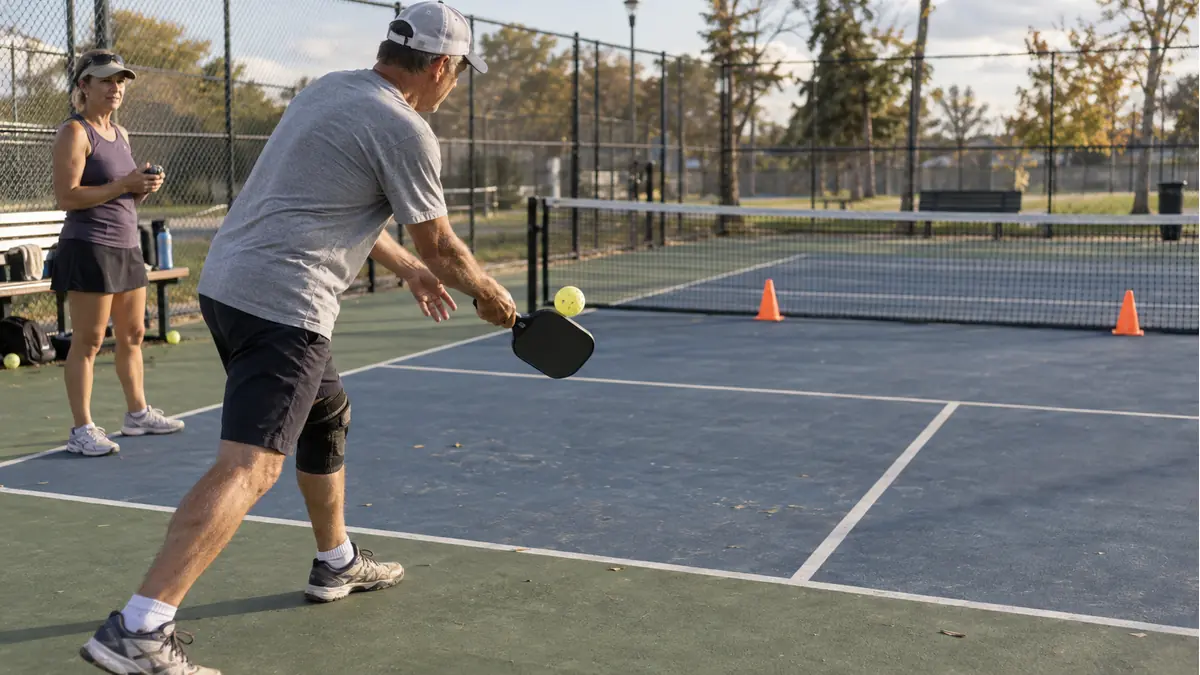
This is the biggest peak in these three stages. Even if you've mastered form and course, it means nothing if you can't produce them under match tension. Stage 3 is the finishing process that gives your acquired technique the guarantee of "not breaking down even when it counts."
The point is to deliberately bring tension into practice. Rather than just hitting pleasantly, create a "can't-fail situation" yourself and confirm whether you can reproduce your usual movement within it.
Count-system pressure drill
It's a practice method you can do alone, and the rule is simple.
Hit 10 balls, and if 8 or more go in, it's a "success." If you fail, reset the count from the start.
The pressure of "you can't finish until you get 8 in" creates a state close to match tension. Once you get used to it, raise the success line to 9 balls. It's more nerve-racking than you'd imagine, so do try it once.

Editor's Note
The point of pressure practice is "reset if you fail." The experience of rebuilding your focus for each ball comes into play on the very first serve of a match. 8 successes is plenty at first. Once you get used to it, raise the bar.
Building awareness in a game format
In practice matches, go in with a clear theme, such as "always aim the first serve at the deep corner" or "try the body once every three games."
The difference three months later between practice you just get through and practice with a theme is completely different. Even with fewer balls, intentional practice improves you faster. This I can state for certain.
3 common no-nos in serve practice
People who practice but don't improve have common pitfalls. Check whether any apply to you.
Suddenly aiming for course and power
Trying to do "deep, fast, and aimed" all at once before your form is solid makes your movement different every time, and reproducibility doesn't develop. Focus only on getting it in for the first two weeks, and leave course for stage 2.
Racking up balls while tired
"You'll get good if you just hit a lot" is a misunderstanding. Rather than hitting 100 balls with tired, broken-down form, 50 focused balls leaves the correct template in your body. When quality drops, resting once is the right answer.
Hitting without deciding a theme
Practice where you just hit aimlessly doesn't improve you much for the time spent. Deciding one theme per session, like "today only the drop serve" or "the first serve always to the deep corner," changes your improvement speed even with the same number of balls.
Points tennis and badminton players should watch out for
People with experience in other racket sports improve fast, but there are moments where that experience gets in the way. Graspingthe differences from tennisthese in particular makes the switch to the serve smooth. If you feel "it's harder than I expected even though I'm experienced," that's a sign your past feel is interfering.
| Sports experience | Mistake you tend to fall into | Countermeasure |
|---|---|---|
| Tennis | Trying to hit from above (overhand habit) | Be conscious of underhand, don't raise your elbow |
| Badminton | Applying snap too strongly | Keep wrist movement to a minimum |
| Table Tennis | Applying too much spin and going out | Suppress the spin amount and get it in first |
| No experience | Hitting too much by brute force | Learn that it goes into the court even when hit lightly |
Try reviewing your form from scratch once, as if you were a beginner. That humility accelerates your improvement the most.
Summary: Stepping through the three stages in order is the shortest route
To make your pickleball serve consistent, stepping through the three stages in order without rushing is, in the end, the number one shortcut.
| Stage | Period | Purpose |
|---|---|---|
| Stage 1: Solidify form | 2 weeks | Ingrain the form into your body |
| Stage 2: Place to courses | 2–4 weeks | Become able to intentionally choose courses |
| Stage 3: Pressure practice | Ongoing | Become able to use a non-breaking serve in matches |
If you "want to acquire a serve usable in matches," keeping this order is the shortest route.
Rushing to just rack up practice matches is counterproductive if your form isn't solid. Even if it looks unglamorous, the repetitive drills of stage 1 are the foundation, so carefully finishing this off is, in the end, the number one shortcut.
The serve is the only shot in a match that you can "start at your own rhythm." That's exactly why the effect of making it consistent is large, and just being able to calmly get the first one in makes it easier to seize the initiative in the following rally too. More than a flashy put-away, a serve that goes in steadily every time works far more toward your win rate.
Do try working on it starting today. If you're unsure where to practice,court information nationwideis also worth referring to. The satisfaction when your serve lands in a match blows away the hardship of practice in an instant.
FAQ
What's the most common mistake with the pickleball serve?
The most common mistake is "trying to hit from above." Unlike tennis, a pickleball serve requires an underhand hit below the waist. Make it a habit to check during practice whether your hand is unconsciously rising.
My form changes every time. How can I fix it?
Filming video is the most effective. Record your serve on your smartphone and compare your form when it goes in versus when it misses. Once the difference is visualized, you'll immediately see the point to fix.
Which do you recommend, the drop serve or the toss serve?
For beginners we recommend the drop serve (hitting after a bounce). Matching the timing of the bounce makes the contact point easier to keep consistent, which is an advantage at the stage of solidifying form. Once you get used to it, do try the toss serve too.
How many balls should I hit per practice?
In stage 1, use 50 balls a day as a guide. Continuing to hit with broken-down form while tired is counterproductive. Hitting 50 balls with focus and resting well improves you faster.
How do I recover when my serve breaks down mid-match?
We recommend "taking a deep breath once, then checking how tightly you're gripping." When nervous, you unconsciously grip too hard. Just recalling the "feeling of gently holding a towel" often brings your form back.
Related Articles Worth Reading
- The Complete Guide to Pickleball Skill Ratings (2.0–5.0) | Know Your Level
- Are There Pickleball Tournaments Beginners Can Enter? How to Join and the Right Mindset
- Pickleball and Mental Health | Why It Works for Stress Relief and Preventing Depression
- A Stretching Routine Before and After Pickleball | Care to Enjoy It Injury-Free for Years
- Elbow Injuries Common in Pickleball | Preventing Tennis Elbow and Self-Care Methods
Reference Links
Related Articles