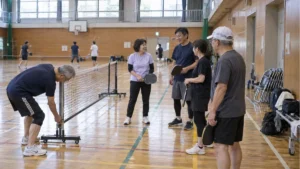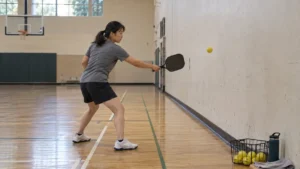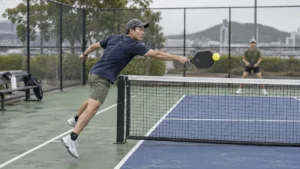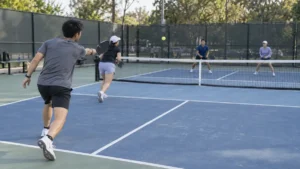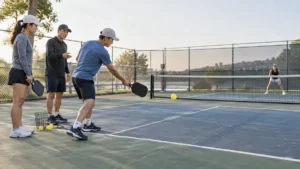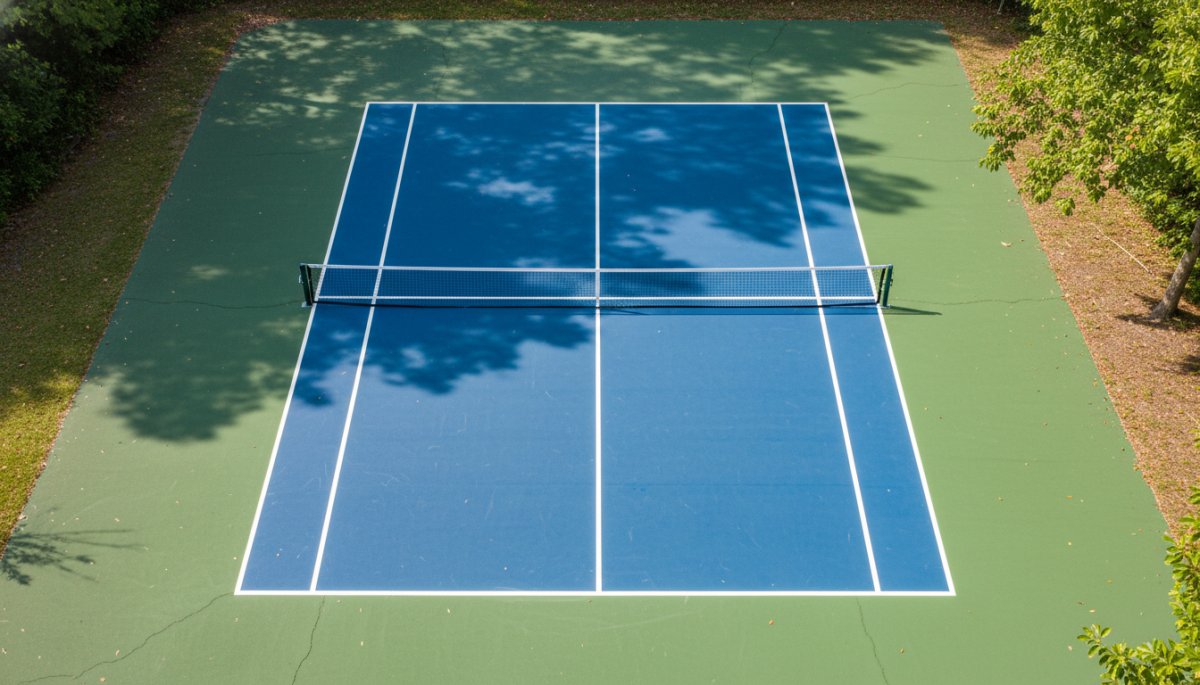
What those just starting pickleball are most thrown by, and fault most often at, is the area called the kitchen.
Its formal name is the non-volley zone. It is a special area set within 2.13 m (7 feet) of the net, on both sides of the court. Within this area, hitting the ball directly (a volley) is prohibited. This article focuses on not faulting in the kitchen and sums up, in practical terms, the common fault patterns and the standing position, body use, and practice methods to avoid them. For the origins of the rule and its tactical use, seenon-volley zone explanation.
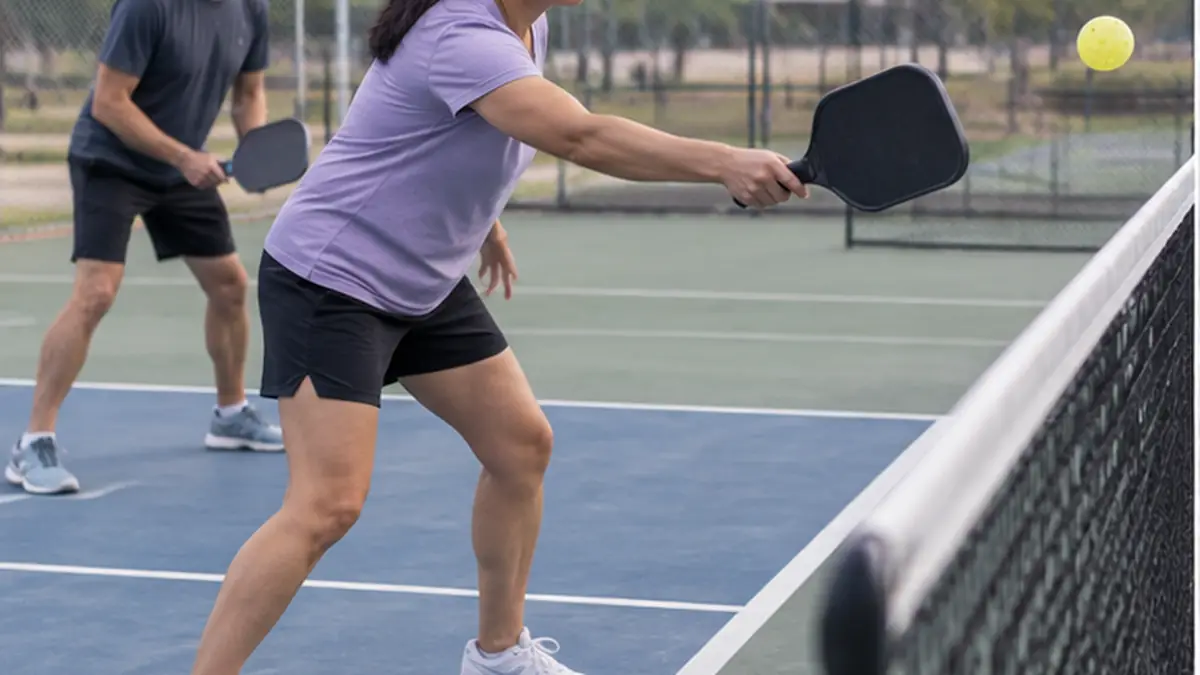
Fault patterns in the kitchen [quick reference]
First, grasp when it becomes a fault from the table. The accurate understanding is not that you must not enter but that you must not hit without a bounce.
| Situation | Call |
|---|---|
| Volleying within the zone (hitting without a bounce) | Fault |
| Stepping on the line or touching the zone while volleying | Fault |
| Something you are wearing or your paddle touches the zone | Fault |
| Entering or touching the zone from momentum after a volley | Fault |
| Volleying the opponent's out ball and entering the zone | Fault |
| Hitting within the zone after a bounce | OK (legal) |
The conditions under which volleying is prohibited
The core of the kitchen rule is that a volley (hitting without a bounce) within this area is prohibited.
However, after the ball has bounced once, you are allowed to enter the zone and hit it. It is not a complete no-entry area; you can hit if you let it bounce. But because a volley is easier to put away than waiting for the bounce, many players take the strategy of standing right at the edge of the line and waiting for the opponent's ball to float up to finish with a volley.
Stepping on or touching the line
Stepping on the non-volley zone line is treated the same as entering the area.
When you volley, entering the zone, stepping on the line, or having something you are wearing (clothing, a hat, etc.) or holding (a paddle, etc.) touch inside the zone including the line, these are all faults. Not just your feet but all of your body and gear must be outside the zone when you volley.
The action after a volley
What you especially want to watch is the action after a volley.
If after a volley the momentum carries you over so that you step on the line, or enter or touch the zone, that too is a fault. Because it is regarded as one continuous motion, you need to be attentive not only to the moment you hit but to the flow of your feet afterward. Even if the opponent's ball is out, it is a fault the moment you enter the zone after a volley.
Fault patterns beginners tend to fall into
The first step to avoiding faults is to know the patterns you tend to do. Let us look at three representative ones.
Stepping on the line from excess momentum
The most common fault is the case of entering the kitchen from momentum after a volley.
After hitting a hard volley, your body's momentum does not stop and you step on the line. This is a mistake common not only to beginners but to intermediates too. When you volley, always be conscious of your footing and keep enough distance from the line.
Your hat or paddle touching
What tends to be overlooked is the case of something you are wearing or holding touching the kitchen.
It is also a fault if, during a volley, your hat flies off and falls into the kitchen, or the tip of your paddle touches the line. Because it is hard to stay aware of fine details in the middle of intense play, care is needed.
Reacting to the opponent's out ball
Even when you can tell the opponent's ball is likely to go out, there are cases of reflexively volleying and entering the kitchen.
Even if the ball is out, it is a fault if you volley within the kitchen. The calm judgment to not reach for a ball likely to go out and let it pass prevents needless lost points.
The correct standing position to avoid faults
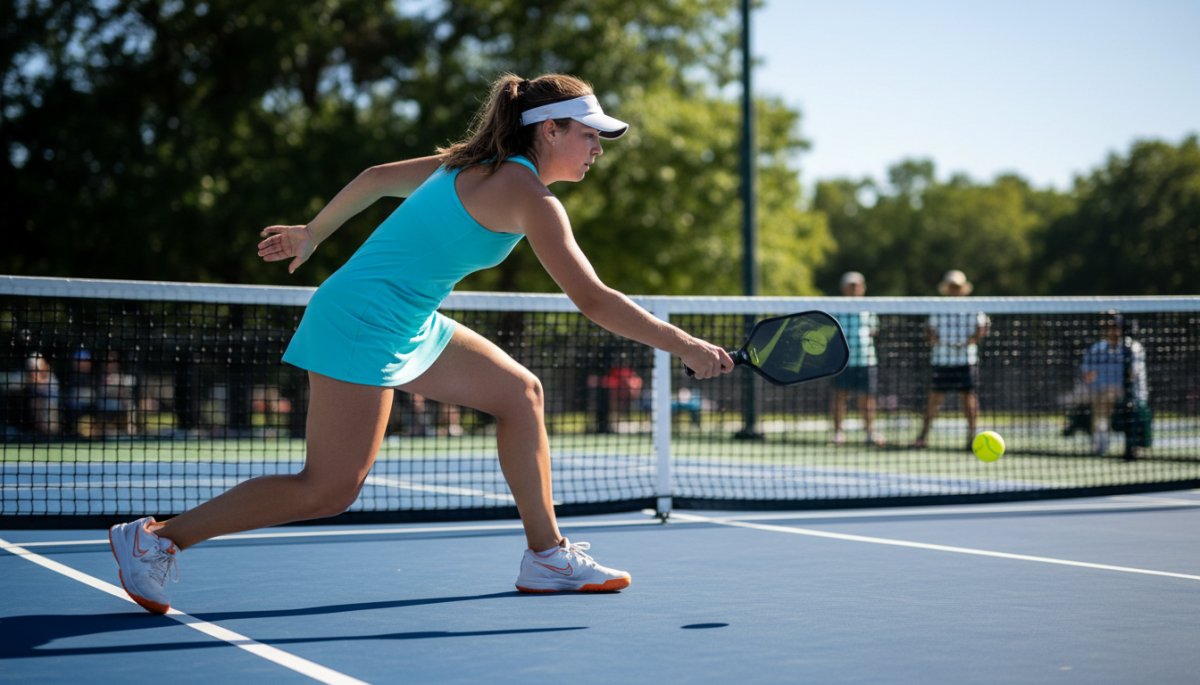
Ideally 10 to 20 cm behind the kitchen line
The most advantageous position in pickleball is right behind the non-volley zone, just behind the kitchen line.
From this position you can react quickly to the opponent's shots and use dinks and volleys effectively. However, standing right at the edge of the line raises the risk of a fault. Standing with a little room, about 10 to 20 cm behind the line, reduces the risk of stepping on the line from momentum. The trick is to balance advantage and safety margin. In doubles, the two stand side by side and cover the court evenly.
Advancing after the two-bounce rule
After the serve, the two-bounce rule means you cannot volley until both the serve and the return have bounced.
The serving side needs to let the opponent's return bounce once before returning it. For that reason, the serving side stays near the baseline and, after the two bounces, advances to move near the kitchen line, which is the basic play. The timing of this advance bears on both avoiding faults and the initiative in the match. Take care, because if you rush forward too early, you tend to reach for a ball in a situation where you cannot yet volley.
Practical training to prevent faults
Kitchen faults can surely be cut by learning with your body, not just with knowledge. We introduce drills to bring into your daily practice.
Practice being conscious of the line
To avoid faults, forming a habit of always being conscious of the line is the shortcut.
In practice, deliberately play near the kitchen line and confirm the position of your feet. Making a habit of glancing at your footing right after a volley to check whether you have stepped on the line is also effective. Having your partner watch and point out when you step on the line lets you correct habits you cannot notice yourself.
Controlling weight transfer
Controlling your weight transfer during a volley reduces the risk of entering the kitchen from momentum.
Hitting the volley with the image of not stepping in too far and leaving your weight on the back foot makes it easier to keep balance. Because a hard volley especially tends to carry the whole body forward, learning as a set the motions of returning your weight to the back foot after hitting and taking a small step back after hitting is effective.
The habit of self-checking to prevent faults
Make a habit of a simple self-check you can do yourself during a match.
Before going into a volley, judge in an instant whether it is a ball you may hit without a bounce right now, and if in doubt, wait for the bounce. Right after hitting, be conscious of your footing and check whether you are too close to the line. Just repeating these two every time greatly cuts faults from excess momentum. Along with that, practice to raise the precision of your dinks is also effective. Keeping a dink rally going with your partner and learning the feel of hitting at a height just over the net lets you wait for a chance without relying on forced volleys. For how to hit, seedink mastery guideexplains it in detail.
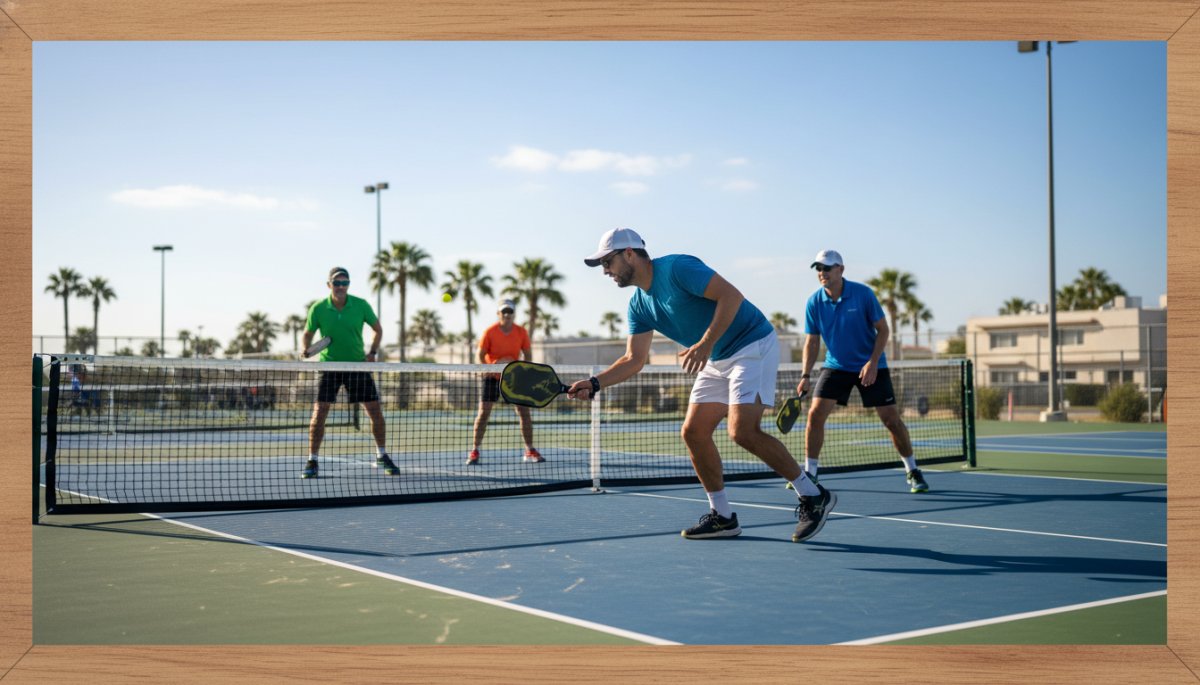
Dinks and third shots that make use of the kitchen
Once you can avoid faults, next it is time to make use of the kitchen for attack. The keys are the dink and the third shot.
Seize the initiative with the dink
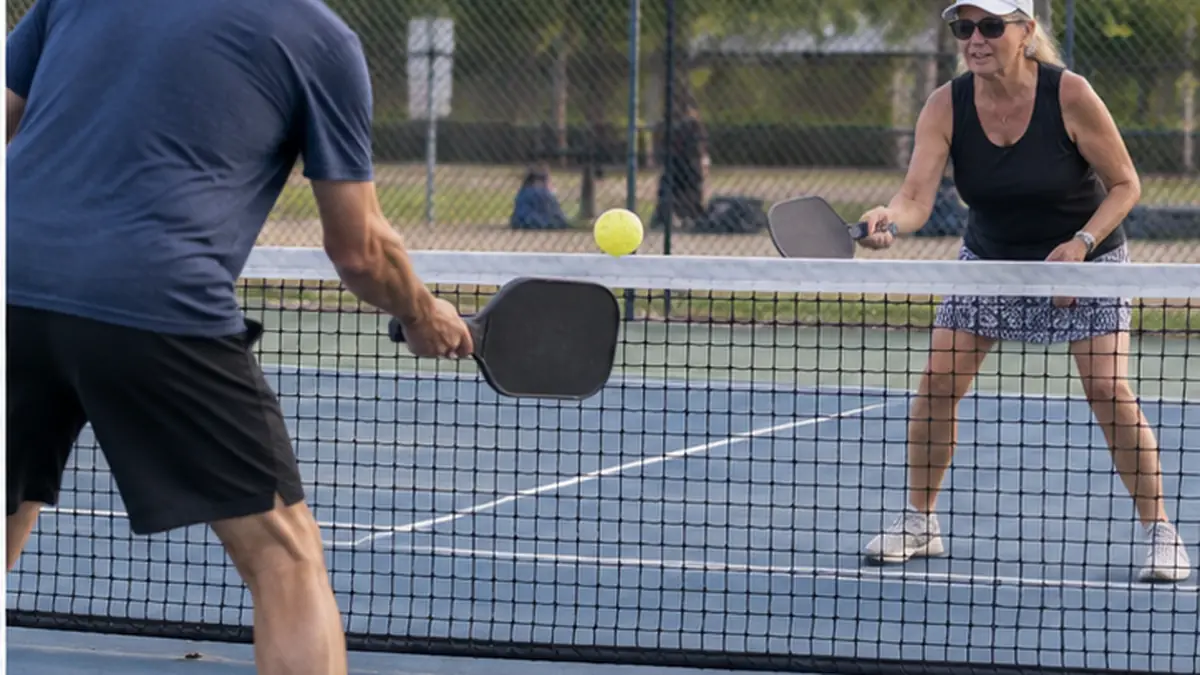
The dink is a shot hit low and soft over the non-volley zone.
It pins the opponent to the kitchen line and prevents aggressive volleys. Getting it just over the net, aiming at the opponent's feet, and varying your placement between crosscourt and straight makes the opponent easier to break down. Above all, keeping it low so the dink does not float up and give the opponent a chance is important.
Move forward with the third-shot drop
The third-shot drop, used on the third stroke after the serve, is the key to kitchen strategy.
After the serve return, the serving side is still near the baseline. By dropping a low, soft ball over the net rather than hitting hard, you can prevent the opponent's attack while closing in forward. If it succeeds, you can secure the advantageous position near the kitchen line and seize the initiative in the rally. For details, seethe explainer on the third-shot drop.

The number-one tip for cutting kitchen faults is not to press the edge of the line too hard. Just backing off 10 to 20 cm sharply reduces faults from excess momentum. And just being thorough about letting balls that look out go by erases needless lost points. Reining in your urge to attack a little is, as a result, the shortcut to raising your win rate.
FAQ
Are you not allowed to enter the kitchen?
It is not that you must not enter but that the accurate rule is you must not hit without a bounce within the kitchen (volleying is prohibited). After the ball has bounced once, you can enter the zone and hit it.
Is it a fault if I step on the kitchen line?
It is a fault if you step on the line while volleying. Not just your feet, but it is also a violation if something you are wearing or holding, such as a hat, clothing, or paddle, touches the zone including the line. A volley needs to be done with all of your body and gear outside the zone.
Is it a fault even if I enter the kitchen after volleying?
Yes, it is a fault. If after a volley the momentum carries you over so that you step on the line or enter the zone, that too is regarded as one continuous motion and becomes a fault. Making a habit of taking a small step back after hitting prevents it. Even if the opponent's ball is out, it is a fault if you enter the zone after a volley.
Are there tips for cutting kitchen faults?
Three are effective: standing about 10 to 20 cm behind rather than right at the edge of the line, returning your weight to the back foot after a volley, and letting balls that look out go by. Just reining in your urge to attack a little greatly cuts faults from excess momentum and needless lost points.
Summary: Make the kitchen rule your ally
Pickleball's kitchen rule may feel complex at first.
But this very rule creates pickleball's strategy and makes it a sport anyone can enjoy regardless of age or fitness. If you grasp that volleying is prohibited within the zone, that stepping on the line is also a fault, and that the action after a volley needs care too, you can surely cut faults.
The ideal standing position is a little behind the kitchen line. If you stay conscious of the line, control your weight transfer, and form the habit of letting balls that look out go by, needless lost points disappear. Once you can avoid faults, make use of the kitchen for attack with dinks and third shots. For the whole picture of faults, seethe explainer on fault rulesplease also have a look.
Related Articles Worth Reading
- What is the non-volley zone? Pickleball rules and points for using it
- What are the pickleball foul rules that beginners tend to stumble on?
- Mastering the pickleball dink: basic technique and tactical points
- Pickleball Line Judging | The Criteria for In and Out Explained
- What's the difference between pickleball and tennis? Comparing rules, gear, and difficulty
Related Articles