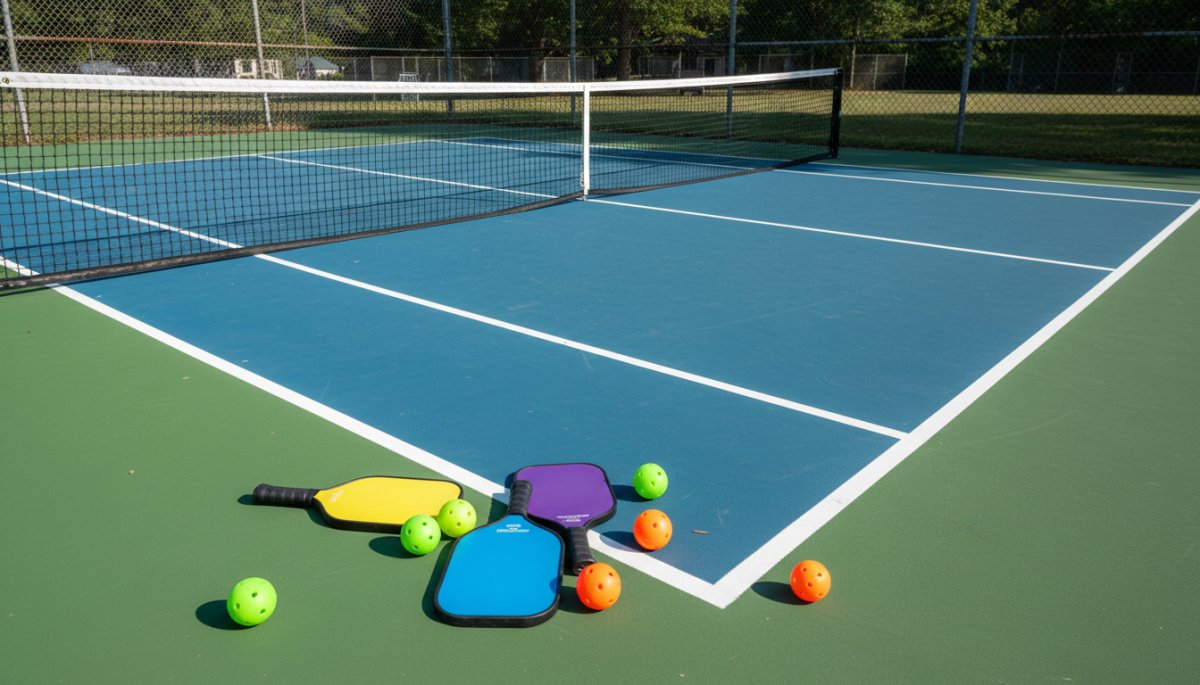
When you're thinking of starting pickleball, the first thing you wonder about is the court size.
Quite a few people agonize over "how much space do I need to play" and "can I do it in my home's yard or a gymnasium." In this article, we've compiled all the information needed for building a court, from the official regulation dimensions to the space needed for setup, using existing facilities, and how to draw the lines. The figures are summarized in an at-a-glance table, so you can also read just the parts you need.
Pickleball's official court size [Dimensions at a glance]
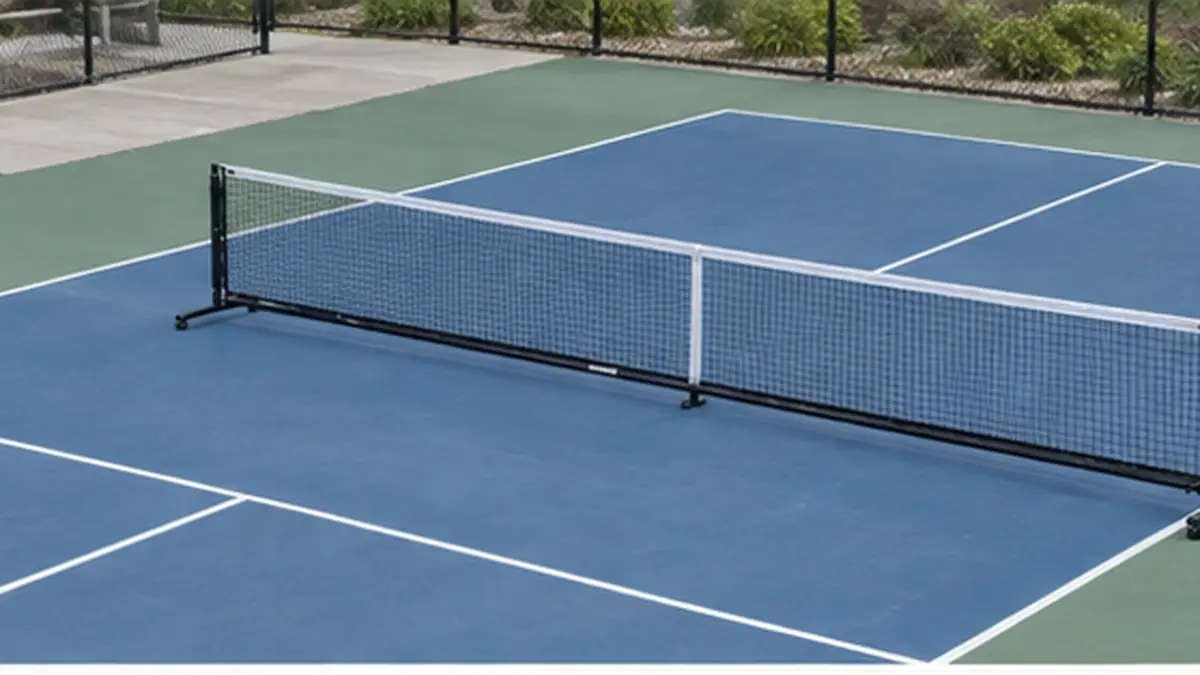
A pickleball court is 13.4 m long by 6.1 m wide, common to both singles and doubles. It's the same size as a badminton doubles court, roughly a quarter of a tennis court. We've compiled the main dimensions in a table.
| Item | Dimension (meters) | Feet and inches |
|---|---|---|
| Total court length | 13.4m | 44 feet |
| Total court width | 6.1m | 20 feet |
| Non-volley zone (from the net) | 2.13m | 7 feet |
| Net height (center) | 86.3cm | 34 inches |
| Net height (ends) | 91.4cm | 36 inches |
| Line width | 5.08cm | 2 inches |
| Court area | About 81.74 m² | 880 square feet |
Looking at area, it's only slightly narrower than a tennis service box. The advantage of this smaller design is that the distance you move per point is short, keeping the physical strain down.
Source Japan Pickleball Association (general incorporated association), "Official Rules"Created from
The net height differs at the center and the ends
The net height is 86.3 cm (34 inches) at the center and 91.4 cm (36 inches) on the post side at both ends.
It's a structure similar to tennis, but set somewhat lower. Making the center lower is to encourage tactics that use net-sidedink(soft shots) and drop shots. This difference of a few centimeters creates the strategic depth unique to pickleball.
The meaning of the non-volley zone (kitchen)
The most distinctive part of the court is the "non-volley zone," commonly called the kitchen, set within the 2.13 m (7 feet) range from the net.
Within this zone, volleying—hitting the ball directly—is prohibited. However, after the ball has bounced once, you are allowed to step into the zone to hit it. Having this rule curbs play that overpowers with force, making delicate touch and positioning important. Rallies being easy to sustain for a long time is also thanks to this rule. For details, see thenon-volley zone explanationas well.
The space and environment needed for court setup
To actually play, you also need safe space outside the lines.
The area needed for a match, and the minimum space
USA Pickleball's official rules recommend a run-off of 1.5m from the sidelines and about 2.4m from the baselines for match play (roughly 9.1m x 18.3m in total).
However, if it's just for having fun among friends, you can play plenty with about 1 m of room around the court. Even with about 50 cm on the sides, a rally itself can happen, but for safety, you'll want to secure as much margin as possible.
Indoors, check the ceiling height too
If you play indoors, check the ceiling height too.
The recommendation is about 5.5 m (18–20 feet). Even if it doesn't reach the standard, with about 3.5 m there's no worry of touching the ceiling with a jump, and you can enjoy basic rallies. High lobs become hard to hit, but there's no problem for entry-level play or practice.
How to choose the ground (surface)
In the home of the sport, the U.S., using a tennis hard court is common.
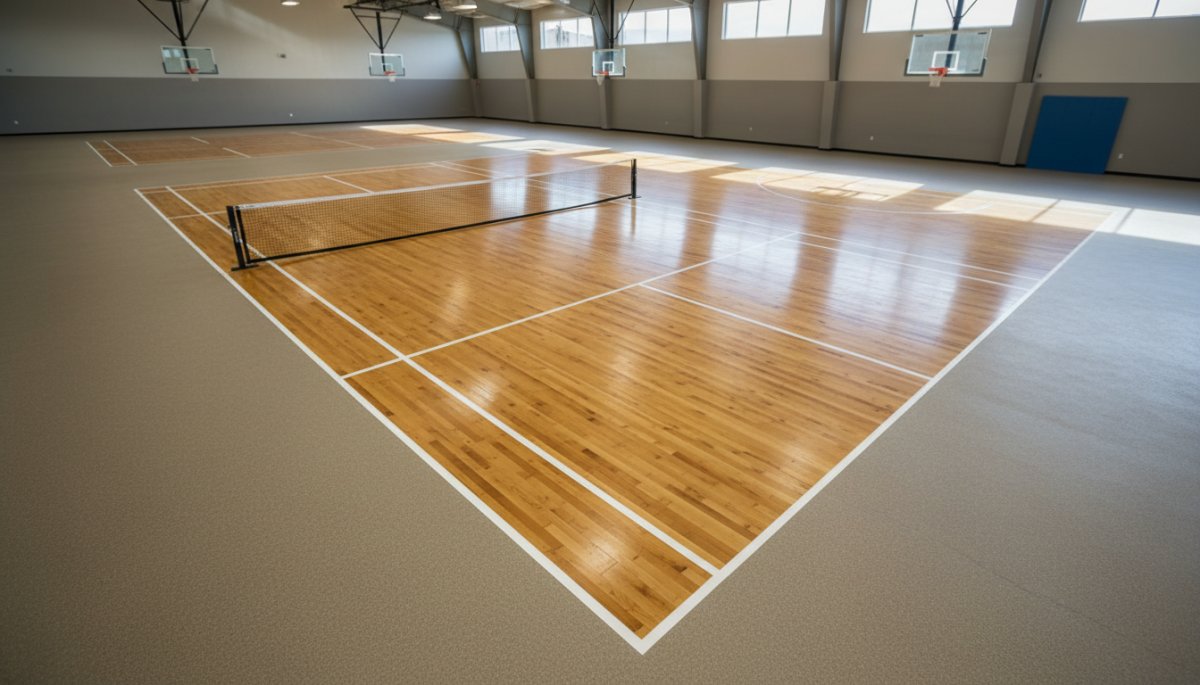
A hard court is made by coating a hard, flat base such as asphalt with rubber or acrylic. In Japan, pickleball hard courts are still few, and the reality is that gymnasiums are often used as substitutes. If the base is hard and flat, a tennis hard court, a gymnasium floor, or a hard carpet court can be used as is. Sand-filled artificial-turf omni courts have unstable bounce and are unsuitable.
Source Pickle One, "What's the size of a pickleball court? What's the net height?"Created from
Can existing facilities be used? A comparison with tennis and badminton
Even without a dedicated court, being able to make use of existing facilities is pickleball's strength. We've organized how many courts you can fit at each facility.
| Facility | Guideline court count | Point |
|---|---|---|
| Tennis court | About 4 courts | Easy to secure 1 to 4 courts, with many conversion examples |
| Badminton court | 1 court (same size) | Some line positions differ. Suited to repurposing a gymnasium |
| Basketball court | About 4 courts | 15 m x 28 m. Fit 4 courts if you close up the spacing |
| Futsal court | 3–6 courts | The court count changes depending on the court's size |
The relationship with badminton courts
The outer dimensions are the same as a badminton doubles court, but the positions of the inner lines are a little different.
Pickleball's non-volley zone line is about 11.3 cm behind badminton's short service line. Because many Japanese gymnasiums have badminton lines drawn, there's a high chance you can repurpose them, but some facilities prohibit pickleball for reasons of noise or floor damage. Always check and get permission before use.
You can fit 4 courts on a tennis court
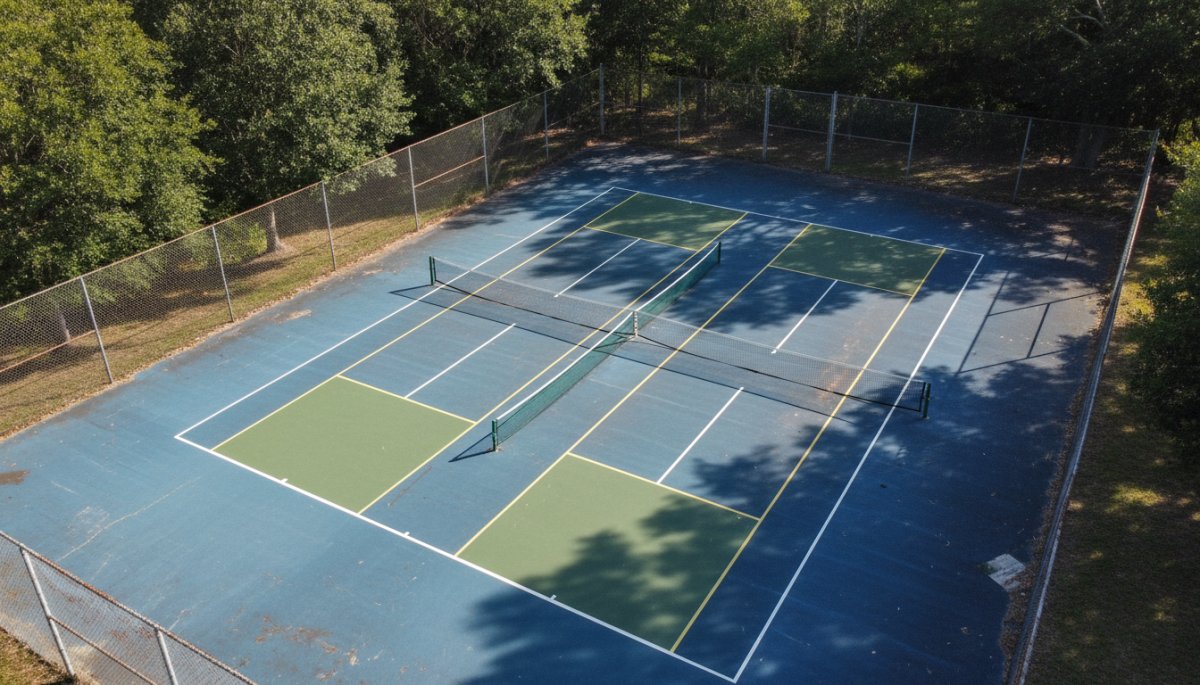
From a single tennis court, you can usually make 4 pickleball courts.
Valued for making efficient use of land, the conversion of tennis courts is progressing in various places. As popularity grows, some areas are seeing a need to coordinate court use with tennis enthusiasts. For the differences from tennis, seethe comparison of pickleball and tennis.
A comparison with padel
Compared with padel, a similar racket sport, the court is larger for padel.
A padel court is 20 m x 10 m, about 2.4 times the area of pickleball (13.4 m x 6.1 m). Being easy to introduce in a small space is one reason pickleball spreads easily to facilities.
Source Pickle-002, "Pickleball court size / dimensions / measurements, net height"Created from
How to draw court lines and set up
There are several methods for drawing lines when building a court, depending on the use.
Short-term, temporary setup
If you're using it temporarily, there are two easy methods.
One is applying protective tape (masking tape) for court lines, and the other is using simple markers you just place at the corners. If you choose an easy-to-peel type of protective tape, you can use it without damaging the gymnasium floor. For a temporary outdoor court, chalk or spray-type temporary marking is convenient too. Since it disappears easily in rain or wind, take measures against slipping and falls.
Full-fledged setup, and examples of dedicated courts in Japan
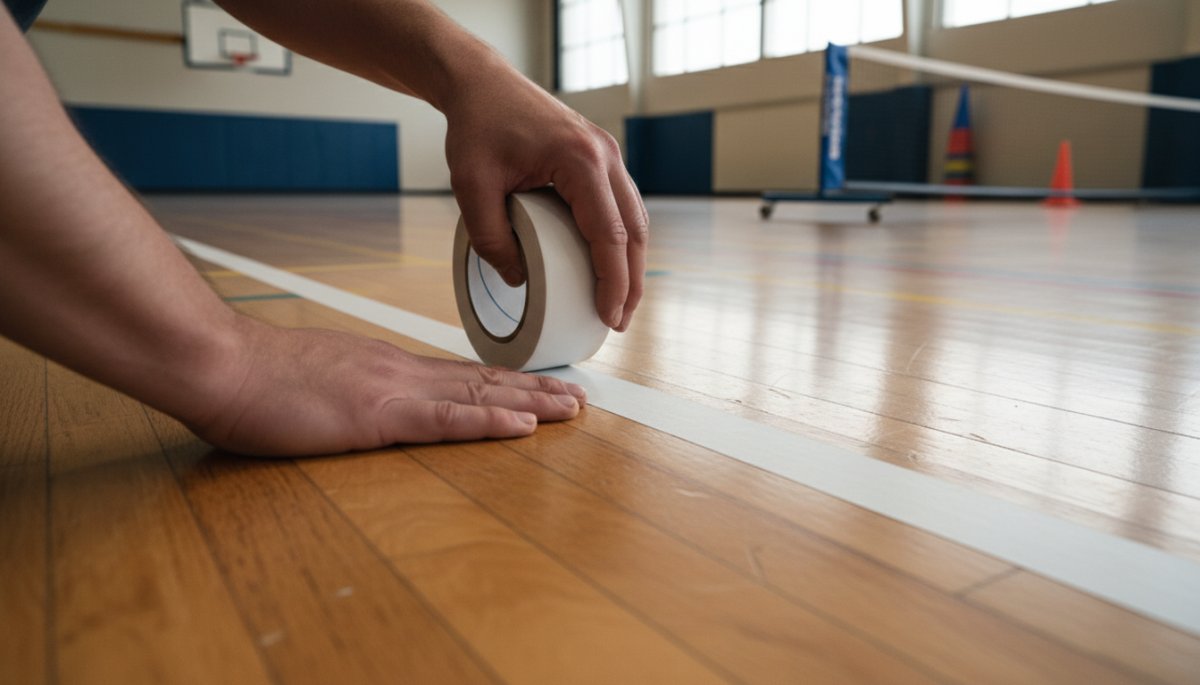
For long-term use, you construct it with outdoor paint or weather-resistant lines.
The development of dedicated courts has begun in Japan too. In 2025, Hokkaido's first Pickleball Japan Federation-sanctioned dedicated court was completed at Rusutsu Resort, using the outdoor-court surface color material "Pickle Color Tex" to create a comfortable playing environment. Also, two dedicated courts were constructed at the Kumamoto Prefecture Football Center (nicknamed COSMOS), where a pickleball trial was held at the facility's 3rd-anniversary event in November 2025.
Source Toa Road Corporation, "Hokkaido's First Pickleball Japan Federation-Sanctioned Dedicated Court Completed"/"Dedicated Pickleball Courts Completed at the Kumamoto Prefecture Football Center"Created from
How to set up the net
For the net, using a dedicated freestanding type is common.
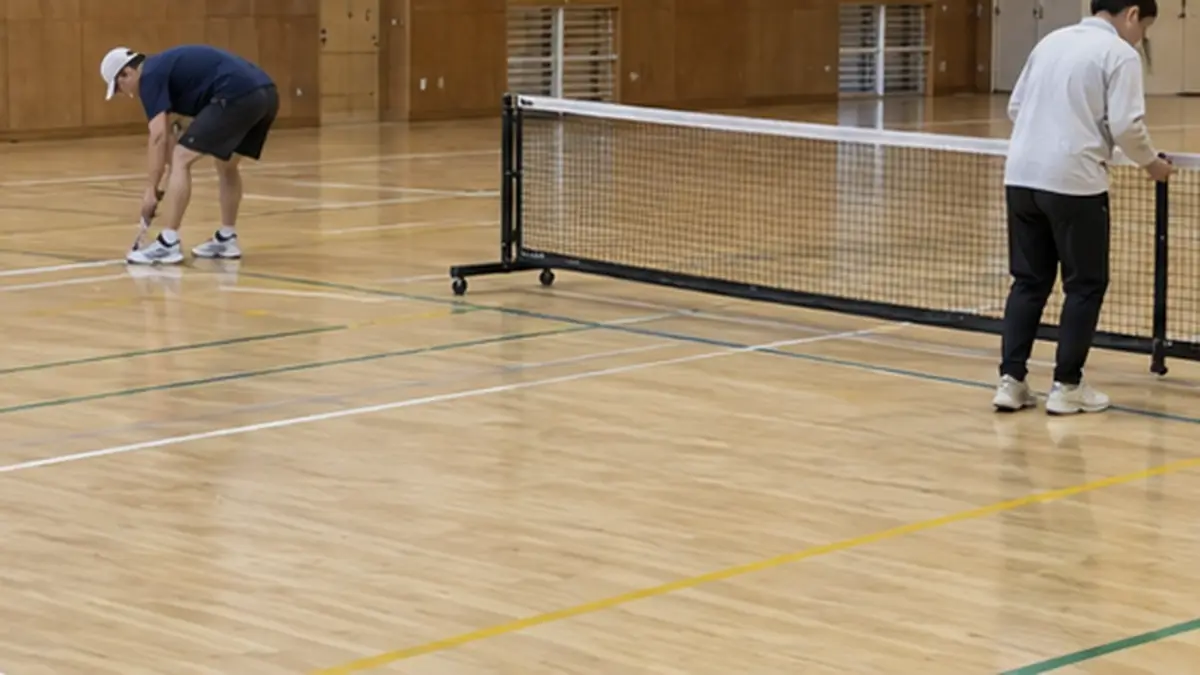
When substituting a badminton court in a gymnasium, there's also a method of standing up badminton posts and setting the net lower. A foldable portable net comes with a carrying bag, making it easy to carry and store, and it's well suited to running a circle that does a lot of mobile setup.
Points to note when playing on an outdoor court
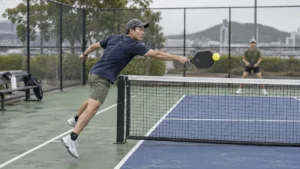
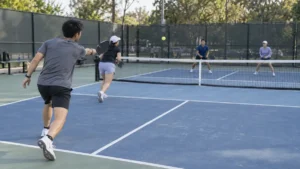
Outdoor play has fun that differs from indoors, but there are also a few points to watch out for.
Surface and shoes
On a hard court, the paddle's surface gets scratched easily, so if you use your own paddle, play knowing that. Using a separate outdoor paddle is one option too.
There are no rules on shoes, but running shoes are weak to lateral movement and increase the risk of sprains. Choosing shoes that can handle lateral movement, such as all-court tennis shoes, is safer.
Consideration for wind and safety
Outdoors, wind affects the ball's trajectory. High lobs and floaty balls drift easily, so being conscious of lower shots keeps things stable.
If there are cracks in the hard court surface, be careful of tripping. With 4–5 m of room from the end line to the fence, you can safely retrieve balls that go astray behind you. Since outdoor events are easily affected by the weather, judge your participation within reasonable limits.
Source MIZUNO, "Pickleball Outdoors"Created from

If you just want to try one court first, the easiest is to add the non-volley zone line with protective tape on a gymnasium's badminton court. Since the outer dimensions are the same as badminton, just drawing the kitchen line (2.13 m from the net) turns it into a pickleball court right away. Just don't forget to check in advance whether floor use is allowed.
FAQ
How large is a pickleball court?
It's 13.4 m long by 6.1 m wide (44 feet x 20 feet), common to both singles and doubles. It's the same size as a badminton doubles court, roughly a quarter of a tennis court. The area is about 81.74 m².
How many centimeters is the net height?
It's 86.3 cm (34 inches) at the center and 91.4 cm (36 inches) on the post side at both ends. Setting the center somewhat lower creates tactics that use net-side dinks and drop shots.
What is the non-volley zone (kitchen)?
It's an area set within the 2.13 m (7 feet) range from the net, and within it, volleying—hitting the ball directly—is prohibited. After the ball has bounced once, you can step in to hit it.
Can I play at home or in a gymnasium too?
You can. A badminton court has the same outer dimensions, so it's easy to repurpose, and you can set it up just by adding the non-volley zone line with protective tape. With about 1 m of margin around the court, you can enjoy it plenty among friends. Check in advance whether floor use is allowed.
Summary: A pickleball court is easy to introduce
A pickleball court is 13.4 m x 6.1 m, the same size as a badminton doubles court.
Because the court takes about a third of the space of a tennis court, the physical load is lighter and players of many ages can enjoy it. The distinctive non-volley zone (the kitchen) that extends 2.13m from the net creates the sport's particular strategy. Ideally you want at least 1.5m of run-off at the sides and about 2.4m behind the baselines, but for a casual game among friends around 1m is enough.
You can make use of existing badminton and tennis courts, and the lines can also be set up short-term with protective tape or simple markers. For full-fledged use, construction using dedicated surface materials is spreading too. From local governments and schools to community circles and company events, pickleball's appeal is that it's easy to introduce in a wide range of settings. First, try starting with a single court.
Related Articles Worth Reading
- What is the non-volley zone? Pickleball rules and points for using it
- What's the difference between pickleball and tennis? Comparing rules, gear, and difficulty
- Pickleball Line Judging | The Criteria for In and Out Explained
- What are the pickleball foul rules that beginners tend to stumble on?
- Pickleball Glossary | 50 Essential Terms Worth Knowing
Related Articles