"Which paddle should I choose?"
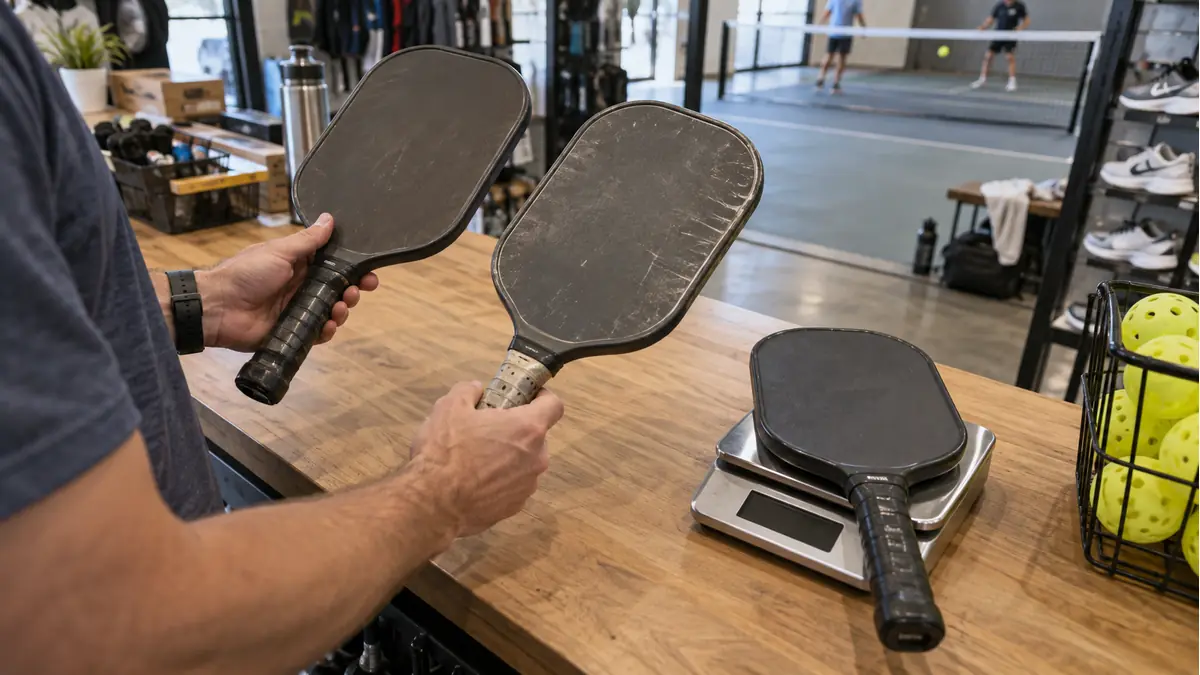
The first thing people who start pickleball agonize over is this weight question. Not the design, not the grip—more people pause at the "weight" than anything else. That's how directly a paddle's weight ties into play.
A difference of just a few dozen grams changes everything—rally fatigue, shot power, and the precision of fine touch. The intuition that "lighter seems easier to move" and "heavier seems to produce power" is broadly correct, but choosing on that alone often leads to regret.
In this article, we compare the pros and cons of lightweight paddles (7.5 oz or less) and heavy paddles (8 oz or more) on the basis of data and real experience, and reach the answer that suits your play style.
In This Article
- The concrete differences between lightweight and heavy paddles
- How weight affects speed, power, and control
- Recommended weight guidelines by your play style
- The weight range beginners should choose first
Paddle weight ranges: first, know the "three categories"
As a premise for choosing weight, pickleball paddles are divided into three weight ranges. Let's grasp this first.
| Weight range | Weight guideline | Features |
|---|---|---|
| Light (lightweight) | 7.5 oz (213 g) or less | Focus on handling and speed |
| Medium | 7.6〜7.9oz(215〜224g) | Balanced type, all-purpose |
| Heavy | 8.0 oz (227 g) or more | Focus on power and stability |
Compared with a Japanese badminton racket (about 85 g), a pickleball paddle is quite heavy. Even so, there's about a 28 g difference between 8 oz and 7 oz, and this gradually affects the fatigue of continuous rallies and the quality of your shots.
Converting "oz (ounces)" to grams?
Overseas-made paddles often use oz notation, so refer to the conversion table below.
| oz notation | Gram conversion |
|---|---|
| 7.0oz | About 198 g |
| 7.5oz | About 213 g |
| 8.0oz | About 227 g |
| 8.5oz | About 241 g |
Where can you check the weight?
Most paddles have it listed in the spec sheet on the maker's official site. However, wrapping grip tape adds about 5 to 15 g. Assume the actual post-purchase weight will be a bit heavier than the spec value.
The pros and cons of lightweight paddles (7.5 oz or less)
"I just want to raise my reaction speed," "I have a lot of fine movement in front of the net"—the lightweight paddle at 7.5 oz or less lands with those play styles.
The strengths of lightweight paddles
A light paddle's biggest weapon isits swing speed and ease of handling.
| Strengths | Concrete effects |
|---|---|
| Handling at the net | Drop shots are sharp, and fine touch is easy to land |
| Strain on the wrist and elbow | Hard to tire even in continuous rallies, with a lower risk of tennis elbow |
| Coping with a fast tempo | Even in rallies that demand reaction, you're less likely to be late on the swing |
In particular, for people who have a lot of exchanges near the kitchen (non-volley zone) in doubles, a lightweight paddle lets you cope without stress.
The weaknesses of lightweight paddles
Honestly, it's also true that there are moments when you feel a "lack of power."
| Weakness | Concrete impact |
|---|---|
| Power shots | Hard to produce hard hits that fly far |
| Being overpowered | When receiving an opponent's hard shot, your arm tends to lose out |
| Stability outdoors | Easily affected by wind, and the course tends to waver |

The pros and cons of heavy paddles (8 oz or more)
"I want to overwhelm my opponent with drives and smashes," "I want to unleash hard hits from the baseline"—if that's your play style, a heavy paddle of 8 oz or more becomes a reliable weapon.
The strengths of heavy paddles
The appeal of heavy paddles isthe power and stability of the shot.
| Strengths | Concrete effects |
|---|---|
| Weight of the shot | Smashes and drives are heavy, and hard for the opponent to return |
| Resistance to face wobble | You can return shots stably even when receiving a strong ball |
| Stability outdoors | The course is less disrupted even in windy environments |
| Sweet spot | It still flies well even if you're a bit off center |
For those with tennis or badminton experience who want to make use of power, a heavy paddle fits easily.
The weaknesses of heavy paddles
Because it's heavy, a trade-off with handling is unavoidable.
| Weakness | Concrete impact |
|---|---|
| Strain on the body | Fatigue in the wrist and elbow accumulates easily |
| Touch shots | Fine control near the net becomes harder |
| Reaction speed | There are cases where you're late on the swing when returning fast balls |
If you have a preexisting condition in your arm or joints, consider a heavy paddle carefully. Raising your injury risk with your gear defeats the purpose.
Light vs. heavy: recommendations by play style
"So, which suits me?"—here's a straight answer.
| Play style | Recommended weight | Reason |
|---|---|---|
| Kitchen-centered doubles | Lightweight (7.5 oz or less) | Quick face handling is needed |
| Hard hits from the baseline | Heavy (8 oz or more) | Power and stability are the weapon |
| Beginners / for resolving lack of exercise | Medium (7.6–7.9 oz) | Hard to tire and easy to get used to |
| People with shoulder or elbow concerns | Lightweight (7.5 oz or less) | Reduces strain on the joints |
| Those with tennis experience | Heavy to medium | You can make use of your sense of power |
| Small-framed, female, or older people | Lightweight to medium | Prioritizes ease of handling |
Three factors to check along with weight
Choosing by weight alone is risky. Check the following factors together too.
- Grip size: too thin and it's hard to swing, too thick and it's hard to apply force
- Paddle face material: carbon types are light and control-oriented, fiberglass types are power-oriented
- Balance point: top-heavy (weight toward the tip) is for power, handle-heavy (weight toward the hand) is control-oriented
For example, an "8 oz top-heavy" paddle feels heavier than the spec suggests. Getting in the habit of looking at weight and balance point as a set reduces choosing mistakes.
Three ways to actually try it
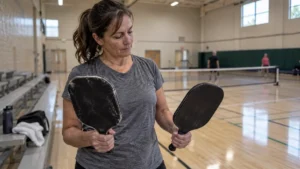
Seeing is believing. If you can, actually holding and swinging one is best.
Method 1: Test-hit at a sporting goods store
Lately, more shops have a dedicated pickleball corner. Just gripping and shadow-swinging gives you a pretty good sense of the weight.
Method 2: Borrow a friend's paddle on the court
The easiest way to get a real feel is to call out to friends who play on the same court, borrow a few, and hit-compare. When you use them in actual rallies, the difference in weight becomes clearly noticeable.
Method 3: Actively make use of rental paddles
Trial events and gym rental paddles often have a variety of weights available. Deliberately trying "a light paddle today," "a heavy paddle next" reveals your own preferences.
If a beginner is choosing first, go with "medium weight"
Frankly, if you've just started pickleball,choosing the 7.6–7.9 oz medium range won't steer you wrong。
There are three reasons.
- Hard to tire — At first your form isn't stable and you use extra force. A weight that's neither too light nor too heavy curbs that extra fatigue
- You can decide after improving — After a few months of play, the sense of "I want to control more" or "I want to hit farther" emerges. Moving to lightweight or heavy at that point makes sense
- It's all-purpose, so you're less likely to regret it — Because medium can handle any play style, you're less likely to feel "I made a mistake buying it"
Summary
Choosing a paddle's weight is neither "lighter is the right answer" nor "heavier is stronger." Choosing to match your play style and physical condition is the shortcut to improvement.
| Criterion | Lightweight (up to 7.5 oz) | Heavy (8 oz and up) |
|---|---|---|
| Strong shots | Drop / touch types | Smash / drive types |
| Fatigue | Hard to tire | Tires easily over long periods |
| Power | Somewhat weak | Strong |
| Control | High | Somewhat difficult |
| Recommended players | Beginners, women, seniors | Intermediate and above, tennis-experienced |
If you're unsure, first try from medium, and once you get used to play, adjust the weight to match your own feel. That's the smart way to choose.
Pickleball is a sport that "changes with your gear." By all means, find the paddle that suits you and enjoy every single shot on the court.
FAQ
Q1: Light or heavy paddle—which should beginners choose?
A1: For beginners, medium (7.6–7.9 oz) is the most recommended. It's hard to tire and strikes a balance between control and power, so you can pin down your preferences while improving. Extremely light or heavy paddles are less likely to cause regret if you choose them after getting used to play.
Q2: Are heavy paddles better suited to those with tennis experience?
A2: Since they're lighter than a tennis racket, at first you can often handle even a heavy paddle without much awkwardness. However, pickleball's form differs from tennis, so we recommend first getting a feel with medium and then adjusting to your preference.
Q3: If my elbow or wrist is weak, what weight is ideal?
A3: If you have joint concerns, choosing a lightweight paddle of 7.5 oz or less can reduce the strain. Also, not making the grip too thick and reviewing your swing form are equally important. If pain persists, rest from play and consult a specialist.
Q4: Will switching to a heavy paddle always strengthen my smash?
A4: The added weight does increase the force transmitted to the ball, but it's meaningless if your swing speed drops. Switching to a heavy paddle before your form is set can result in shots that don't fly as far as you'd expect. Honing your basic form comes first.
Q5: How much does wrapping grip tape change the weight?
A5: One typical sheet of grip tape adds about 5 to 15 g. Wrapping tape on an originally 7.8 oz medium paddle can make it feel closer to heavy. When buying, it's good to keep the grip-tape-included weight in mind.
Q6: Should I change the paddle's weight for outdoor and indoor play?
A6: Outdoors, you're easily affected by wind, so a somewhat heavier paddle makes it easier to hit stable shots. If it's indoor-only, a lightweight paddle is fine. If you play both, the medium range is easy to use across the board.
Related Articles Worth Reading
- The Complete Guide to Pickleball Skill Ratings (2.0–5.0) | Know Your Level
- Are There Pickleball Tournaments Beginners Can Enter? How to Join and the Right Mindset
- Pickleball and Mental Health | Why It Works for Stress Relief and Preventing Depression
- A Stretching Routine Before and After Pickleball | Care to Enjoy It Injury-Free for Years
- Elbow Injuries Common in Pickleball | Preventing Tennis Elbow and Self-Care Methods
Reference Links
Related Articles