世界標準のレーティングDUPRと、ニューデリー発のラケットスポーツ基盤Courtlyが2026年8月20日に提携した。狙いは、Courtlyのアプリで記録した試合を自動でDUPRへ送り、大会でもカジュアルな打ち合いでも同じ数値に積み上げる仕組みをインド全土に敷くことだ。日本ではレートを取れる場が大会や一部の体験会に限られており、「普段の1試合をどう数値に変えるか」という同じ課題を先に解こうとしている点で、日本のプレーヤーにも読みどころがある。

Matches played on Courtly land in DUPR with no manual entry
What changes is the route a score takes to reach a player's rating. Results confirmed in Courtly's Tournament Management System no longer need organizers to re-enter them into DUPR; they feed the official rating directly. Casual matches logged with friends in Courtly's community app join the same DUPR stream. A tournament match and a knockabout on the court end up in one number instead of two separate ledgers.
DUPR moves on score margins as well as wins and losses, so the more matches a player logs, the closer the number tracks real ability. That also means the more matches that go unrecorded, the coarser the rating gets. Funneling tournament scores and app matches into the same intake, as Courtly does, increases the sample and sharpens the resolution. This partnership is designed to gather that sample wholesale on Indian courts.
DUPR CEO Tito Machado said the partnership makes it easier for players to track their progress, compete and connect with the wider community across Asia. Courtly founder and director Tanishq Mahendru framed it as putting a globally trusted rating directly into the hands of every Courtly player. Less work for organizers, more places to record. It is not flashy, but it is the kind of move that makes a rating a foundation for growth.
30 tournament formats plus DUPR to pair players of similar level
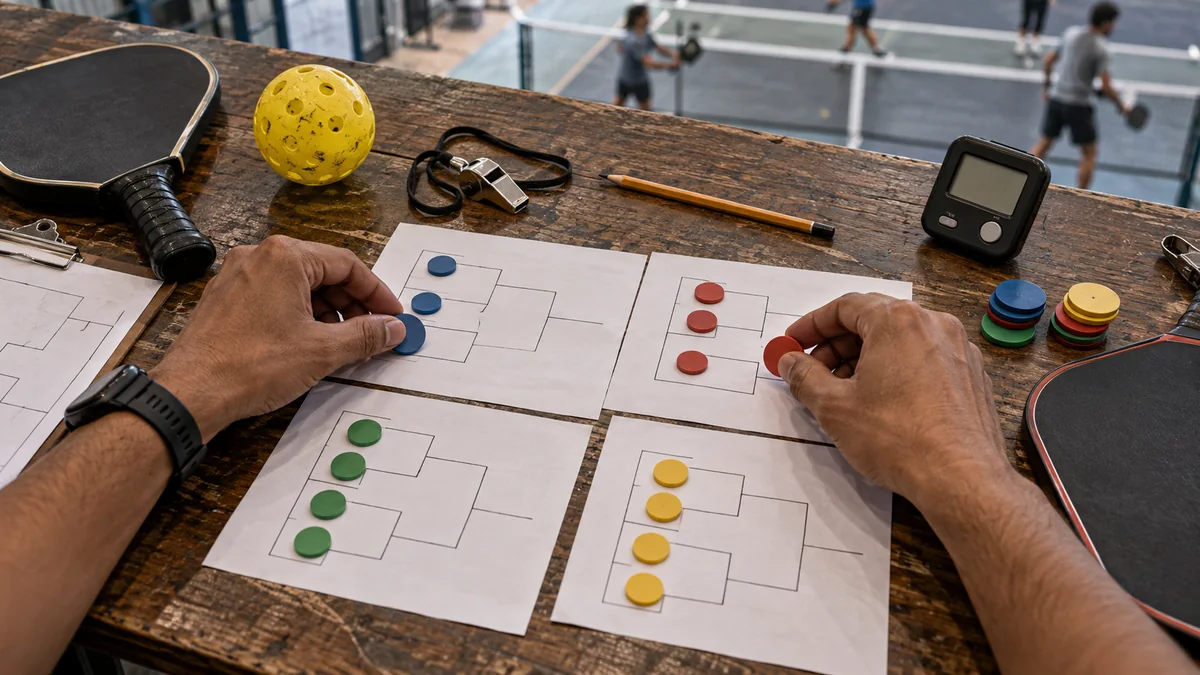
Courtly gives organizers 30 competition formats. Round robin, double elimination, league play and others can be picked to suit whoever shows up. Layer DUPR ratings on top and organizers can carve draws by the numbers. Splitting a beginner bracket around 3.0 from a 4.5-level upper bracket becomes a decision made on a shared metric rather than by feel.
That combination of format flexibility and rating-based sorting maps onto a familiar headache at Japanese grassroots events. In a block with a wide skill gap, beginners disappear early and stronger players grind through dead rubbers. If ratings line up at entry, matches are competitive from the first round. Courtly's design, with the management system and the rating on one screen, builds participant satisfaction at the pairing stage.
Courtly runs tournaments, an app and its own leagues under one roof
Courtly is based in New Delhi and runs a tournament management system, a community app for players and its own competition series as a single operation. Its in-house events include the Amateur Pickleball Tour, Minor League Pickleball India and the Corporate Pickleball League. From an amateur entry point to company-versus-company play, owning several settings where ratings move is its strength.
Over the past year or two, India has stood out for the speed of its organized competition, with the recognized federation IPA pursuinga growth plan that builds 150 tournaments from schools and courts. Drop a globally shared yardstick like DUPR into that, and a match inside India can be weighed the same as a match abroad. In Vietnam too,standardization that makes a win in Hanoi worth the same as a win in LAis advancing, and one major Asian country after another is choosing DUPR as the common language.
Japan is running the same everyday-to-number shift separately, through UTR and PIQLZ
Efforts to turn an everyday match into a number are under way in Japan as well. In Yokohama,a UTR tour that converts a single amateur match into a world-standard ratinghas begun, and five minutes against a wall now produces a provisional DUPR throughan entry point for beginners like the PIQLZ partnershipas well. In Japan, though, the setups that let a player earn a rating are scattered venue by venue and event by event, and plenty of players see their number move only on the days they enter a tournament.
What Courtly's structure shows is vertical integration: tournament operations, a community app and in-house leagues bundled inside one company, with every match played there sent to the rating. India is ahead of Japan on commercializing players too, and a base that spins tournaments, app and rating together is the engine behind it. In Japan, tournament operators, recording apps and rating providers still largely move separately, leaving players to decide for themselves where their numbers accumulate.
So what Japanese players can do now is choose DUPR-compatible tournaments and recording apps and leave a number behind after every match. Pick places where the rating stacks up across venues, and the accuracy of your next partner or bracket improves. Even practice matches among friends show how your game is changing if they are logged. India's partnership looks like news from a distant country, but it puts the same question to players here: where do you play so that the record sticks?