"Pickleball Glossary: 50 Essential Terms Explained"
「dink"Banger? What's that?"
When you first started pickleball, did you ever end up thinking "???" every time words like this flew around?
You're standing on the court but can't follow the conversation. You want to ask, but you don't even know what to ask—everyone hits that wall at least once.
This article rounds up and explains 50 pickleball terms you'll often hear in matches and practice. By the time you finish reading, conversations on the court should be a lot more fun.
In This Article
- Shot and technique terms you'll often hear during a match (15 picks)
- Essential words for the court and the rules (20 picks)
- Tactics and position terms intermediate players use (10 picks)
- Culture terms that help you fit into the community (5 picks)
Why do you need to learn pickleball terms?
Honestly, you can sort of play without knowing the terms. But it's a shame if your coach tells you to "be patient with the dink" and it doesn't click, or an opponent compliments you—The third shot"You've really got that drop down"—and you just draw a blank, isn't it?
Pickleball has a very strong community-sport side to it. The number of players is growing rapidly worldwide, and it's spreading in Japan too. Just knowing the terms makes conversations with fellow players flow and speeds up your improvement.
Three things you gain by learning the terms
| Pros | Concrete situations |
|---|---|
| You understand what advice means | You can grasp instructions from coaches and advanced players on the spot |
| Match-video commentary starts making sense | You can enjoy commentary on YouTube and overseas videos |
| You fit into the community | Communication with your doubles partner gets smoother |
[Basic shots] 15 terms to learn first
The terms you'll hear most during a match are shot terms. Nail these down and conversations on the court get much clearer.
| Term | Reading | Meaning |
|---|---|---|
| dink | Dink | A soft shot dropped just over the net. The essence of pickleball |
| Banger | Banger | The name for a play style—or a player—that relies heavily on hard hitting |
| Drive | Drive | A groundstroke hit flat and powerfully |
| Drop | Drop | A soft shot that arcs and falls just over the net |
| Lob | Lob | A high, looping ball sent over your opponent's head to the back |
| Smash | Smash | An overhead shot that puts away a high ball |
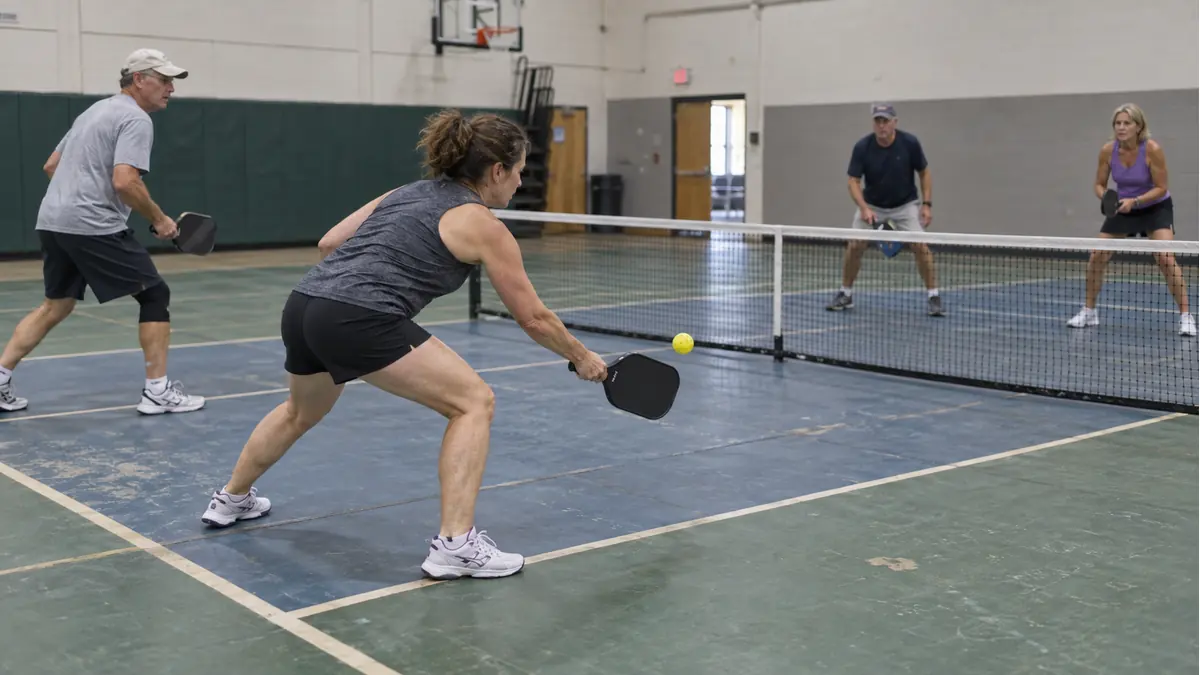
| Volley | Volley | A shot returned without letting the ball bounce |
| Erne | Erne | An advanced volley hit while flying in from outside the net |
| Reset | Reset | The skill of turning an attacked situation back into a calm dink |
| Flick | Flick | A quick, wrist-driven shot that changes the angle |
| Spin | Spin | The skill of putting spin on the ball (topspin, slice, and so on) |
| ATP | Around The Post | A spectacular shot hit around the net post |
| Shake & Bake | Shake and Bake | A partner-coordination move: one player hits hard, the other finishes with a volley |
| First volley | First Volley | The first volley hit after the serve |
| Attack | Attack | A hard shot aimed at your opponent's feet |
Dink or banger—which is stronger?
It's a common question, but it's not about "which is stronger"—it's a difference in style. That said, many top players build their game around the dink. Wearing your opponent down while reducing errors ends up raising your win rate. A banger style works at first, but as you improve you'll come to feel the importance of the dink. The moment you graduate from "just hit it hard" is the turning point to the next stage.
[Rules & court] 20 terms you'll struggle without
Get a handle on court and scoring terms and the rules fall neatly into place. Check at least these before you play in a match.
| Term | Meaning |
|---|---|
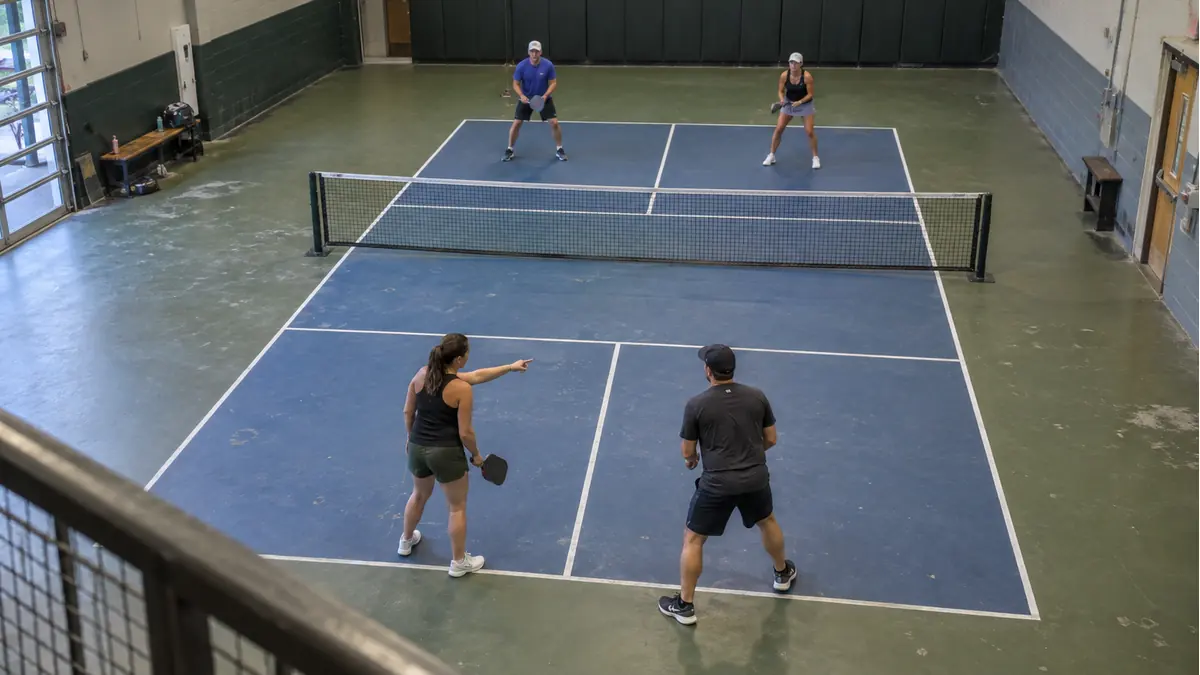
| Kitchen | The common name for the Non-Volley Zone (NVZ). The area on either side of the net,2.13mthe area |
| NVZ | Short for Non-Volley Zone. The official name for the kitchen |
| Kitchen fault | The fault of volleying inside the NVZ |
| Side out | When the right to serve passes to the other team |
| Fault | The general term for an act that loses a point through a rule violation |
| Let | A serve that touches the net and lands in the service area. Under current official rules it's in play and is not replayed |
| Ace | A point where the serve is so good the opponent doesn't touch it at all |
| Double bounce | The rule that the serve and the return must each bounce once (applies to both sides) |
| Score call | Calling out the score as three numbers before serving |
| Carry | The fault of dragging the ball along the paddle |
| Centerline | The line that divides the court lengthwise in two |
| Baseline | The line at the end of the court |
| No man's land | The nickname for the "easy-to-get-caught-in area" between the NVZ and the baseline |
| Out | When the ball goes outside the court |
| Foot fault | The fault of your foot touching the designated line during the serve |
| Post | The pole that supports the net. Important for the ATP shot |
| Hard ball | The hard plastic ball used outdoors. Its many small holes make it resistant to wind |
| Soft ball | The softer ball used indoors. Its larger holes make it bounce more easily |
| Change of ends | Switching courts between games |
| Game point | The point that decides that game |
The "three numbers" of the score call—surprisingly, a lot of people don't know them
In pickleball doubles, you announce three numbers before serving, like "4-3-2." In order, they're your team's score, the opponent's score, and the server number (1 or 2). It's confusing the first time you hear it, butafter just three games it comes naturally. If anything, once you've got it down, you start finding it hard to ignore players who skip the call (laugh).
[Tactics & positions] 10 terms for intermediate players
Learn the language of strategy and the depth of pickleball suddenly comes into view. No need to rush to memorize it, but knowing it makes it far easier to follow what advanced players are talking about.
| Term | Meaning |
|---|---|
| the third shot drop, | The standard tactic of hitting a drop shot on the third ball after the serve and moving up to the NVZ line |
| Stack | A formation where partners line up on the same side during the serve |
| Poach | An aggressive play where you cut in on a ball on your partner's side to hit it |
| Transition | The movement phase of advancing from the baseline up to the NVZ line |
| Bunji | The state of dinking while still moving forward and back after advancing to the NVZ line |
| Down the line | A straight shot hit along the sideline |
| Cross-court | A shot hit diagonally |
| Middle | An aggressive shot aimed between your partners (opponents) |
| Replay drive | A counter shot you deliberately drive instead of resetting |
| Early position | The move of getting up to the NVZ line early, before your opponent's shot |
Why is the third-shot drop talked about so much?
It's one of the most-discussed tactics in pickleball. Since the serving side starts from a more disadvantaged position than the receiving side, they hit a drop shot on the third ball to buy time to move up. Whether you can do this greatly changes who takes control of the match. It's easy to overlook, but players with a higher third-shot-drop success rate tend to have a higher win rate too. If you want to graduate from "just hitting it hard," start here.
[Community & culture] 5 terms that instantly help you fit in
Beyond sport terms, pickleball has words unique to its community. Just knowing them greatly closes the distance with advanced players you're meeting for the first time.
| Term | Meaning |
|---|---|
| Pickleballer | The general term for someone who plays pickleball |
| Open play | A casual practice session anyone can join |
| Round Robin | A round-robin-format play session. Easy for beginners to join |
| Bandage | The nickname for a deuce (when the score reaches 11-11) |
| Pickled drunk | The state of being "completely hooked on pickleball" (a playful expression) |
The pickleball community really has a warm atmosphere. The energy everyone has for this sport is so strong that a word like "pickled drunk" was even coined. Just making advanced players think "this person knows the terms" on the court gets them actively striking up conversations with you.
Summary: Knowing the terms makes pickleball even more fun
To pull everything together:
| Category | Priority | Point |
|---|---|---|
| Basic shot terms (dink, banger, etc.) | ★★★ | Learn these first |
| Rule and court terms (kitchen, NVZ, etc.) | ★★★ | Directly tied to understanding the game |
| Tactics terms (third-shot drop, etc.) | ★★☆ | Dig into these once you reach intermediate level |
| Community terms | ★☆☆ | Knowing them keeps conversations with fellow players lively |
Learning the terms isn't the goal—it's the start. Use them for real on the court and let them sink in little by little. When you run into a word you don't know, actively asking an advanced player is the fastest route—pickleballers are the kind of people who are happy to field those questions.
FAQ
Q1: Are pickleball terms mostly in English?
Yes. Since the sport originated in the US, most terms come from English. That said, in the Japanese community they're often used in katakana, like "dink" and "kitchen," and they're all easy to remember. It's no problem even if you're not good at English.
Q2: What's the difference between a dink and a drop?
A dink refers to the "situation" of a soft exchange in front of the NVZ, while a drop refers to a specific "skill" of dropping the ball from the baseline near the NVZ. Remembering "dink is a situation, drop is a skill" makes it easy to keep them straight.
Q3: Am I not allowed in the kitchen (NVZ)?
Entering the kitchen itself is no problem. However, volleying (hitting without a bounce) inside the kitchen is a fault. Hitting a ball that has bounced from inside the kitchen is legal, so be careful not to mix the two up.
Q4: What do the "three numbers" of the score call mean?
In order, they're the serving side's score, the receiving side's score, and the server number (1 or 2). For example, "5-3-2" means "my team has 5 points, the opponent has 3, and I'm the number 2 server." It takes a little time to get used to, but you'll pick it up naturally within a few games.
Q5: Is the banger style bad for improvement?
Not necessarily, but relying too much on hard hitting often means hitting a wall from the intermediate level onward. Bringing dinks and drops into your practice early tends to raise your overall ability. Aiming to be a "dinker who can also beat bangers" is the royal road to improvement.
Q6: Any tips for memorizing the terms efficiently?
The fastest route is to narrate in your head during actual play. Playing while consciously thinking "that was a dink" or "this is a third-shot drop" makes them stick naturally. Checking the terms while watching match videos is effective too.
Related Articles Worth Reading
- The Complete Guide to Pickleball Skill Ratings (2.0–5.0) | Know Your Level
- Are There Pickleball Tournaments Beginners Can Enter? How to Join and the Right Mindset
- Pickleball and Mental Health | Why It Works for Stress Relief and Preventing Depression
- A Stretching Routine Before and After Pickleball | Care to Enjoy It Injury-Free for Years
- Elbow Injuries Common in Pickleball | Preventing Tennis Elbow and Self-Care Methods
Reference Links
Related Articles