The pickleball paddle has become, without question, a tool in a carbon race. Fiberglass faces, once the mainstream, have given way to carbon fiber in the upper models, and the stronger the player, the stronger the tendency to move up to an expensive carbon model. Fiberglass is still in active use in the entry and mid price bands, though, so the material has not been replaced across the board. Into that comes an unusual move out of Japan: making paddles from carbon fiber recycled out of offcuts from aircraft manufacturing. Mirai Kasei of the Mitani Sangyo group is behinda next-generation paddle developed with Bs Co., Ltd., which runs the Higashi-Osaka brand TOCO. A prototype sample gets its first public showing at SPORTEC2026 on July 8-10, 2026, where visitors can hit with it. Why does a chemicals group that is not an equipment maker step into the tools of the sport? Three angles are worth digging into: materials, sustainability and domestic production.
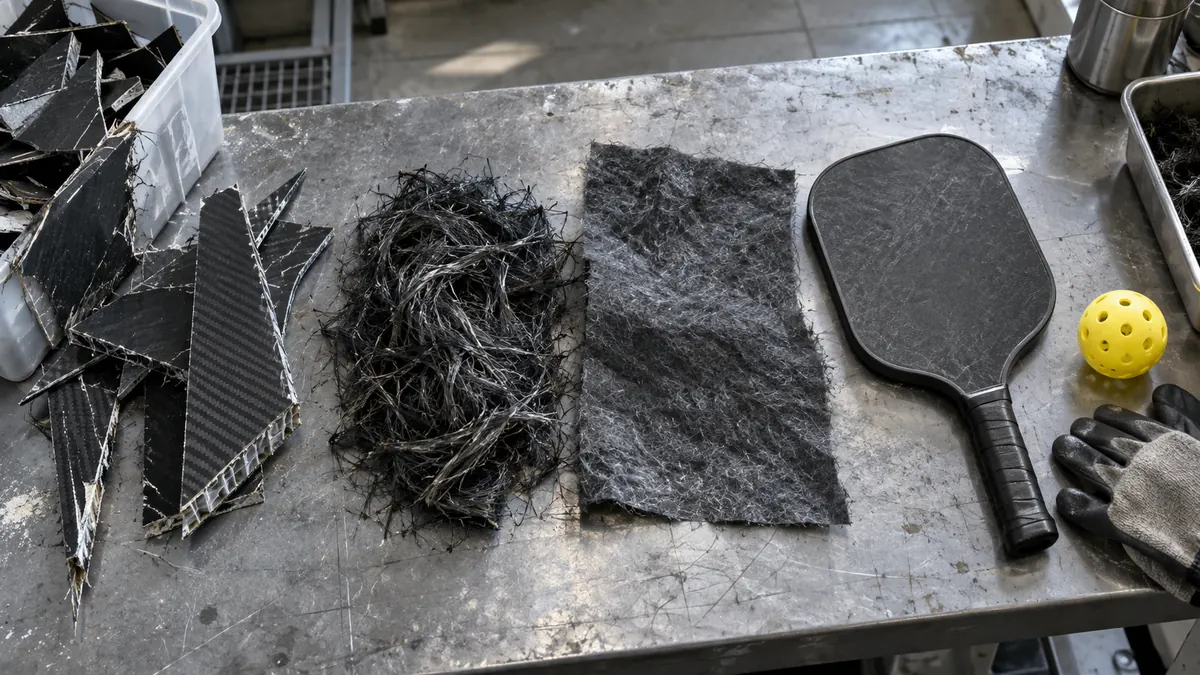
Aircraft carbon fiber reborn as a paddle face
The heart of this paddle is the face material. The raw material is offcuts generated during the manufacture of aircraft-grade CFRP (carbon fiber reinforced plastic) containing Toray's high-strength T800 carbon fiber. Mirai Kasei recovers and recycles the carbon fiber from those offcuts, processes it into a nonwoven fabric and forms the face from it. Using aircraft-grade fiber is meant to combine light weight with high strength and to give a feel that catches the ball for an instant before sending it back.
The division of roles is clear as well. Mirai Kasei (Chikuma, Nagano), whose parent is Mitani Sangyo of Kanazawa, Ishikawa, handles recycling and molding, while Bs (TOCO) takes product design and brand strategy. Toray, the source of the material, supports with expertise in recycling T800 plus design and evaluation, and Teijin joined for resin selection and impregnation to secure durability. Having both of the country's major carbon fiber makers standing behind a single paddle is rare in Japan.
The long-running problem of carbon fiber that gets thrown away
This prototype is not an environmental PR stunt. CFRP is light and strong, but the resin and fiber are bonded so tightly that recycling is difficult, and the more aircraft and cars adopt it, the heavier the burden of handling scrap and offcuts becomes. Research into recycling it is still thin both in Japan and abroad.
At its research base in Misawa, Mirai Kasei has refined a solvent process that dissolves the resin with chemicals, regenerating the fiber while preserving its length and properties as far as possible. In fiscal 2023 the work was selected for a NEDO program in this field. The Mitani Sangyo group has set out to build a supply chain linking offcut collection, recycling and a molded-product business, and the paddle makes an ideal showcase for putting those recycled carbon fiber moldings (rCFRP) in front of consumers.
Where domestic paddles stand: the TOCO lineup and where this prototype fits
組んだ相手のビーズは1997年設立の東大阪の企業で、2025年11月にピックルボール専用ブランドTOCOのパドル3機種を発売して市場に参入した。既存モデルと今回の試作を並べると、「国産カーボンパドル」の到達点が見えてくる。
| Model | Face material | Reference price | Position |
|---|---|---|---|
| EMBER(TPR-101) | Fiberglass | 7,800 yen | Entry Model |
| EVOL(TPR-501) | Toray T700 RAW carbon | 24,800 yen | Control-oriented, 16mm thick |
| FORZA | T700 Carbon | — | Power and attack oriented |
| Prototype paddle (SPORTEC2026) | Recycled T800 carbon fiber nonwoven | Undecided | Sustainability proof of concept, first public showing |
Where the production models use virgin T700 carbon, this prototype puts recycled aircraft-derived T800, fiber that would otherwise be thrown away, on the face. Putting what is normally a higher grade of fiber on the face in recycled form turns the usual order on its head, and it tests whether a domestic maker can carve out its own identity through materials. Whether recycled T800 in nonwoven form can deliver the same playing performance as virgin T700 carbon is a separate question, and that has to wait for a production version and on-court testing. Where domestic makers stand on equipment is easier to place next toMizuno's full-scale entry with five paddle models, which makes the overall trend easier to follow.
The stage: what SPORTEC2026 means as a venue
SPORTEC2026, chosen for the first showing, is one of Japan's largest sports and health industry trade shows, held at Tokyo Big Sight East Halls. Getting the value across through the feel of a hit rather than a materials pitch, by way of test hits, shows how serious this effort is.
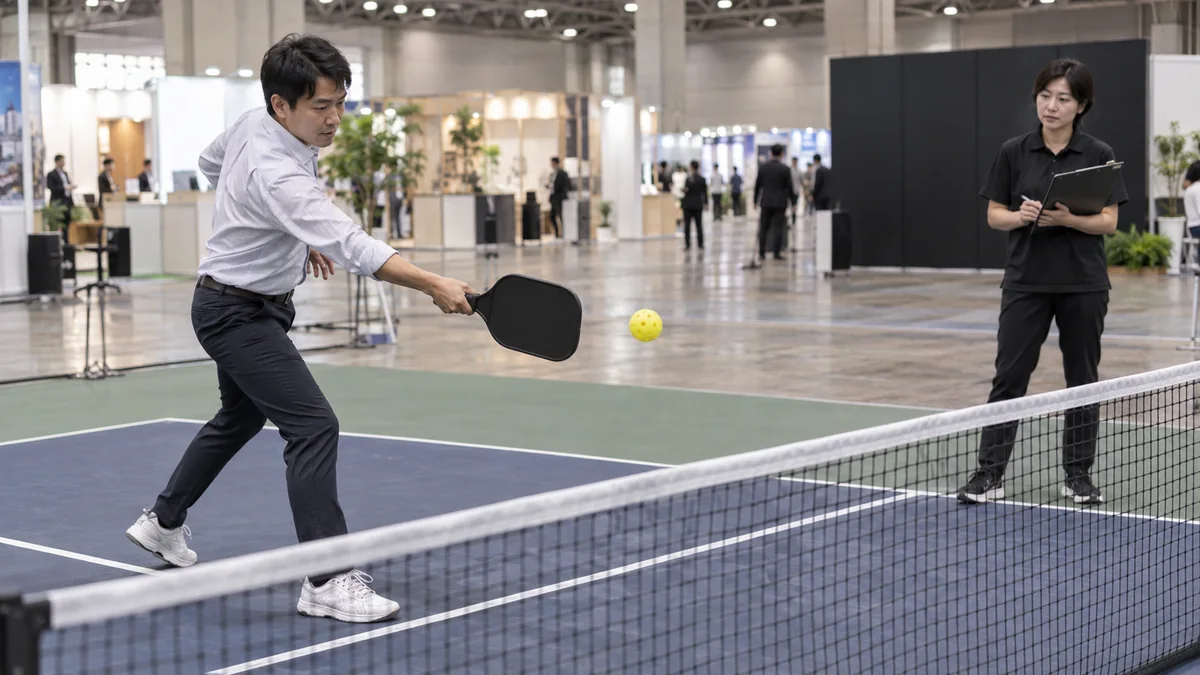
- 会期・会場——2026年7月8日(水)〜10日(金)、東京ビッグサイト東展示棟。
- Exhibits: Mirai Kasei will show its recycled carbon fiber technology and the prototype paddle, with test hits offered to visitors.
Putting it to the test at a B2B event where industry buyers and local governments gather, rather than a consumer retail event, matters. The response to the test hits becomes first-hand data on whether rCFRP can be extended into sporting goods.
What players and operators in Japan should take from this
This prototype raises three points for people involved in the sport in Japan.
First,Environmental impact as a new axis for choosing a paddle. Carbon paddles perform well, but neither making the fiber nor disposing of the paddle is light on the environment. In a sport with a fast replacement cycle, once a paddle made from recycled material becomes a realistic option, where the material came from joins the criteria for choosing equipment. In an era when facilities and schools keep large numbers of paddles for lessons, it becomes a theme that operators replacing them in bulk cannot ignore either.
Second,Manufacturing that starts from the material maker as a winning route. While leading overseas brands compete on face resins and core molding, Japan has Toray and Teijin, the originators of carbon fiber. Recycling their offcuts into a distinctive nonwoven and letting a dedicated brand turn it into a tool is a division of labor no equipment maker could draw up alone. It matters that domestic players have shown room to compete on the story of the material, not only on price and quality.
Third,The link to Asian brands taking on the world. Already under way aremoves by Asian brands to win official US approval for their paddles. If a Japanese recycled carbon paddle clears competition-level performance and the approvals required in each country, it could become an export product on an angle Western brands have left thin, combining environmental consideration with high performance. The key is whether it can get past test hits at home to approval and volume production.
Key facts
| Item | Details |
|---|---|
| Development structure | Mirai Kasei (recycling and molding) / Bs, TOCO (design and brand) / Toray and Teijin (technical support) |
| Parent company | Mitani Sangyo (Kanazawa, Ishikawa) |
| Face material | Recycled carbon fiber nonwoven from aircraft CFRP offcuts containing Toray T800 |
| Public showing | SPORTEC2026 (July 8-10, 2026, Tokyo Big Sight East Halls) |
| What is offered | First showing of the prototype sample plus test hits for visitors |
| Production and price | Not announced at this point |
Summary — will recycled carbon become part of the sport's vocabulary
捨てられるはずだった航空機の炭素繊維が、コートで球を弾く道具に変わる。まだ試作の段階で、性能も価格も製品化時期も明かされていない以上、過度な期待は禁物だ。それでも、素材の本家と専用ブランドが組んで「再生カーボンのパドル」を業界の場で試打にかけた事実は、国産用具の議論を一段先へ進める。読者が次に確かめるべきは三点。SPORTEC2026での試打の評判、市販化の有無と価格帯、そして各国の競技用パドル認定を取りにいくのかどうかだ。
Sources
- Mirai Kasei of the Mitani Sangyo group develops a next-generation pickleball paddle using recycled carbon fiber nonwoven jointly with Bs Co., Ltd. (TOCO) (Sports Mania)
- Next-generation paddle to be developed from recycled carbon fiber, light and strong (MONOist / Yahoo! News)
- Mirai Kasei of the Mitani Sangyo group accelerates its recycled carbon fiber molding business through collection and recycling of CFRP offcuts (Mitani Sangyo / PR TIMES)
- TOCO, a pickleball brand born in Higashi-Osaka, launches (Bs Co., Ltd. / PR TIMES)
- SPORTEC | Japan's largest international sports and health industry trade show (official site)