ピックルボールのコーディネーター資格講習会が7月25日、岡山県津山市の美作大学アリーナで開かれた。定員36名は募集期間中に埋まり、日本連盟サイトの講習会一覧には「募集定員に達しました」の表示が残っている。中身は講義1時間と実技3時間、受講料は11,000円。この1日講習の満席は、日本のピックルボールがいま何に詰まっているかを示す指標になる。足りないのはコートではなく、コートの上で説明できる人のほうだ。
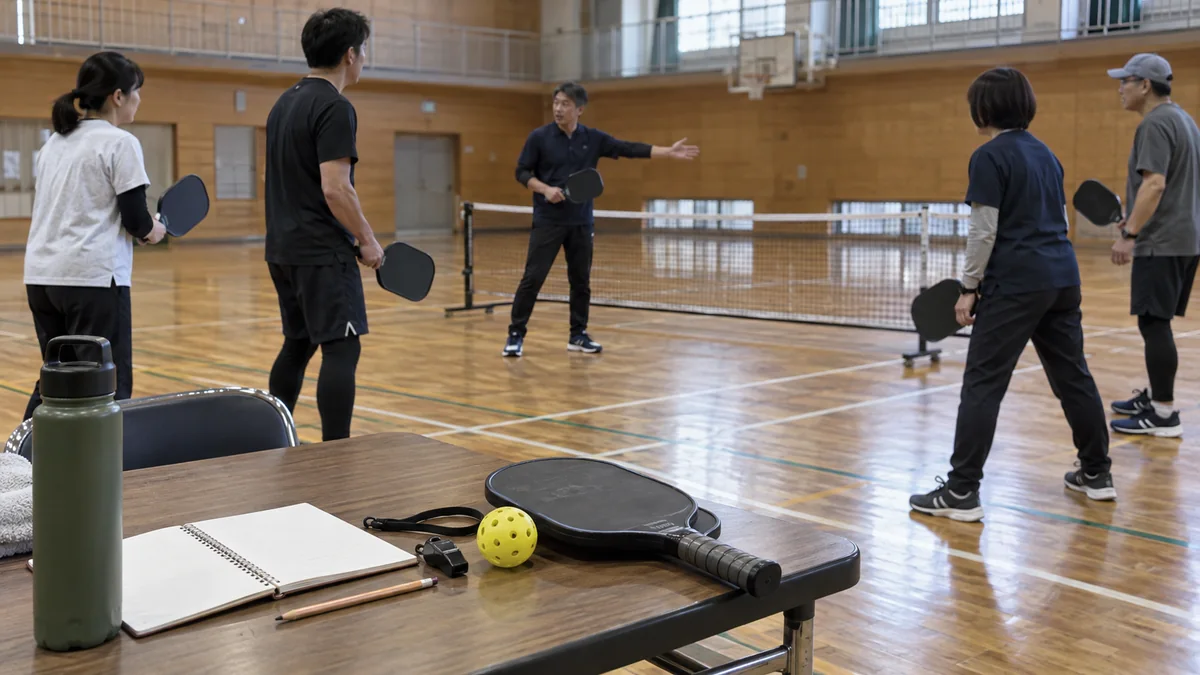
What the one-day programme at Mimasaka University Arena covered
According to the programme, check-in was at 10:30, the lecture ran from 10:45 to 11:45 and the on-court session from 12:30 to 15:30. The venue was Mimasaka University Arena at 50 Kitazono-cho, Tsuyama, Okayama, and the instructor is listed as a Japan Pickleball Association certified instructor. Participants were told to bring a paddle, indoor court shoes, a towel, a drink and something to write with. Eligibility was limited toplayers with playing experience, with complete beginners routed in through the lower Diffuser grade.
The cap is 36, but the programme also states a minimum of 12 for the course to run at all. Needing 12 people to make a one-day course viable captures how hard these are to hold outside the big cities. Tsuyama had the opposite problem: it filled before the July 11 application deadline.
Why it mattered that the venue was a university
That the arena belonged to Mimasaka University was no accident. The university has a pickleball club, and in March 2026 it took first through third in women’s doubles at the KANDAI OPEN hosted by Kansai University. In March 2025 it produced both the champion and the runner-up at JPA TOP TOUR 2025 T3 TSUYAMA. Further back, on July 13 and 14, 2019, the Japan Pickleball Championships drew about 80 players from around the country to Tsuyama Gymnasium, where students from the university won the mixed doubles and the women’s doubles.
Tsuyama already has experienced players, a gymnasium and a memory of running tournaments. That an instructor course came next reads as a signal that the local problem has shifted from gathering people who play to adding people who teach. The jam sits in a different place from regions where the conversation still starts with building courts.
The certification ladder does not yet reach the top
Lay out the certification system the federation publishes and the state of the coaching pipeline becomes plain.
| Category | Certification | Eligibility | Course hours | Fee (incl. tax) |
|---|---|---|---|---|
| Courses | Diffuser | None | 2 hours | 3,300 yen / 3,850 yen general |
| Courses | Coordinator | players with playing experience | 4 hours | 9,900 yen / 11,000 yen general |
| Coaching certifications | Start Coach | One year after earning Coordinator | 1 hour written, 4 hours practical | 22,000 yen |
| Coaching certifications | Coach | One year after earning Start Coach | Under consideration | Under consideration |
| Coaching certifications | Master Trainer | Not listed | Not listed | Not listed |
| Officiating | Referee Level 1 | players with playing experience | 4 hours | 6,600 yen / 7,700 yen general |
| Officiating | Referee Level 2 | One year after earning Level 1 | 4 hours | 9,900 yen |
| Officiating | Referee Level 3 | One year after earning Level 2 | Under consideration | Under consideration |
Note: fees are given as the registered-player and supporter-member price / the general price. “Under consideration” and “not listed” appear exactly as written on the federation site.
Coordinator, the entry point, takes four hours and about 10,000 yen. Start Coach above it, though, requiresOne year after earning Coordinator, and for the Coach grade beyond that both the hours and the fee read “under consideration,” while Master Trainer has blank fields altogether. For anyone who earned Coordinator this year to climb to the point where teaching pays, the one-year wait comes with the wait for the system itself to be finished on top of it.
What the list of host cities shows, and what could not be confirmed
連盟サイトに残る2026年の開催記録では、茅ケ崎(6月18日)、世田谷(6月19日)、寝屋川(6月22日)、仙台(6月29日・午前と午後の2回)、八王子(6月29日、コーディネーターとスタートコーチを同日開催)、寝屋川(7月13日)、津山(7月25日)、須坂(8月15日)が列挙されている。このうち茅ケ崎、世田谷、寝屋川の複数回、八王子、津山が定員到達で締め切られている。
Move back to autumn 2025 and the place names scatter: Futaba District, Inuyama, Hachioji, Obihiro, Sapporo, Hatsukaichi, Hiroshima, with the course archive running to 11 pages. The courses do circulate nationwide. Even so, they lean toward Tokyo, Nagoya and Osaka plus a handful of regional pockets with a university or an established club, most likely because the places that can secure an on-court venue and an instructor at the same time are limited.
What has not been published is the actual number of people who took the Tsuyama course, their ages, where they live, and how many went on to teach. A course selling out and instructors actually appearing on court are two different things, and no material backing the second could be found.
Why the bottleneck is teachers, not courts
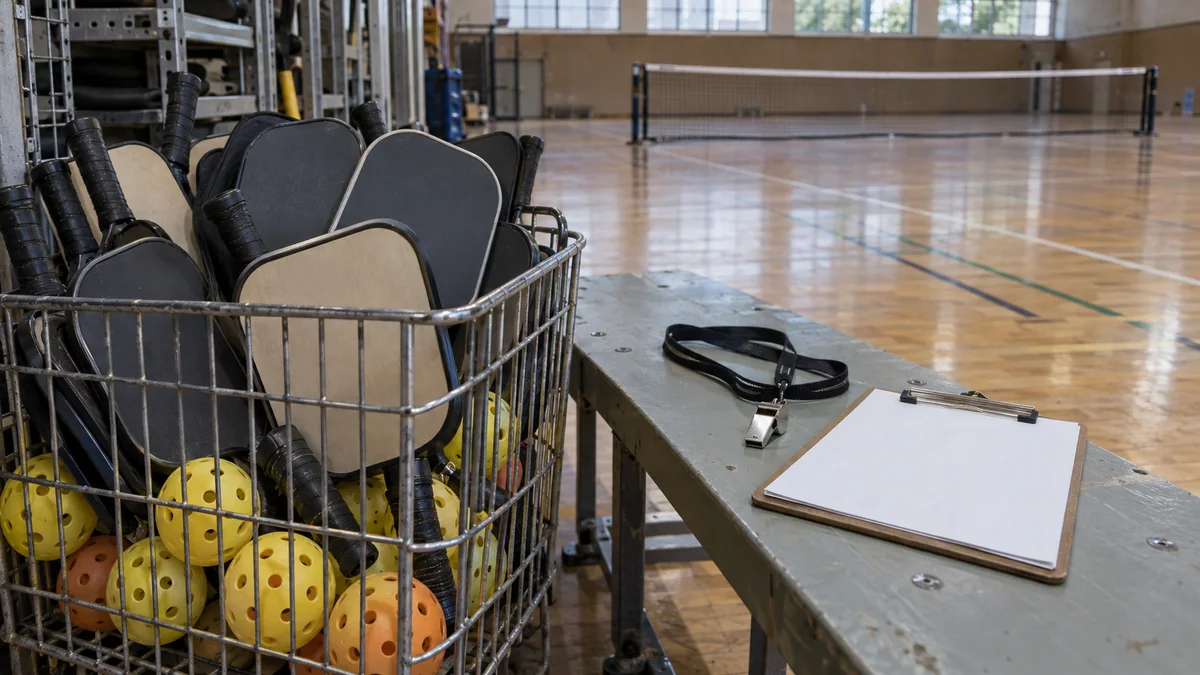
A new sport spreads through equipment, then venues, then instructors. Equipment can be bought, and venues fill once gym slots are booked. Both are solved with money and paperwork. Only instructors run into a wall built out of years of experience, and that one cannot be shortened.
In pickleball’s case the wall is doubled. The sport has only been growing in Japan in earnest for a short time, so the pool of people who meet “one year after earning Coordinator” is small to start with. On top of that, the upper certifications are unfinished, so the more motivated someone is, the less they can see ahead. Before the argument over whether well-paid coaching jobs can exist (Will Japan see a coach earning 30 million yen? The day pickleball becomes a job) turns real, the job grades have to be defined.
One attempt to fill that gap has appeared, a trial of an AI coach on a court in Ikebukuro (Can an AI coach fill the coaching shortage? Sansan starts testing in Ikebukuro). What the Tsuyama course carries, though, is not technical instruction but the rules, etiquette and the routines for running beginners through a session safely. For now that stays work only people can do.
A test for the federation straight after its merger
One practical detail not to miss is who is named as host. The programme lists the Japan Pickleball Association, and the discounted fee brackets read “former JPA players and supporter members” and “former PJF individual members.” The Japan Pickleball Association (JPA) and the Pickleball Japan Federation (PJF) signed a merger agreement on March 13, 2026, and the merger took effect on April 14. An announcement on April 10 said the external name would be unified as Pickleball Japan (PJ), with Rika Riordan as chair, Shigeru Nishigami as vice chair and Gaku Koizumi as secretary general.
The merger’s stated aims include growing the playing population and promoting the sport in the regions. Even so, the application form and the fee brackets still carry traces of the two former bodies. From the point of being recognised as a governing body (The Pickleball Japan Federation Becomes a JSPO-Recognized Body. What Changes?) onward, whether a certification means the same thing anywhere in the country depends on how soon those old brackets can be folded away. Regional dates like Tsuyama become the place to measure whether the merger works on the ground.
Practical details for anyone considering the course
| Item | Details |
|---|---|
| Name | Coordinator certification course (Tsuyama, Okayama Prefecture) |
| Date and time | Saturday, July 25, 2026. Check-in 10:30 / lecture 10:45-11:45 / on-court session 12:30-15:30 |
| Venues | Mimasaka University Arena (50 Kitazono-cho, Tsuyama, Okayama 708-0003) |
| Capacity | 36 places (minimum of 12 to run). Applications closed once the cap was reached |
| Fee | 11,000 yen / 9,900 yen for former JPA players and supporter members and former PJF individual members |
| Eligibility | players with playing experience |
| What to Bring | Paddle, indoor court shoes, towel, drink, something to write with (clothes you can move in) |
| Application deadline | Saturday, July 11. Closes as soon as the cap is reached |
| Instructor | Japan Pickleball Association certified instructor |
| Cancellation | Applications taken up to the deadline; as a rule no refunds |
| Contact | japan.pickleball.association@gmail.com |
| Next date | Coordinator certification course / Suzaka, Nagano Prefecture (August 15, 2026) |
Summary
What the one-day course in Tsuyama shows is that local interest has started to move from the people who play to the people who support the game. Thirty-six places filling is welcome, but whether those people can step up to Start Coach a year from now depends on whether the system can erase “under consideration.”
For anyone ready to act, there are three steps in order. First, the next course available is Suzaka on August 15, so apply early on the assumption it closes once full. Second, since eligibility requires playing experience, send inexperienced friends to Diffuser (two hours, from 3,300 yen) and split the entry points. Third, staff at local authorities and clubs should lock down an on-court venue first, as the bargaining chip for bidding to host a course. A pool large enough to clear the 12-person minimum, and a plan to hold a gym for four hours: the next host cities will come from the places where those two line up.
Source:PICKLEBALL JAPAN course programme/Pickleball Japan Federation certification courses/Pickleball Japan Federation course listing/Pickleball Japan Federation merger announcement/Mimasaka University