ファッション誌『FUDGE』が主催する買い物イベント「FUDGE Marché TOKYO」が、2026年8月22日と23日、東京・北青山のワールド北青山ビルで開かれた。発行元の三栄が7月22日に公開したリリースによれば、古着やハンドメイド作家の作品など50ブランド以上が並ぶ会場に、正規より小さいピックルボールのコートが出現する。大会でもスポーツ施設でもなく、服や器を買いに来た人の動線の上にネットが張られる形だ。日本のピックルボールがどこまで競技の外側へ出たのかを測るうえで、このコートは無視できない。
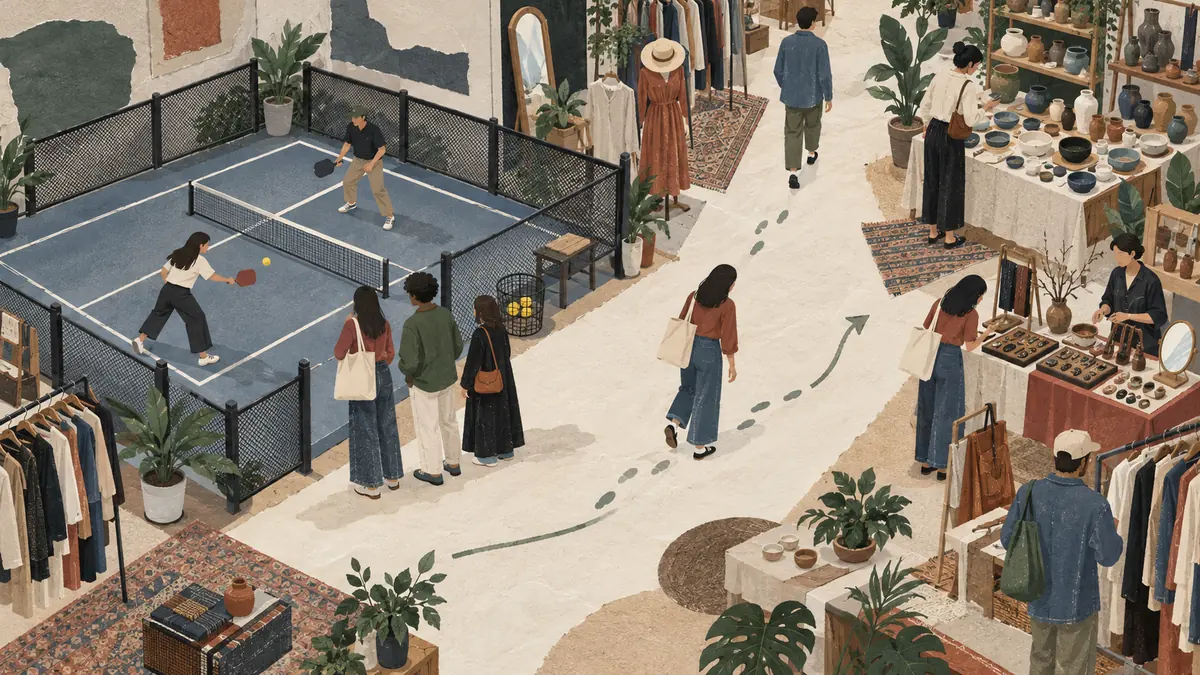
A smaller-than-regulation court to play on between purchases
Most of the release reads as a guide to a shopping event. It runs two days, Saturday August 22 and Sunday August 23, from 11:00 to 18:00 (until 17:00 on the 23rd). Admission is 1,500 yen, door sales only, cash only. Junior high school students and younger get in free, and everyone entering receives a large tote bag. The World Kita-Aoyama Building is a two-minute walk from exit A3 of Tokyo Metro's Omotesando Station, at 3-5-10 Kita-Aoyama, Minato City, Tokyo. Alongside VINTAGE Marche, a gathering of vintage clothing shops, there are flea markets run by the reader community FUDGE FRIEND and by the editorial staff.
Slotted into that lineup isa pickleball taster booth. Sanei introduces it as a sport FUDGE FRIEND members have tried, notes that the court is smaller than a regulation one, and suggests readers give it a go between purchases. Nothing in the wording assumes any playing experience. Rather than a notice about a racket sport, it is placed as one more piece of content to make the venue interesting.
From a magazine feature to a corner of the shop floor
Bringing pickleball into commercial public space had been building through 2026. A joint project started by TBS and Mitsui Fudosan in April 2024 has continued into 2026, moving courts around plazas in central Tokyo: Fukutoku no Mori from May 20 to 24, the Grand Roof Plaza at COREDO Muromachi Terrace from May 27 to 31, and Akasaka Sacas Plaza from June 18 to 21. At Akasaka, Mitsui Fudosan says it set out two full courts plus a separate taster space for children and a mini court just for dinking.
Those events, though, are billed as promoting the sport itself, and visitors come for the pickleball. FUDGE's marche reverses the premise. People come for vintage clothing, tableware and accessories, and the court rides on the time they spend there. The World Kita-Aoyama Building has been used as an official DESIGNART TOKYO venue and as a stage for neighborhood market projects, and FUDGE itself has held a Christmas market in the same building before. Given the character of the venue, the court sits closer to scenery that ends up in visitors' photos than to sports equipment.
Behind the 330,000 players sits awareness of 13.1%
In a survey of about 30,000 people conducted by Pickleball One and published in April 2026, the estimated playing population in Japan was about 330,000. The company's estimate for March 2025 was about 45,000, so the figure has swollen roughly sevenfold in a year. In the same survey, however, awareness stopped at 13.1%.
| Item | Figure | As of / source |
|---|---|---|
| Estimated Playing Population | about 45,000 people | As of March 2025 / Pickleball One estimate |
| Estimated Playing Population | about 330,000 | 2026年4月公表調査 |
| Awareness rate | 13.1% | Same survey (online survey of about 30,000 people) |
| Those with an interest in the sport | about 11.89 million | Same survey |
| Interest among tennis players | 72.5% | Same survey |
| Regulation court dimensions | 13.4m×6.1m | Japan Pickleball Federation official rules |
Lined up, it is the awareness rate rather than the growth rate that catches the eye. More than eight people in 10 walk into the venue without knowing the name of the sport. Sanei's judgment that a court trimmed from regulation size would do reads as resting on the assumption that most visitors do not know the rules. Interest among people with tennis experience reaches 72.5%, yet awareness across the wider population is still thin (72.5% of tennis players interested, and the 36x headroom in a 330,000-player market)。Thin awareness also becomes the grounds for the design call that a downsized court is enough.
Equipment makers, editors and developers run at different temperatures
Creative director Takahisa Sunaoshi, head of STEKKEY, wrote for Yahoo! News Expert on July 15, 2026 that titles including SPUR, Oggi, WWD JAPAN, Smart and FORZA STYLE have been running features one after another. He put it down to the gentler physical demands compared with tennis, which makes it easy for a wide range of ages to start, and to how well it fits the lifestyle wear and athleisure markets.
Movement on the equipment side lines up with that. Mizuno signed a promotion partnership with the Japan Pickleball Association in October 2025 and will start selling paddles, shoes and bags in Japan from August 2026. Fashionsnap reported a sales target of 100 million yen in the first year from launch, with paddles priced across a range: 39,600 yen for the ACROSTRIKE LX and 16,500 yen for the CALIBER (Golf technology goes into a paddle as Mizuno enters pickleball in Japan in August). An August launch landing on an August marche suits an equipment maker well.
The way Sanei writes about it is itself a statement of attitude. No explanation of the rules, no sporting vocabulary, just the entrance to an experience held out. That sits somewhere quite different from TBS and Mitsui Fudosan turning plazas into courts in the name of promotion. Three temperatures coexist in how the same sport gets presented.
Making a downsized court add up
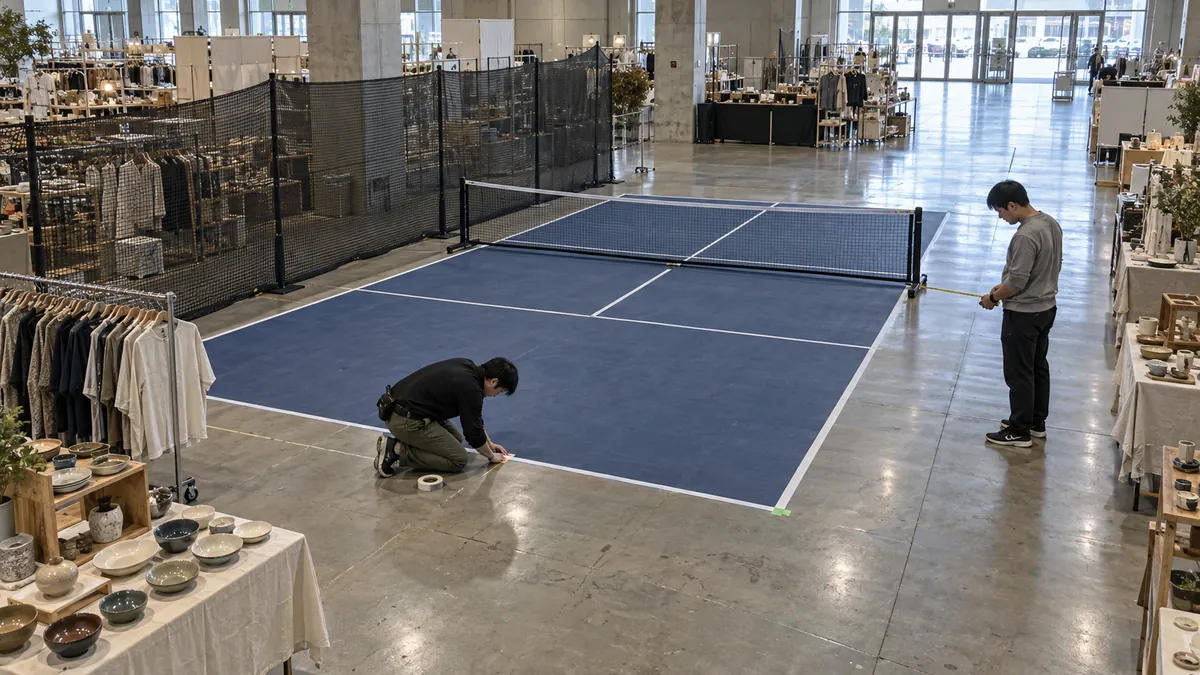
A regulation court is 13.4m by 6.1m, about 82 square meters. Taking that much floor out of the sales area at a retail event is not a light decision for an organizer. At booth rates, it means giving up several booths' worth of sales opportunity. The calculation of that floor cost must sit behind Sanei's choice of a court smaller than regulation.
Shrinking it has operational upsides too. The narrower the court, the sooner rallies end and the faster people cycle through. What a retail event most wants to avoid is a queue blocking an aisle. On top of that, shoppers are not necessarily in sneakers. On a mini court with little ground to cover, a few balls work even in sandals. Cutting the dimensions works directly toward lowering the bar to joining in.
Whether the taster booth is included in admission or costs extra is not written in the release. The message to readers is a single line suggesting they might try it briefly between purchases, with none of the trappings of a competitive event. Placed that way, the court does not have to pay for itself.Treating a taster booth as an investment in dwell time rather than as revenueis the design that venue and event operators can most easily copy. If you are considering it, the number to measure is not how many people played but how many stopped to watch, and how much longer they stayed. For an indoor trial, protecting the floor and putting up a simple fence or a high net to stop balls escaping makes it easier to run.
Paddles start selling outside the sporting goods aisle
By a route separate from growing the sport, paddle and ball motifs are turning up on shelves of general lifestyle goods. Things have reached the point of a wristwatch with a second hand shaped like a ball (The wristwatch whose second hand became a ball, the day pickleball became merchandise), so the motif is circulating ahead of the growth in players. This marche adds a hands-on element to that flow.
The geography is telling as well: the Aoyama area already has a permanent site with a court next to a golf practice facility (南青山でゴルフの隣にコート、pickle9が示す都心の勝ち筋). In a neighborhood where a permanent venue exists to catch them, a two-day pop-up creates first contact. If those two layers work together, people who try it flow straight to the permanent court nearby. Do the same thing in an area with nowhere to catch them and the experience tends to end there.
Exposure on the scale of a fashion magazine is hard to buy on a sports body's PR budget. It is borrowed attention, though, so a poor experience means no invitation to the next project. Unglamorous operations, from the number of paddles to ball management to how waiting is handled, decide the next exhibiting opportunity.
FUDGE Marche TOKYO at a glance
| Item | Details |
|---|---|
| Name | FUDGE Marché TOKYO |
| Run | Saturday August 22 and Sunday August 23, 2026 |
| Hours | 11:00 to 18:00 (until 17:00 on the 23rd) |
| Venues | World Kita-Aoyama Building (3-5-10 Kita-Aoyama, Minato City, Tokyo) |
| Access | Two-minute walk from exit A3 of Omotesando Station on the Tokyo Metro Ginza, Chiyoda and Hanzomon lines |
| Admission | 1,500 yen (door sales only, cash only / free for junior high school students and younger) |
| Admission gift | A large tote bag |
| Scale of the event | More than 50 brands |
| Pickleball | A taster booth inside the venue. Court smaller than regulation size |
| Host | FUDGE magazine (publisher: Sanei) |
| Information updates | Instagram @fudge_event |
The court's operating hours, the conditions for borrowing paddles and whether the taster session needs booking are not stated in the release. If you are building plans around taking part, check the official Instagram for last-minute notices.
Summary
What this corner shows is pickleball shifting from something people do to something that holds a space when you put it there. Awareness of 13.1% means, turned around, that there are still not enough places where someone sees it for the first time. A shopping event run by a fashion magazine reaches further than a sports facility for making that first encounter happen.
If you run a facility or a school, go to Kita-Aoyama on August 22 and 23 and measure for yourself how fast a downsized court turns over and how the queue forms. The dimensions and staffing you would need to recreate it become concrete. If you sell paddles or related goods, it is time to add retail event organizers to your list of prospects alongside sports events. And for anyone already playing, these two days are a handy excuse to drag along a friend who does not know the rules.
Source:PR TIMES (Sanei)/FUDGE.jp/PR TIMES (Pickleball One)/PR TIMES (Mitsui Fudosan)/Fashionsnap/Yahoo! News Expert/Pickleball Japan Federation