On July 10, 2026, Tokyu Resort Town Hamanako, operated by Tokyu Resorts & Stay, donated pickleball equipment to the Hamamatsu Board of Education: 352 paddles, 704 dedicated balls and 10 nets. It went to the 44 schools that applied out of Hamamatsu's 96 municipal elementary schools, putting equipment into roughly half the city's public elementary schools. The company ran the same program in June for both public elementary schools in Katsuura, Chiba, making this the second site where a resort operator has handed equipment to local public schools. It is a case that shows the conditions under which schools could become the entry point for pickleball in Japan.
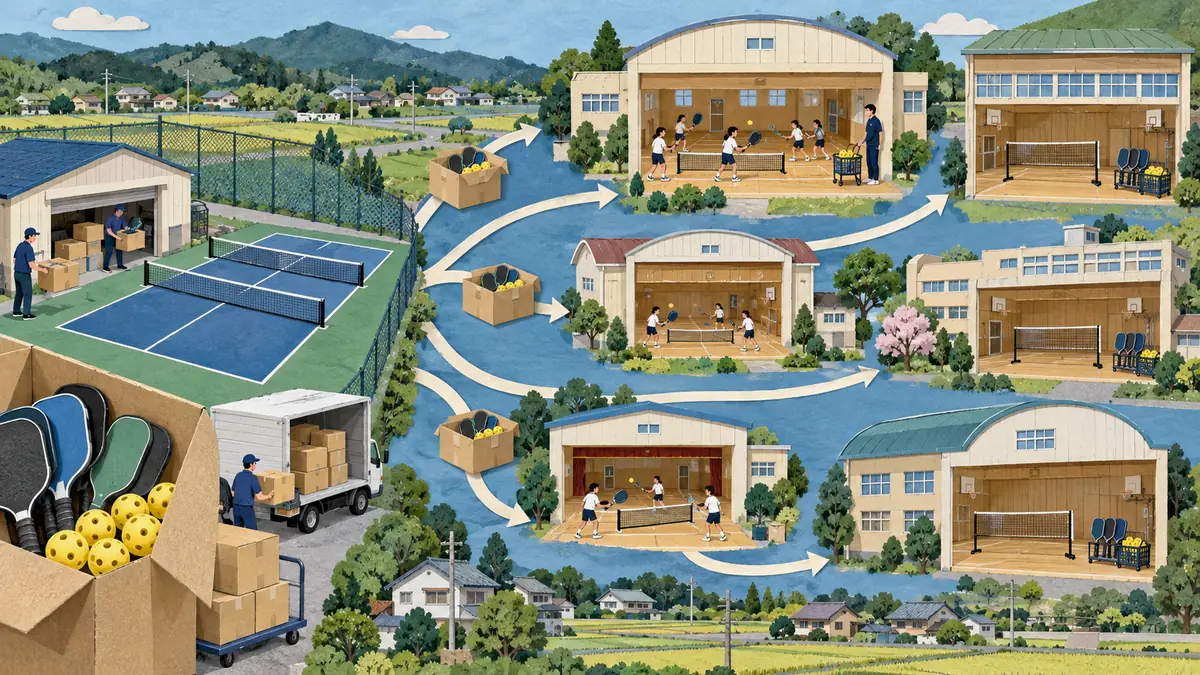
352 paddles and 704 balls, divided across 44 schools
According to the press release, the donation consisted of 352 paddles in an original design themed on "sky, rainbow and stars," 704 dedicated balls and 10 nets. They were distributed through the Hamamatsu Board of Education to the 44 of the city's 96 public elementary schools that applied. The company says the paddle design carries the meanings of "limitless possibility," "respect for individuality" and "goals for the future."
Divided evenly, that is eight paddles and 16 balls per school. Barely enough for the players on two doubles courts to hold one at the same time, and nowhere near enough for a whole class to play at once.Working back from the quantity, this is not a donation meant to replace a full PE unit but an allocation designed for break times, part of a PE class, or club activitiesis how it works.
As background, the company cited smartphones and game consoles along with record heat restricting outdoor activity, leaving children in their growth years with fewer chances to move. Hamamatsu recorded 41.1℃ on August 17, 2020, matching the national high at the time. The motive is clear: the equipment was chosen on the premise that outdoor space cannot be used.
From two schools in Katsuura to 44 in Hamamatsu, the second site changed the order of magnitude
The first round was in Chiba. On June 19, 2026, Tokyu Resort Town Katsuura donated paddle and ball sets to Katsuura's two public elementary schools, Katsuura Elementary and Ueno Elementary, announcing it on July 6 (Tokyu Resort puts paddles in every Katsuura elementary school: making exercise work for a generation raised in extreme heat). With only two elementary schools, Katsuura could cover them all, but Hamamatsu is a government-designated city with 96 municipal elementary schools. Switching from blanket distribution to inviting applications is the practical answer to that wall of scale.
What both sites share is that the resort has two outdoor pickleball courts. Katsuura Tokyu Sunny Park and Tokyu Resort Town Hamanako each have two, pairing the equipment donation with the company's own courts. Hand out equipment alone and there is nowhere to play; build courts alone and nobody comes. Holding both in the same trade area is where the design of this program sits.
The 44 schools that applied are 46% of the total, and more schools did not raise a hand
| Item | Hamamatsu (July 10, 2026) | Katsuura (June 19, 2026) |
|---|---|---|
| Recipients | 44 Hamamatsu municipal elementary schools | 2 Katsuura public elementary schools (all of them) |
| Total public elementary schools in the city | 96 (from Hamamatsu's list of elementary schools) | 2 (company announcement) |
| Coverage | About 46% | 100% |
| Paddles | 352 (average 8 per school) | Number not disclosed |
| Dedicated balls | 704 (average 16 per school) | Number not disclosed |
| Nets | 10 | Not listed |
| Announced | July 23, 2026 | July 6, 2026 |
Two things stand out in this table: 44 does not reach half of 96, and there are only 10 nets. Schools were invited to apply and 46% did. When free equipment is on offer and more than half do not take it, the reason on the school side is not a shortage of equipment.Who teaches a sport nobody knows, and how to find the gym time— it is more natural to read those operational questions as outweighing the fact that it cost nothing.
The 10 nets lead to the same point. Ten nets across 44 schools works out to one for every four or five. The rest have to start with equipment they already own, which puts the badminton posts and net in the gym into play.
"Start by getting people to know it": the words from the growth side have not changed in three years
Tokyu's own read comes through in comments recorded in the company's sustainability coverage. On a taster session held in October 2023 at Hamanako Tokyu Sunny Park inside Tokyu Resort Town Hamanako, general manager Sato said, "I imagine almost nobody knows pickleball itself, so we want to start by getting people to know it." About 10 people took part that day: employees from nearby companies, tennis school coaches and children. In just under three years, the reach went from 10 people to 44 schools.
The company's explanation has been consistent. Tokyu Resorts & Stay framed the donation as support for building an environment where a sport that can be enjoyed safely indoors can be worked into PE classes and recreation. The wording assumes the equipment will be used in lessons, not simply handed over.
Interest on the government side lies less in the sport than in the condition of school gyms. To push air conditioning into gymnasiums at public schools, the Ministry of Education set up a temporary special grant for air conditioning installation, covering half of eligible construction costs from 4 million to 70 million yen through fiscal 2033. On the governing body side, the Japan Pickleball Federation runs an instructor system, raising the number of people who can teach in stages from the entry-level diffuser course through coordinator to start coach and coach. The 352 paddles sent to schools landed where those three currents overlap.
Move indoors and only 22.7% of gyms have cooling
This is the part of the donation to look at most carefully. A Ministry of Education survey published in June 2025 (as of May 1, 2025) put the air conditioning rate for gymnasiums at public elementary and junior high schools at 22.7%, and 22.0% for elementary schools alone. That is up from 18.9% as of September 1, 2024, but close to 80% of gyms still have no cooling.
Meanwhile, the heat stroke prevention guidelines for exercise from the Ministry of the Environment and the Japan Sport Association state that at a wet bulb globe temperature (WBGT) of 31 or above, exercise should as a rule be stopped, and that it should be stopped outright for children. A gym without cooling has no airflow, and there is no guarantee it stays below outdoor conditions on a midsummer afternoon.The idea that an indoor sport stands up to extreme heat is only half right。
Even so, there is still a point to handing pickleball to schools. It works not on midsummer afternoons but on rainy days in the wet season, in the lingering heat of early September and in short winter breaks — the hours when the schoolyard is unusable but the gym is open. The hours when outdoor courts fill and the hours when school gyms are free line up almost inversely, and having the equipment sitting there increases contact with the sport by itself. Municipalities already run beginner courses in gyms; Misato, Saitama put together a four-session course for beginners (Misato runs a four-part pickleball intro at its gymnasium, because growth starts at the door). Distributing to schools builds that same entrance from the children's side.
"No construction needed" and a 66cm gap, the number to measure before you start
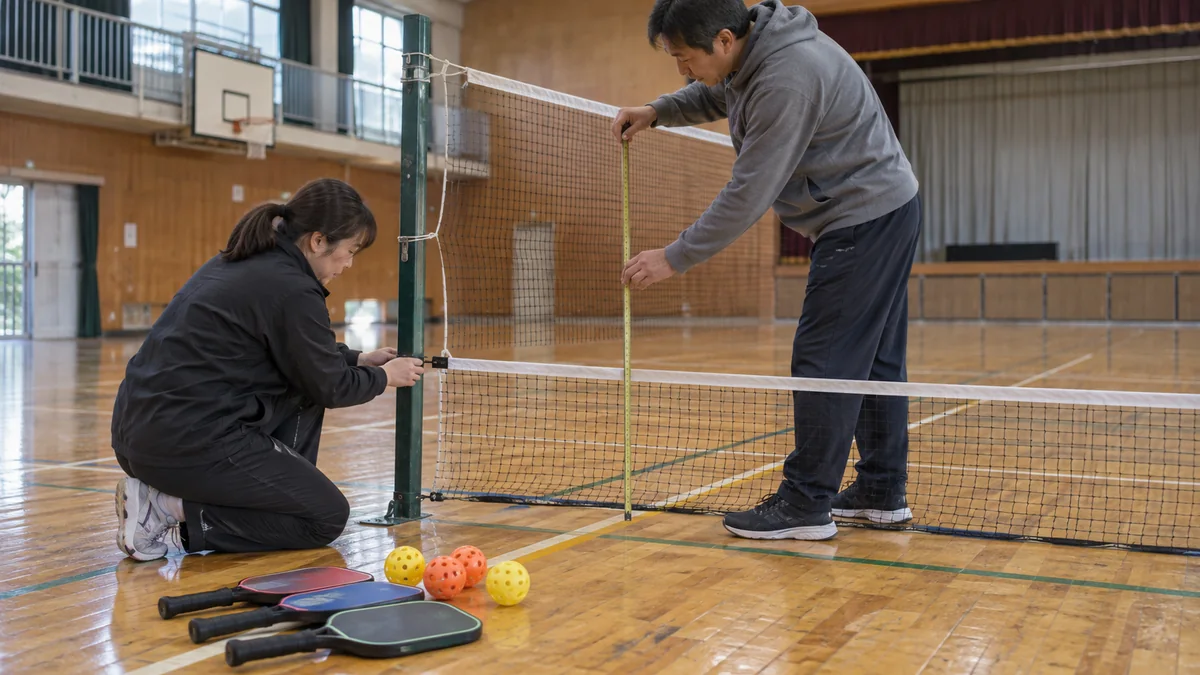
In both the Hamamatsu and Katsuura releases, donor Tokyu Resorts & Stay says that "badminton poles and nets can be used as they are, so no special construction is needed to bring it into a gym." On dimensions that holds: a pickleball court is 13.4m×6.1m (44ft×20ft), the same as a badminton doubles court. Marking the lines takes almost no work.
Height is another matter, and it calls for actual measurement. The Japan Pickleball Federation gives net height as 86.3cm at the center and 91.4cm at the posts. Badminton is 1.524m at the center with 1.55m posts, a difference of about 66cm at the center.No construction needed and playable at the current height are two different things, and even when the poles are reused, the net has to be re-hung 66cm lower.
Can the net be fixed in that lowered position, or can a portable net be bought in addition? That single point decides whether the donated paddles sleep in a storeroom or come out once a week. Schools that received one of the 10 nets and those that did not are likely to diverge in how often they use them six months on. If the board of education tracks anything, the number of schools that could set up a net permanently is closer to reality than the number of schools that received equipment.
The other issue is who teaches. Pickleball fits neatly into the net-type games of the national curriculum guidelines and can be handled within the soft volleyball framework. Still, both the strokes and the serving rules are unknown territory for teachers, and whoever designs the first hour sets the impression. The governing body is running taster sessions and training instructors, and the next two things the 44 schools need to secure are nets and coaching.
A resort's reason for giving to elementary schools sits outside visitor numbers
Judged purely on sending customers, this donation is hard to justify. Tokyu Resort Town Hamanako has two outdoor courts, open 9:00-18:00 (year round, until sunset), at 2,200 yen per court per hour (tax included). If the children from 44 schools arrived with their families, two courts could not take them, and if they do not come the cost is never recovered. It is hard to read as a short-term customer acquisition play.
Read differently, the move looks closer to an investment in placing the company among the providers of community sport. With school club activities shifting to community bodies, receivers outside school are in demand, and resort facilities have weekday capacity to spare. Having the company's own paddle design in half the city's elementary schools becomes the starting condition when talk of community clubs or taster sessions comes up a few years from now. There is plenty of headroom on the player side as well: a private survey estimated about 330,000 players in Japan against 11.89 million with an interest (72.5% of tennis players interested, and the 36x headroom in a 330,000-player market). It is one private company's figure rather than a national estimate from an official body, but it does show the two populations differ by an order of magnitude.
Practical details for schools, facilities and players
| Item | Details |
|---|---|
| Court dimensions | 13.4m×6.1m (44ft×20ft / same as a badminton doubles court) |
| Net height | 86.3cm (34 inches) at the center / 91.4cm (36 inches) at the posts |
| Reusing badminton equipment | The donor says "poles and nets can be used as they are and no construction is needed." Note that with posts at 1.55m and the center at 1.524m, badminton sits about 66cm higher at the center, so the net has to be lowered |
| Where to try it | Tokyu Resort Town Hamanako (Hamana Ward, Hamamatsu, Shizuoka) / 2 dedicated outdoor courts |
| Hours | 9:00-18:00 (year round, until sunset) |
| Usage fee | 2,200 yen per court per hour (tax included) |
| Contact | Hamanako Tokyu Sunny Park 053-526-1515 |
| Securing instructors | Japan Pickleball Federation instructor courses (diffuser → coordinator → start coach / coach) |
| Funding for gym air conditioning | Temporary special grant for air conditioning installation (half of eligible construction costs from 4 million to 70 million yen, through fiscal 2033) |
| Heat index guidance | At WBGT 31 or above, exercise should as a rule be stopped, and stopped for children (heat stroke prevention guidelines for exercise) |
Takeaway: the number to watch is not 44 but how many schools are left next summer
The story does not end when the equipment arrives. What needs to move differs by position.
- School staff should first check whether a badminton pole can hold a net down to 86.3cm at the center. Clear that and you can move on to designing the first lesson
- Staff at the 52 schools that did not apply should ask the board of education about the next distribution round and whether taster sessions are planned
- Facility operators should not plan an equipment donation on its own. It only becomes a circuit when the company's own courts and taster sessions come as a set
- Players should note that the two courts at Hamanako are open year round at 2,200 yen per court per hour
Whether this donation worked can be judged in the summer of 2027, by how many of the 44 schools are still bringing the equipment out. The number of paddles is only the starting condition; the schools left standing will be the ones with a net and someone to teach. The 44 schools in Hamamatsu became a large-scale field test of whether pickleball in Japan can use school as its entrance.
Source:PR TIMES (Tokyu Resorts & Stay, Hamamatsu)/PR TIMES (Tokyu Resorts & Stay, Katsuura)/Hamamatsu list of elementary schools/Ministry of Education, Culture, Sports, Science and Technology/ReseEd/Ministry of the Environment Heat Illness Prevention Information site/Tokyu Resorts & Stay Sustainability Action/Pickleball One/PR TIMES (Pickleball One market survey)/tenki.jp/Pickleball Japan Federation