The ways companies get involved with sport have leaned toward either title sponsorship or ad placement. PX LEAGUE, which Sansan launches in October 2026, breaks that pattern. Six companies each own a team and compete for the title across seven months. What was a development program has been reshaped into a team league owned by companies. It is worth laying out what this step brings to pickleball in Japan.
What happened with PX LEAGUE
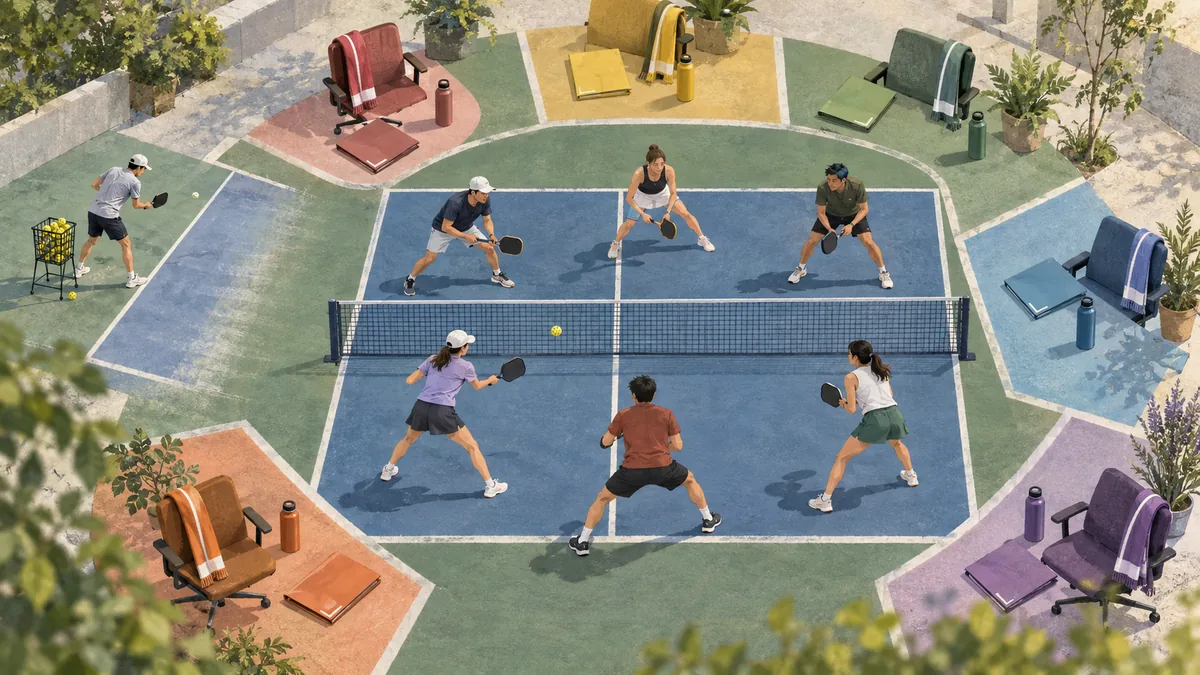
PX LEAGUE is the third season of Pickleball X, which Sansan has been running. Where the first and second seasons were competitive development programs aimed at individuals, the third rebuilds the framework itself around teams and owners. The participants are Asics, Globeride, Sansan, TBS Television, Transcosmos and Mercari. Each holds a franchise team carrying its own name and takes part in running it.
選手募集は2026年8月10日から23日まで、9月12日にドラフト会議、10月14日に初戦という段取りが当時公表されている。会場はSansanが池袋に構えた「Sansanピックルボールコート池袋」が主戦場になる。コーチには元全米王者のダニエル・ムーア氏、テニス元日本代表の藤原里華氏が名を連ねた。個人の腕試しではなく、企業名を背負ったチームが週替わりで勝敗を積み上げていく興行へと、性格が明確に変わっている。
How Pickleball X changed, and the model it borrowed
In its first and second seasons, Pickleball X was a development setting that found talented individuals and gave them match play and coaching. With a thin playing population in Japan, raising the raw number of players and the floor of their ability came first, and an individual program fit that phase. Individual programs have a structural ceiling, though. It is hard for spectators to know whom to cheer for, and hard to build a reason to keep following. Win or lose, the story closes inside one person.
The team format is designed to fill that weakness head on. The six-team, mixed-gender, multi-event aggregate format PX LEAGUE uses is modeled on Major League Pickleball (MLP), the team league that came first in the US. MLP, where companies and celebrities own teams and women's doubles, men's doubles and mixed doubles are played in a single day for a combined win total, pushed pickleball forward as a spectator product. PX LEAGUE's rule of six players, three men and three women, all of whom play with no substitutes, reads as the skeleton needed to make that aggregate format work in Japan.
Individual development versus a team league
| Comparison axis | Pickleball X, seasons 1 and 2 (individual development) | PX LEAGUE, season 3 (team format) |
|---|---|---|
| Party | Individual players | Six teams with corporate owners |
| Composition | Program run at the individual level | Three men and three women, six in all, everyone plays |
| How companies are involved | Sponsorship, equipment supply and the like | Team ownership and direct involvement in operations |
| Period | Short development cycle | Seven months, October 2026 to April 2027 |
| Value sought | Finding players and raising their level | A spectator product, brand exposure, employee engagement |
Side by side, what changed is not the scale but the quality of involvement. Sponsorship is a relationship of putting a logo up; ownership builds the company into whether the team wins or loses. Lose and it stings; win and the office lights up. A mechanism that makes companies participants in sport has been implemented in Japanese pickleball for the first time.
How companies and the industry responded
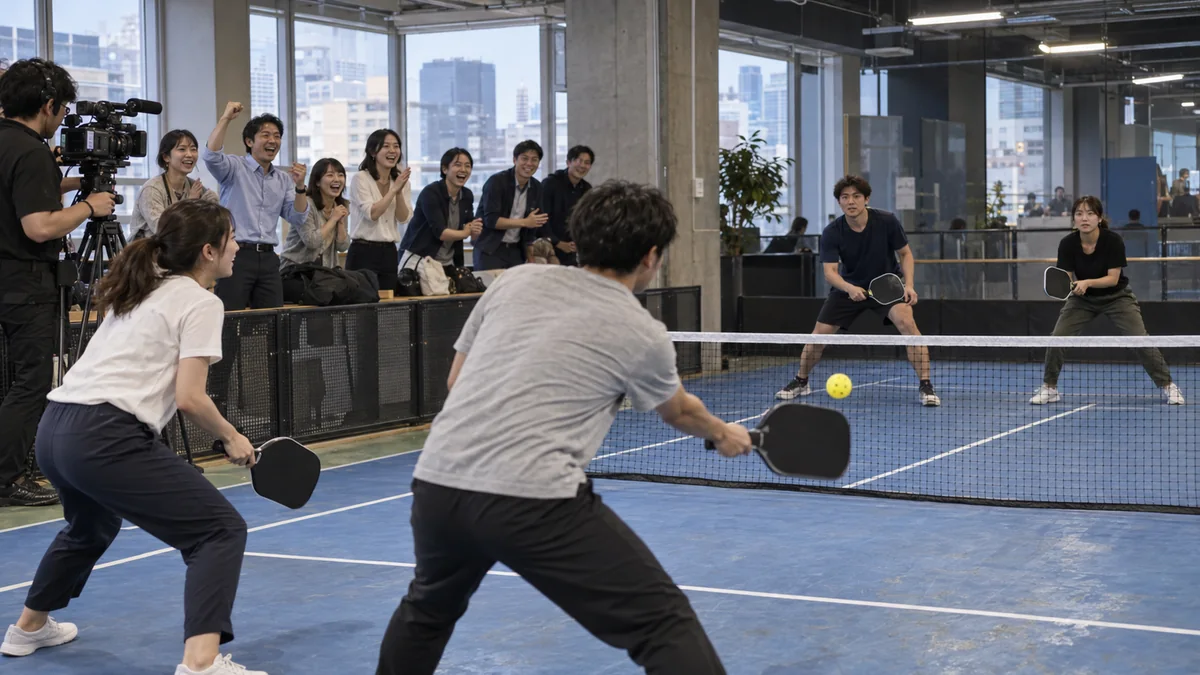
The lineup of the six speaks for itself. Asics was already involved with Sansan's Ikebukuro courts through equipment supply, so stepping up to team ownership is a natural extension. Its earlier moves are covered in our report onhow Asics began supplying equipment to Sansan Ikebukuro.
Globeride in fishing tackle, Mercari in flea-market apps, TBS Television in broadcasting: the industries do not line up at all. What they share is seeing pickleball as a new internal asset that employees can actually play and cheer for. TBS Television's involvement in particular raises the possibility of a broadcaster taking part as both rights holder and participant, widening how the league can be presented. Sansan, whose main business is business card management, owning a team while also running the league puts it in the position of both platform and participant, an advantage for steering the design in year one.
The Ikebukuro courts that host the league drew demand right after opening at a pace that outran forecasts. The reality of usage in the city center is covered inhow overheated demand at the Ikebukuro courts forced an expansion on opening day, and the base for hosting the league was already in place.
What this means for readers
From a player's perspective, PX LEAGUE adds one more destination to a career. Until now, sharpening your game in Japan led to few clear stages beyond it. With the August recruitment and September draft made public, the motivation to aim higher gets a concrete shape. Being drafted by a company team is a target individual programs never offered.
For spectators, there is now a clear object of support. You can follow a team tied to your employer or a company you like, and the story of wins and losses runs for seven months. Watching shifts from chasing one-off tournaments to caring about standings across a season. Combined with the development base Sansan has been testing inits AI coaching work, a cycle in which the player pool and the fan base thicken at the same time is plausible.
Ripple Effects on the Industry
The effects could spread in three directions. First, it becomes a prompt for other operators and court businesses to consider leagues of the same type. A domestic precedent that works matters. Second, how corporate sponsorship enters changes. With ownership added to logo sponsorship as an option, the spending moves sideways from advertising budget toward internal engagement, recruitment and networking. Third, the broadcasting and streaming setup shifts. Having TBS Television inside creates internal pressure to polish the league as content.
Six companies and six teams is only a starting point. How far attendance and streaming numbers climb over a seven-month run, and whether the companies find a return that justifies holding teams from year two, are the practical forks that decide whether the format takes hold. MLP in the US also started with a small number of teams and widened the market as famous owners joined and team counts grew. Whether PX LEAGUE can trace the same curve depends on giving its corporate owners something to show for year one.
Practical information
PX LEAGUEの主な日程は、選手募集が2026年8月10日〜23日、ドラフト会議が9月12日、開幕戦が10月14日、シーズンは2027年4月までと当時予告されている。会場はSansanピックルボールコート池袋(東京都豊島区)が中心となる。参加チームはアシックス、グローブライド、Sansan、TBSテレビ、トランスコスモス、メルカリの6社。試合は男女5種目の合算方式で、各チーム6名が全員出場する。選手として関わりたい層は8月の募集期間、観戦したい層は10月の開幕を起点に情報を追うと動きやすい。
Summary
What PX LEAGUE really does is redesign involvement rather than expand scale. From developing individuals to companies owning teams and holding a stake in the result. By borrowing the MLP-style aggregate format, this third season brings the skeleton of a spectator product to Japan, which makes it something other than an extension of the first two. How the six owners fight through seven months, and how many spectators they draw in, is the first real measurement of whether Japanese pickleball can move from a collection of individual competitions to a team-sport product.
Sources
- Press release on the launch of Sansan's PX LEAGUE (PR TIMES)
- Shoes stay as rentals: why Asics began supplying equipment to Sansan Ikebukuro (pickle-times.com)
- Expansion decided on opening day: what Sansan Ikebukuro says about overheated city-center courts (pickle-times.com)
- Can AI coaches fill the coaching shortage? Sansan's trial in Ikebukuro (pickle-times.com)