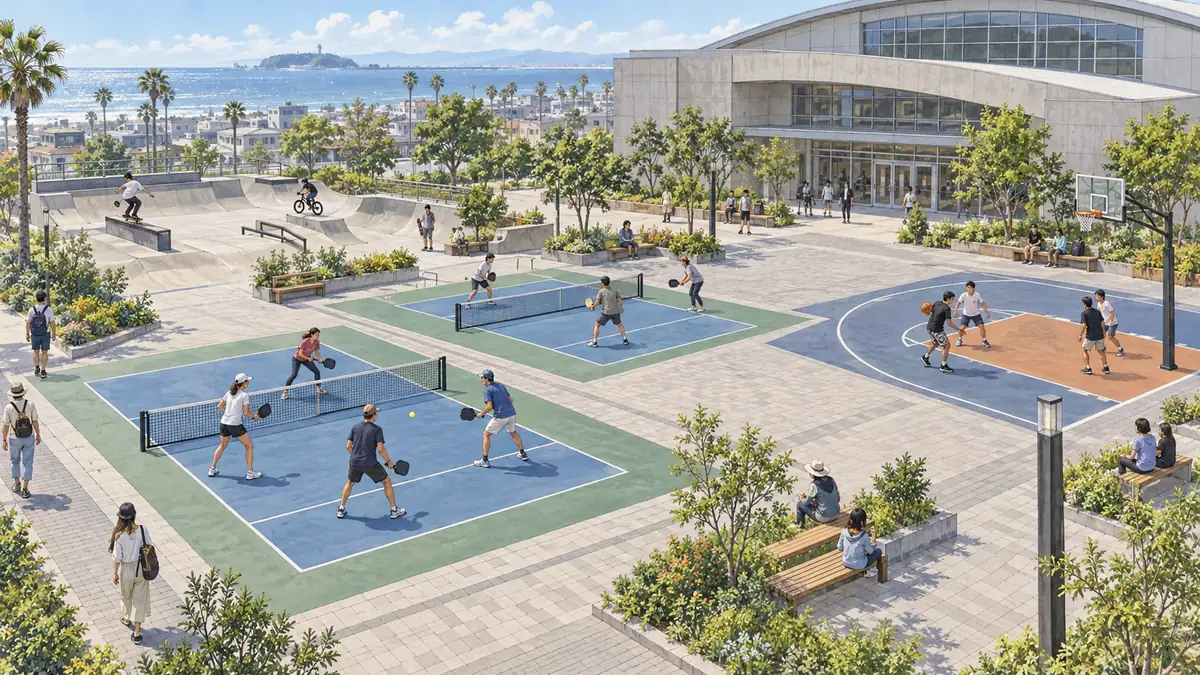
The city of Chigasaki in Kanagawa Prefecture will turn the plaza in front of its municipal gymnasium (about 1,500 square meters) into a free public sports hub called Flat Park (tentative name), mixing skateboarding and BMX, 3x3 basketball and pickleball. There will be two pickleball courts. The distinctive part is that no booking and no registration are required: you can turn up on impulse and play. With paid membership indoor clubs opening one after another in the big cities, a local government putting in permanent courts with no application and no fee is a test of how far pickleball in Japan will reach.
Pickleball lines up in the same slot as skateboarding
What stands out in Chigasaki's plan is the thinking that puts pickleball in the same plaza as skateboarding, BMX and 3x3 basketball. All of those grew up on city plazas and asphalt rather than in dedicated roofed gymnasiums. The novelty here is that the city has positioned pickleball not as a gym sport you book in advance but as a plaza game you wander into.
The layout the city has published has a skateboard and BMX area, one 3x3 court and two pickleball courts. The word "flat" in the name refers to the flat playing surface and also to the idea of a place where relationships form on equal footing regardless of age or playing history, and where anyone can drop by. Lowering the barrier to the sport is itself built into the concept of the facility.
事業費1億8100万円、完成は翌年秋の予定
整備の骨格を数字で押さえておく。総工費は約1億8100万円で、このうち約2100万円は県補助を見込む。6月市議会では、関連する補正予算約2560万円が可決された。スケジュールは基本設計を終えて詳細設計が進行中で、入札は秋ごろ、工事着手は年末、完成は翌年秋を予定する。
| Item | Details |
|---|---|
| Site | Plaza in front of the municipal gymnasium (about 1,500 sq m) |
| Pickleball | Two courts |
| Other sports on site | One 3x3 basketball court / skateboard and BMX area |
| Total construction cost | About 181 million yen (including about 21 million yen in prefectural subsidy) |
| Schedule | 入札=秋ごろ/着工=年末/完成=翌年秋(予定) |
| How to use it | Open at all times, free, no application needed |
Two open-air courts with no roof is a realistic landing point for prime land in a regional city. Year-round, all-weather use is off the table compared with an indoor facility, but the town gains a place people can try while construction and upkeep costs stay down. As an entry point to pickleball, that lightness is an advantage.
Why free and booking-free is the real battleground
For the past few months, news about pickleball facilities in Japan has centered on membership indoor clubs in the big cities. Membership courts have opened in Toyosu and Ikebukuro, with demand strong enough that places were taken before opening. But that entrance is not low. Fees, bookings and equipment are three walls that filter out the people who have nothing yet, the ones standing further back than tennis players and fitness enthusiasts.
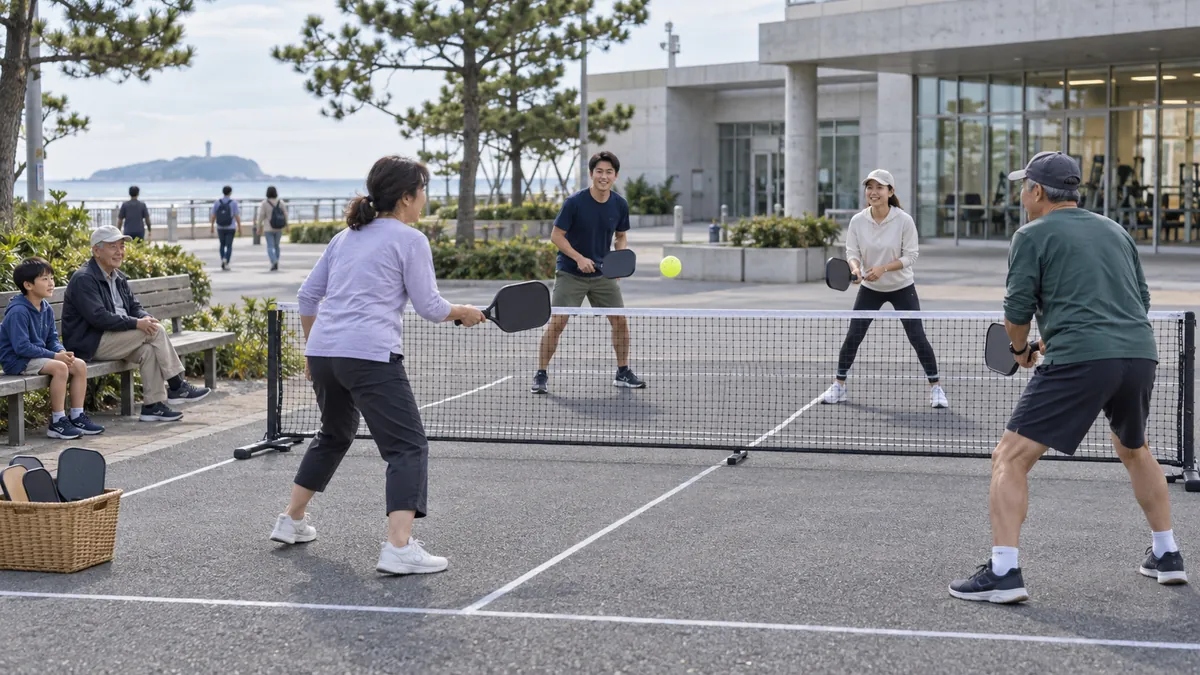
Chigasaki's plaza removes all three from the start. There is no fee, no booking, and someone walking past the gymnasium can see it and join in. Pickleball exploded in North America because countless free courts were painted in parks and on the edges of tennis courts, and anyone with a paddle could play. Recreating that circuit in Japan takes more than expanding paid indoor clubs. At some point local governments have to use tax money to embed places in the town where people can play for nothing. Chigasaki has stepped into that work by borrowing the frame of street sports.
Design lessons other local governments can borrow
The practical hint here is that pickleball does not have to be built on its own. By sharing a plaza with 3x3 and skateboarding, Chigasaki pushed through a budget as an urban sports hub that would have been hard to pass for pickleball alone. The more uncertain a municipality is about its playing population, the better this bundling works. Rather than defending a standalone build, planning a shared plaza for several sports makes assembly approval easier to win.
Local governments are starting to move on pickleball in public spaces around the country. The town of Sakai in Ibaraki Prefecture invited a pro player through the community revitalization corps and is testinga model that places the core of its outreach in the region, person and all, and in Osaka, Mizuno isconverting tennis courts in a prefectural park into pickleball courts, working to grow the playing population in public space. At the Nakagawa Canal in Nagoya, the travel giant JTB offersan example of running courts in the middle of the city, and venues are spreading from inside the gymnasium out to the town plaza. Chigasaki's free plaza is arguably the clearest, most government-led version of that shift.
茅ヶ崎に住む愛好者にとっては、翌年秋を待てば予約なしで打てる場所が一つ増える。他の街の関係者にとっては、「ピックル専用コートを作る」ではなく「アーバンスポーツ広場の一区画にピックルを入れる」という通し方が、自分の自治体でも使える設計図になる。無料で予約不要という当たり前の入り口を、公共がどれだけ増やせるか。日本のピックルボールが競技の枠を越えて生活に根づくかどうかは、こうした地味な広場の数にかかっている。