Pickleball has grown its player population worldwide over the past few years and is developing into a major market that draws in gear, facilities, and services. What people wonder is whether this momentum will keep going, and where the business chances are.
This article reads pickleball's future potential from market-size (value) forecast data, analyzing from many angles the drivers powering growth, the potential of the Japanese market, the path to becoming an Olympic sport, points to watch for investment, and even the risks that could slow growth, based on information as of June 2026. Market forecasts change in their figures with the research body and assumptions, so also check the source and the point in time.
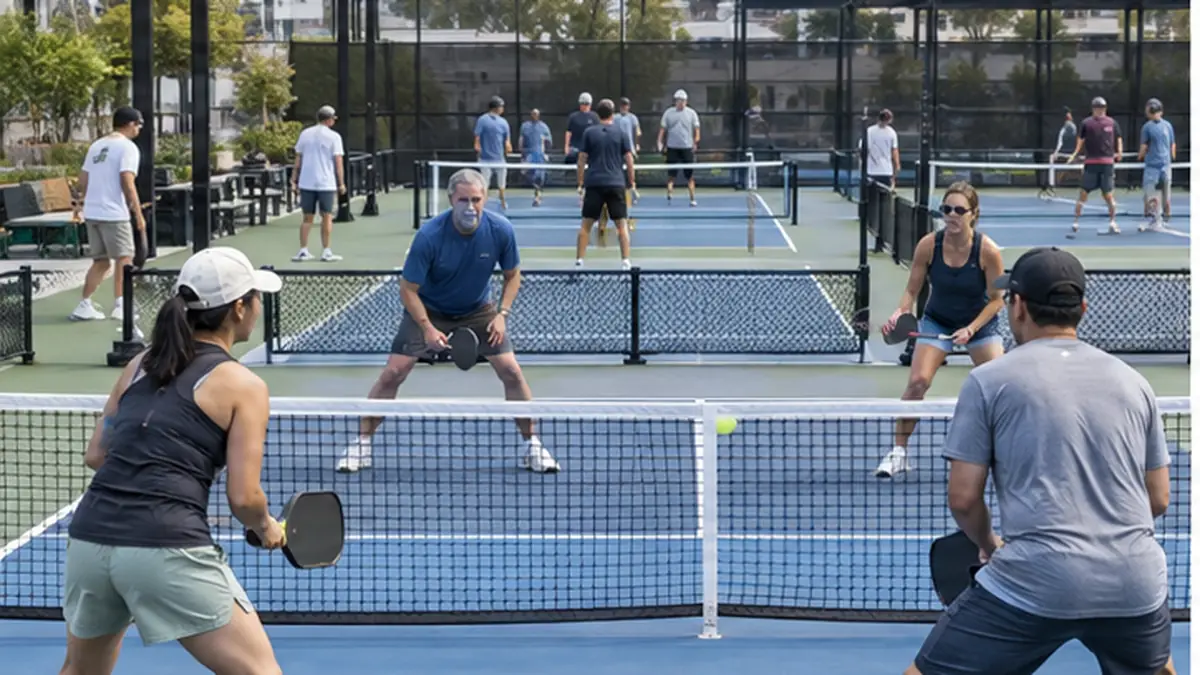
How far will the global market grow? [forecast data quick reference]
First, we confirm the future potential from value-based market forecasts. The table below is a guide based on research firms' reports, and figures differ by scope (gear only / including apparel, etc.).
| Market | Forecast | CAGR (compound annual growth rate) |
|---|---|---|
| Global (gear and apparel) | 2.5 billion dollars in 2024 to 6.3 billion dollars in 2030 | 17.0% |
| United States | About 647 million dollars in 2024 | — |
| China | Forecast of about 969 million dollars in 2030 | 15.9% |
| Japan | High growth expected | 15.7% (surpassing Canada's 14.6% and Germany's 12.4%) |
The global market for gear and apparel is forecast to expand from 2.5 billion dollars in 2024 to 6.3 billion dollars in 2030 (17.0% CAGR). What stands out isJapan's growth rate of 15.7%outpacing Canada (14.6%) and Germany (12.4%). That the value growth tracks the growth in player numbers shows a future potential that will not end as a mere fad.
Source Global Information, Inc., Pickleball Apparel and Gear Global Marketcreated from (August 2025)
The main drivers powering market expansion
The following movements are behind the value-side growth.
Professionalization and the entry of star players
In the United States, pro tours such as PPA, MLP, and APP run tournaments with total prize money in the millions of dollars, and tennis-world names like Andre Agassi and Andy Roddick have begun to invest and take part. Professionalization raises credibility as a sport and creates new revenue sources in broadcast rights and sponsorship income.
Social media and influencer marketing
Tutorials, match highlights, and pro-player endorsements have spread on Instagram, TikTok, and YouTube, pushing up demand for the premium gear top players use. High-ticket items such as premium paddles, performance apparel, and limited collaborations drive the market's value growth.
Development of dedicated facilities and academies
The development of dedicated courts, training academies, and sports complexes is advancing worldwide. Beyond selling gear, surrounding services such as facility operation, coaching, and tournament management are broadening the market's base. In addition to majors like Nike, Adidas, and Wilson,Selkirkand specialty brands such as JOOLA and Six Zero are also stepping up investment.
Advancing gear technology and digitalization
Another axis supporting the future potential is technological innovation in gear. Paddle materials are advancing with evolving carbon fiber and improved core structures that suppress rebound, and performance differentiation ties into higher unit prices. Furthermore, products and services linked with digital technology have appeared, such as sensor-embedded paddles that record shot data, AI selection tools that suggest a paddle to match your preferences, and virtual fitting online. Such value-added moves take in demand for match analysis and training and become a factor pushing the market's value growth up a further notch. If you want to know the criteria for replacing or choosing a paddle,the complete guide to choosing a paddleis also worth a look.
The growth potential of the Japanese market
The Japanese market is in a takeoff stage, and the size of its room to grow is at the heart of its future potential.
In a survey by the domestic media outlet Pickleball one, the domestic player population as of March 2025 reachedan estimated roughly 45,000 peopleand is said to have grown roughly fivefold in just one year. Monthly active users (MAU) also grew roughly fivefold, from 6,159 in March 2024 to 30,219 in March 2025. By region, the Tokyo metropolitan area stands out at 66.5%, followed as a second wave by Kinki (13.5%) and Tokai (6.8%).
(Note: this figure is an MAU-based estimate, and its definition differs from other metrics such as registered membership. For details on Japan's market size and adoption,the analysis of the Japanese marketsee.)
Source Pickleball One, Inc., Estimating Japan's Domestic Pickleball Player Population! Reaching 45,000, Roughly Five Times in One Year!created from (announced May 2025, estimate as of March 2025)
Growth factors unique to Japan are also clear. Suitability as a lifelong sport in an aging society (low strain on the joints, well suited to seniors and rehabilitation), land efficiency from being able to repurpose existing tennis and badminton courts, and use in companies' health management and building in-house community. There are signs of professionalization too, and in February 2026 the UTR Pickleball Japan Tour, using the UTR rating that quantifies players' skill, was held domestically.
Source Pickleball Japan Federation, UTR Pickleball Japan Tour 2026(February 2026)
The path and conditions to becoming an Olympic sport
Not to be left out in discussing future potential is the possibility of becoming an Olympic sport. The international governing bodies are being reorganized around the International Pickleball Federation (IPF) (with moves such as merging with a separate body), and as of 2025 some 77 national and regional organizations are said to be members. As the groundwork for standardization and adoption continues, realization requires clearing the following conditions.
| Conditions to clear | Details |
|---|---|
| Geographic expansion of the player population | Further adoption in Asia, Africa, and South America |
| Standardization of rules and officiating | Unifying international competition rules and judging systems |
| Anti-doping framework | Establishing a testing and operating framework in line with international standards |
| Viewer base | Expanding media exposure and a global audience |
Meeting the requirements of a modern sport that the IOC values, such as inclusiveness (regardless of age or gender), low-cost facility development, and low environmental burden, is a tailwind. On the other hand, the current situation of multiple governing bodies that are not yet consolidated is an area that needs sorting out toward becoming a sport. Should it be adopted as an Olympic event, broadcast rights, sponsorship income, and each country's development budgets would flow in at once, potentially pushing market forecasts well above their range. Conversely, if becoming a sport recedes, growth will likely continue in a form led by private demand for gear and facilities. The Olympics is one of the largest variables swaying the future potential, and its trajectory ties directly to market-size forecasts. For the latest trends on event status,the explainer on becoming an Olympic sportsums it up in detail.
Business chances and points to watch for opportunity
Market expansion is creating chances for business and entry across several fields.
Gear and apparel field
The market for paddles, balls, apparel, and shoes is the center of growth. In addition to major brands such as Selkirk, Paddletek, JOOLA, HEAD, and Wilson, emerging brands from Asia and Vietnam such as Kamito, Sypik, and Facolos are raising their presence in the Asian market (price bands range from entry to top tier). Sales innovations such as e-commerce and DTC (direct-to-consumer) models, limited drops, and community-driven branding are broadening revenue chances on both unit price and customer touchpoints.
Facilities and services field
The base of surrounding services is broadening, including court construction, indoor dedicated facilities, membership clubs, coaching, tournament management, and media production. In Japan, cases of building courts into new residential developments have also begun to appear. Complexes that attach a bar or cafe next to play and productize sport plus socializing are drawing attention as a model that extends dwell time and spend per customer. Especially in Japan, there is room to grow in urban areas short on indoor courts and in corporate services that answer companies' health-management needs. What sways the recovery of the initial investment is location and utilization rate, and how to fill weekday-daytime use (senior classes, corporate rentals, etc.) becomes the key to business design. If you want to know which paddles sell well, seethe explainer on value paddlesis also helpful.
Risks to growth forecasts: what could slow the momentum
Alongside the bright forecasts, you should also calmly grasp the factors that could slow growth. If you are considering investment or entry, these risks are exactly the points you want to check. We have organized the main variables.
| Risk factors | Details |
|---|---|
| Facility shortage and noise regulation | Court development not keeping up with demand, and in residential areas regulation and lawsuits over the sound of the ball, could become a drag on growth |
| The initial boom running its course | The retention rate of the crowd who joined out of novelty is hard to read, and growth could slow depending on the continuation rate |
| Fragmentation of governing bodies and standards | There are multiple pro tours and bodies, and if the rules and approved-paddle standards do not line up, it becomes an obstacle to adoption |
| Economy and disposable income | Demand for high-priced gear and membership facilities is easily affected by the economy |
These are not reasons it will not grow but variables that sway the speed of growth. Whether the market expands as forecast rests on facility development, coordination with local communities, and how far the retention rate can be raised.
Thinking in terms of three growth scenarios
Future potential comes closer to reality when captured as a range rather than told with a single forecast figure. Depending on how the above variables turn out, the market going forward splits into the following three scenarios.
| Scenario | Assumption | Impact on the market |
|---|---|---|
| Bullish | Facility development keeps up with demand and the retention rate holds at a high level | Expansion as forecast, or above the range |
| Neutral | Adoption continues but coordinating facilities and standards takes time | Gradual growth toward the lower end of the forecast range |
| Bearish | Noise regulation, a falling retention rate, and a recession overlap | Growth speed slows and the market plateaus |
Which scenario it approaches is greatly swayed by the speed of facility development and consensus-building with local communities in each country and region. If you are considering entry or opening a location, a perspective that discerns not just the overall market figures but which scenario the target area is likely to ride is essential.

The X billion dollars, X% CAGR of market forecasts differ by research firm in scope (gear only / including apparel, etc.). When comparing multiple forecasts, checking what is included in the market first, rather than the size of the figure, keeps you from being swayed by the numbers.
FAQ
How much will the pickleball market grow going forward?
The global market for gear and apparel is forecast to expand from 2.5 billion dollars in 2024 to 6.3 billion dollars in 2030 (17.0% CAGR, Global Information). Japan's growth rate is also expected at 15.7%, surpassing Canada and Germany, and growth is seen continuing on both value and population.
About how many pickleball players are there in Japan?
In the MAU-based estimate by the domestic media outlet Pickleball one, it is put at roughly 45,000 as of March 2025, reported to have grown roughly fivefold in one year. Figures differ by how the count is defined, and care is needed as the assumptions differ from other metrics such as the federation's registered membership.
What is the possibility of becoming an Olympic sport?
As the international governing bodies are reorganized, there are moves aiming for future entry into the Olympic program. Realization requires clearing conditions such as geographic expansion of the player population, standardization of rules and officiating, an anti-doping framework, and building a viewer base.
Is there a risk that growth slows?
Facility shortages, noise regulation in residential areas, a falling retention rate as the initial boom runs its course, fragmentation of governing bodies and standards, and the effect of the economy are risk factors that sway the speed of growth. Grasping these not as reasons it will not grow but as variables that sway the pace of growth makes it harder to misjudge.
Summary: Read future potential from value forecasts and the retention rate
Pickleball's future potential is backed by value data such as the forecast that the global market for gear and apparel expands to 6.3 billion dollars in 2030 (17.0% CAGR) and Japan's high growth rate (15.7%). Professionalization, social media marketing, and facility development drive the market, and wide-ranging investment chances are arising from gear to facilities and services.
On the other hand, risks such as facility shortages, noise regulation, and the initial boom running its course also exist. To read the future potential correctly, it is important to look not only at the bright forecasts but also at what sways the speed of growth. If you focus on the assumptions behind the figures and the retention rate, the pickleball market's true potential comes into view.
Related Articles Worth Reading
- The rapidly growing pickleball market | Why it became a growth sport, explained
- Analyzing the Pickleball Scene in Japan | A Thorough Look at Its Spread and Future Outlook
- Pickleball's popularity spreading worldwide | The background of the boom and its growth drivers
- Will Pickleball Become an Olympic Sport? The Possibility and Future Trends Explained
- How much does pickleball cost? A complete guide to initial and ongoing costs
Related Articles