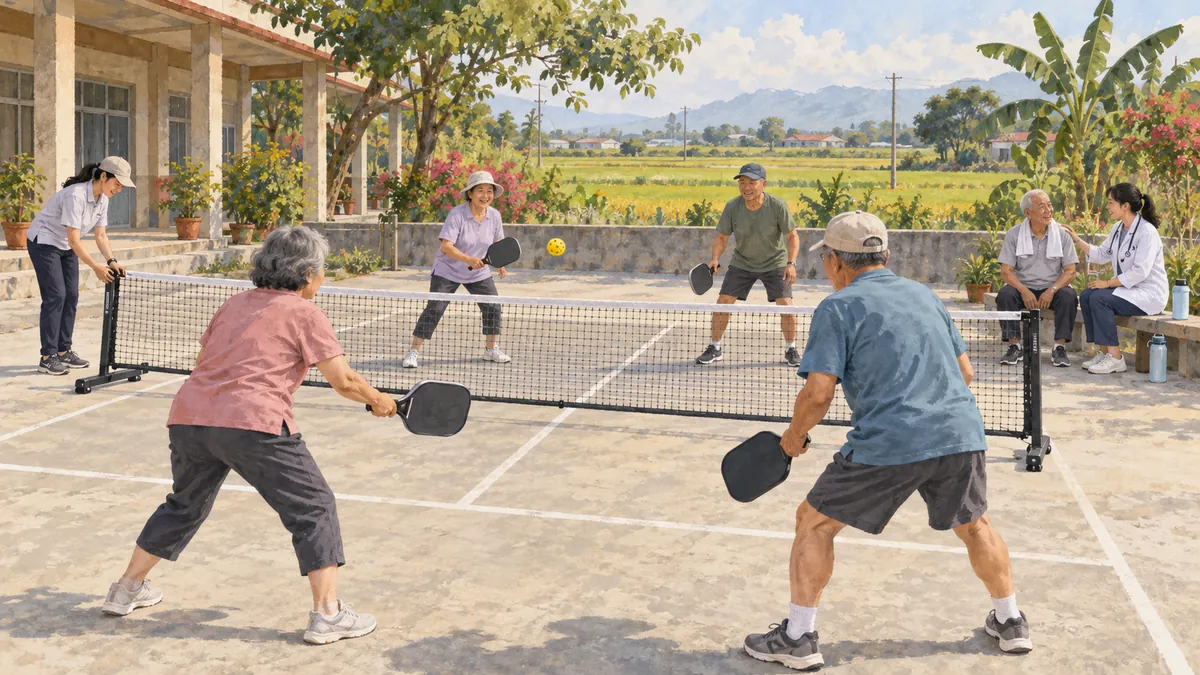
Taiwan's central and local governments have jointly begun an effort to get older people onto pickleball courts. In central Taiwan,Yunlin Countyhosted a Senior Pickleball Health Promotion Carnival that drew about 200 older people, organized by the Sports Administration under the Ministry of Sports and by the National Health Research Institutes, the core of the country's medical research. Rather than a one-off event, pickleball has been positioned as an official preventive measure to extend healthy life expectancy, which reflects the urgency in a Taiwan that entered super-aged society only in 2025. For Japan, which has the world's highest aging rate, this is not someone else's story. It reads as a blueprint for replacing care prevention with exercise people enjoy.
What happened in Yunlin County
The reported details are simple. Senior fitness clubs in Yunlin County and community care centers that serve as bases for home care hosted the event, and about 200 older people picked up paddles. The Sports Administration and the National Health Research Institutes led it, putting the government's sports arm and a medical research institute at the same table. The Sports Administration said it would keep developing sports programs suited to every age group in cooperation with central and local governments and academic institutions.Care preventionis being treated not only as a question of medical costs but as something to dissolve into everyday recreation.
The reason pickleball was chosen is clear too. The court is about a quarter the size of a tennis court, and the light perforated plastic ball and rigid paddle mean less impact on the joints. The rules are easy to learn and the intensity is moderate. Because doubles is the default, conversation comes naturally and people connect while they move. The article described the sport as medicine that does not feel like medicine. Satisfying exercise and social participation at the same time is what makes it a good fit for policy aimed at older people.
Why Taiwan is in a hurry
Behind it is the speed of Taiwan's own aging. At the end of December 2025, people aged 65 and over reached 20.06% of the population, about 4.67 million, crossing the government's definition of a super-aged society. The striking part is how fast the shift came. Taiwan became an aged society, with over 14% aged 65 and up, in 2018, and took only about seven years to reach 20%. Japan needed roughly 13 years to cover the same ground, so Taiwan's aging is running downhill.
The shorter the grace period, the greater the need to act before medical and care costs crush the system. Primary prevention, using exercise habits to delay the move into needing care, is also rational on cost-effectiveness. Taiwan connecting its sports administration with a medical research institute and betting on pickleball looks like the result of a search for something that gets older people moving actively in limited time.
The hard part of exercise policy for older adults is sustaining the motivation to move. Tough training does not last, and the effect disappears once people stop going. Pickleball being doubles-based and conversational is a key to clearing that wall. Losing independence involves not only declining muscle strength but fewer reasons to leave the house and social isolation. Even one session a week of rallying with friends supports both fitness and social contact. Taiwan choosing this sport reads as an assessment of a design that combines staying power with sociability.
Japan and Taiwan in numbers
| Item | Japan | Taiwan |
|---|---|---|
| Aging rate (share aged 65 and over) | 29.3% (as of October 2024) | 20.06% (end of December 2025) |
| Population aged 65 and over | About 36.24 million | About 4.67 million |
| Reached super-aged society (over 20%) | 2007 | 2025 |
| Years from aged society to super-aged society | About 13 years | About 7 years |
Japan's aging rate of 29.3% far exceeds Taiwan's 20.06%, and the scale is on another level. But Taiwan is moving faster. Japan is the country already deep inside it, Taiwan the one chasing hard, and both need preventive measures now. Japan is in a position to watch and test the move Taiwan made first.
How Taiwan and its institutions see it
First, the stance of the Sports Administration. It has stated it will keep developing programs for every age group with central and local governments and academic institutions, positioning this carnival as part of continuing policy rather than a single event. Second, the National Health Research Institutes joining as co-organizer is no small matter. A medical research institute putting its name on an exercise event is itself proof that pickleball has been officially elevated to a means of health promotion. Third, the venues were community care centers and senior fitness clubs, the front line of home care. Because places that deal with older people every day did the receiving, about 200 participants turned up. A top-down call and organizations rooted in the community meshed.
What Japanese local governments can take away
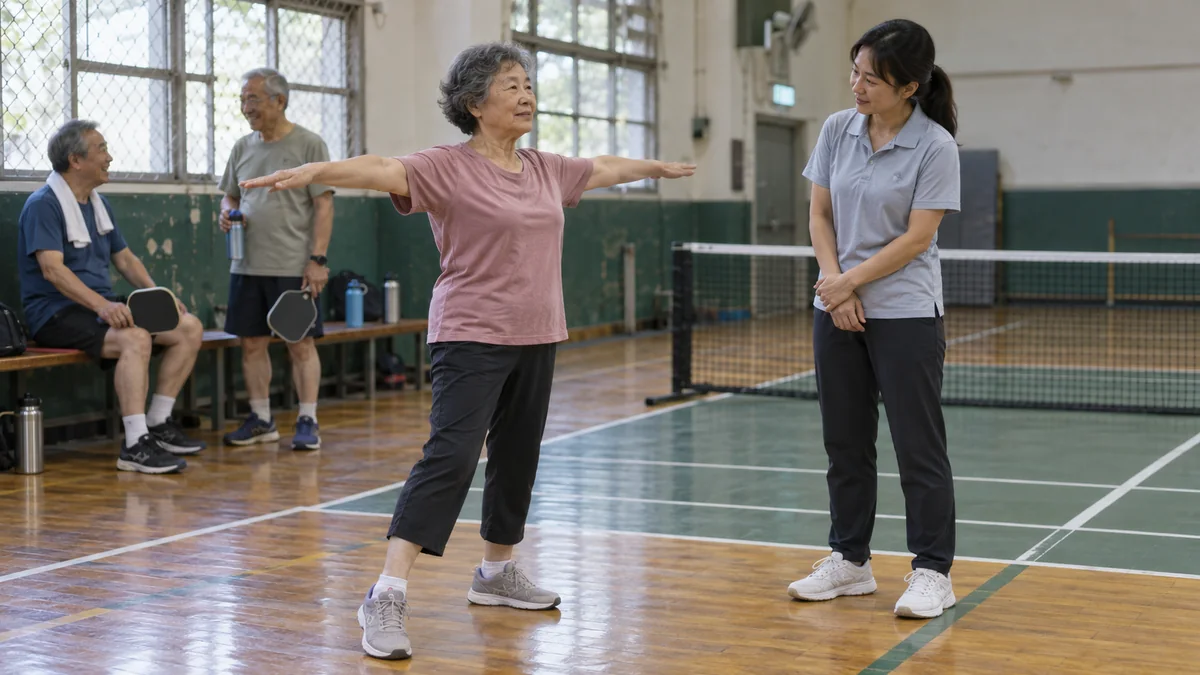
Care prevention in Japan has been built by each municipality around exercise classes and community gathering places. There is ample room to add pickleball. The court is small, so school gyms and community centers convert easily, and the equipment is cheap. The core of the Taiwan model is binding the sports department, the medical side and local care bases into one from the start. If Japan's sports promotion sections and community comprehensive support centers worked on the same budget at the same venue instead of moving separately, the entrance for recruiting participants would widen at a stroke.
There are operational cautions. Expanding to older adults means preparing for falls and heatstroke, setting participation criteria for people with chronic conditions, and arranging transport. Taiwan involving a medical research institute was presumably also about grounding that safety design in science. If a Japanese municipality copies the model, the realistic answer is to work with public health nurses and rehabilitation staff at community comprehensive support centers and station someone to watch over the sessions. Fun as the way in, safety guaranteed behind it, is the condition for growth.
日本国内でも、自治体が公費でコートや体験会を用意する動きは既に始まっている。米国では空き店舗を9面の公共コートに変えた自治体もあり(An empty store becomes nine public courts as a US city builds a pickleball hub with tax money)、日本の三郷市のように体育館で入門講座を全4回組む例も出てきた(Misato runs a four-part pickleball intro at its gymnasium, because growth starts at the door)。こうした「入口」を高齢者向けに最適化し、介護予防の文脈と接続できれば、台湾の公的モデルは日本の自治体施策へそのまま移植しうる。
Ripple Effects on the Industry
公的介護予防にピックルボールが採用される流れは、競技団体や用具メーカーにとって静かな追い風になる。若年層の趣味やプロツアーとは別に、行政予算という安定した需要が生まれるからだ。指導者の役割も変わる。勝敗を教えるコーチではなく、高齢者の体調に配慮しながら安全に体を動かさせる、健康運動指導に近い人材が求められる。シニア専用の大会が世界で増えている潮流(No Tournament for Over-60s Only -- A Former Player Fills a Gap in Wales)とも重なり、「競技」と「健康施策」の二つの市場が並行して育つ可能性がある。
Practical notes for people and municipalities that want to start
For older people trying pickleball, an indoor gymnasium or a room at a care center is enough at first. A badminton court works without a dedicated court, and lowering the net adjusts the load. Non-slip indoor shoes and clothes that move with you are all you need. Anyone worried about exertion can share the court in doubles and keep going comfortably. For municipalities, the realistic design is to slot taster sessions into fitness clubs and gathering places first, then add sessions while listening to participants. A full set of equipment does not cost much, and there are Japanese examples that started with small free tasters.
Summary
Taiwan put pickleball forward as an official means of care prevention right after entering super-aged society. Binding sports administration, medical research and local care bases together and bringing about 200 older people to the courts in Yunlin County is not a passing trend but one example of policy design. For Japan, at the front of the world's aging curve, the idea of keeping care at bay with exercise people continue because they enjoy it is instructive. The question is how Japanese municipalities translate Taiwan's first step into their own words.