On July 11, 2026, the city of Sterling Heights, Michigan (a Detroit suburb in Macomb County), opened the Sterling Heights Athletic Hub, an indoor public sports facility. The centerpiece is nine indoor courts to USA Pickleball specifications plus six table tennis tables. The operator is not a private club but the city itself, funded by a dedicated tax approved at the ballot box. Japan is also starting to see municipalities adapt tennis courts and corners of parks for pickleball; one regional city, for instance,built 25 covered courts with tax money and treated courts as public infrastructure. Sterling Heights shows that same shift toward public infrastructure from a different angle: indoors, and by converting an idle building. Here is what is new about it and what operators in Japan can take from it.
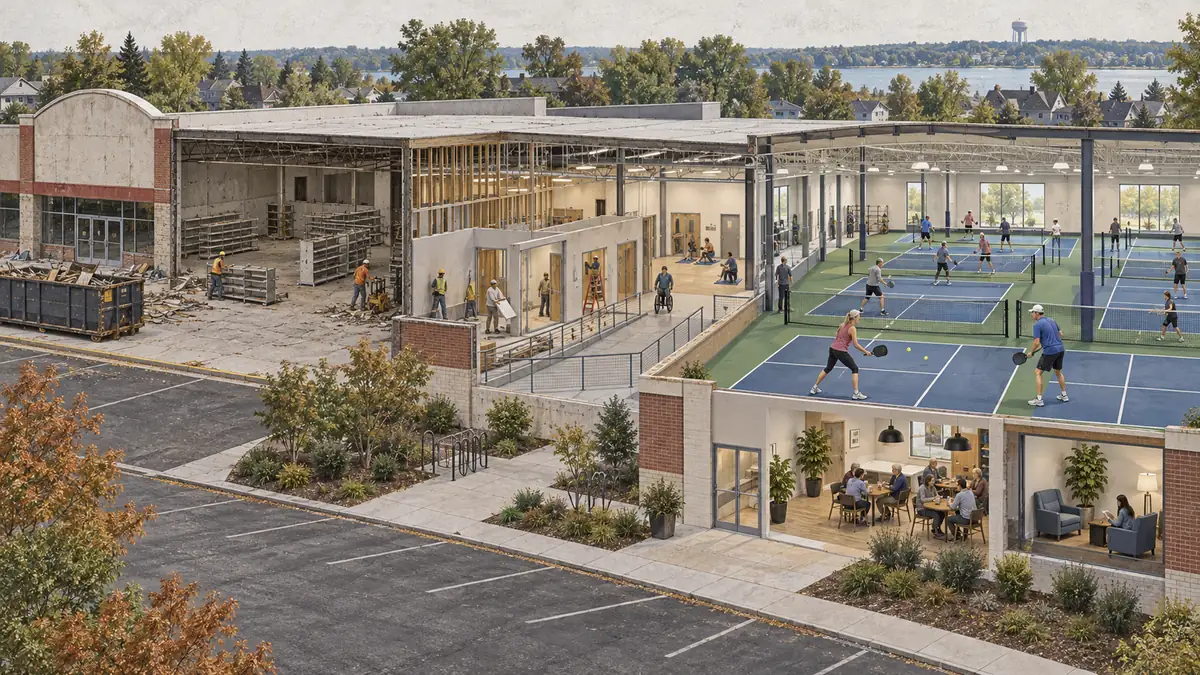
An empty store turned into nine indoor courts
The venue sits at 35630 Van Dyke Avenue, a main road. It was originally an F&M drugstore, and most recently housed a Spirit Halloween pop-up shop. The city bought the vacant unit, gutted the interior and rebuilt it as an indoor sports facility.
Inside, alongside nine pickleball courts and six table tennis tables, are a multipurpose space called the Rally Room for meetings, parties and classes, a cafe, a quiet Reflection Room, a nursing room and lounge seating. The design is said to meet or exceed the 2010 ADA standards, and after an opening ceremony on July 11 public use began on the 13th. What stands out is that it is put together as a community hub where residents can linger, not merely a place to compete.
Funded by a dedicated tax approved at the ballot box, at about 1.5 billion yen
What separates this from a private membership club is where the money comes from. The total project cost is about 10 million dollars (about 1.5 billion yen at 150 yen to the dollar), made up of about 2.5 million dollars (about 375 million yen) to acquire the building and up to 7.5 million dollars (about 1.1 billion yen) for interior and exterior renovation. The funds come from a dedicated tax called Pathway to Play and Preservation, which residents approved in a 2024 ballot measure.
By the city's account, this is the first municipally funded indoor pickleball-only facility in Macomb County and the second in Michigan. Rather than leaving competition courts to the private sector, the decision was to build them with tax money and hold them as a public asset, with residents' consent behind it. That is the backbone of this case. Japan has its own efforts to turn public sites over to the sport, andthe move to rebuild tennis courts in a prefectural park for pickleballis one of them. The funding design differs, but the idea of using public land and buildings to house the sport is converging in Japan and the US.
The Sterling Heights public model in numbers
Here are the pricing and scale figures that only a public facility could set, laid out with verified numbers.
| Item | Details |
|---|---|
| Pickleball courts | Nine indoor courts (USA Pickleball specification) |
| Table tennis tables | 6 |
| Total project cost | About 10 million dollars (about 1.5 billion yen) = 2.5 million dollars to acquire + up to 7.5 million dollars to renovate |
| Funding source | A dedicated tax approved by ballot measure in 2024 |
| Usage fee | Free for residents / 5 dollars a day (about 750 yen) for non-residents |
| Position | The first municipal indoor pickleball facility in Macomb County and the second in Michigan |
The pricing is what stands out. Sterling Heights residents play free, and only users from outside the city pay $5 a day. Returning value in kind to the taxpayers who funded it while charging outsiders the running cost is a line only a public facility can draw. A private club chasing break-even on membership fees is optimizing for something else entirely.
全会一致ではなかった、意思決定の記録
公共投資である以上、意思決定の過程には異論も残りました。開業をめぐる当事者の声を拾うと、次のような状況が見えます。
- Kyle Langlois, Parks and Recreation Director — “This is the only municipally funded dedicated facility in Metro Detroit, or at least in Macomb County.”
- Langlois, before the opening — “Once we open, I think plenty of people will be happy with how it is run. The build and the equipment will be second to none.”
- City Council — in the vote on the construction plan, Council member Henry Yanez cast the only vote against
- Older players — requests for dedicated playing hours had been raised in advance
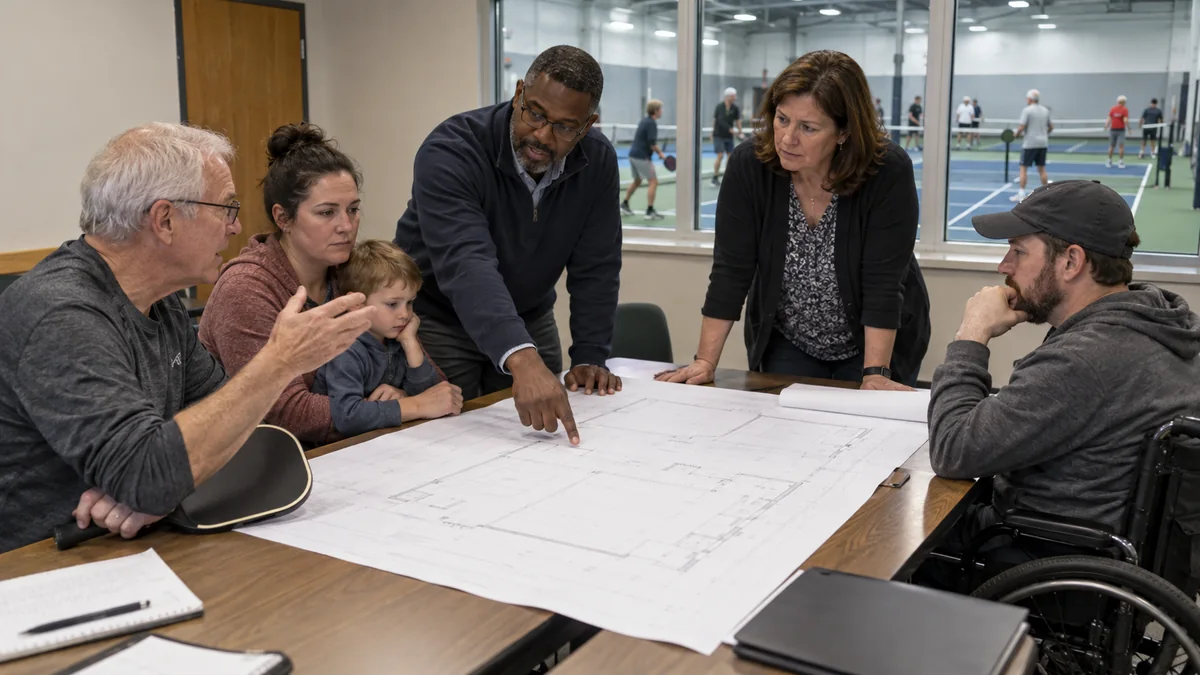
When roughly ¥1.5 billion in tax money goes into a single sports facility, opposition inside the council is only natural. The dissenting vote stayed on the record, concerns about usability for older residents came out in the open, and the project still reached its opening. Transparency in building consensus becomes the facility's legitimacy.
Three takeaways for operators in Japan
This case raises three main points for players and facility operators in Japan.
First,A model for converting idle retail property. Sterling Heights chose not to build new on empty land but to turn a shuttered drugstore and variety store into indoor courts. As long as ceiling height and floor area are there, an empty tenant space works well enough as a shell for courts. For regional cities in Japan struggling with vacant suburban storefronts and abandoned big-box stores, this option costs less and takes less time than new construction. Being under a roof also means play is not at the mercy of the weather and the courts can run year-round, a strength outdoor builds do not have.
Second,A route to funding through resident consent. The money here did not come from the mayor or a single department acting alone; it came from a dedicated tax approved at the ballot box. When Japan builds or converts public sports facilities, accountability for “why this sport, and why this amount” is unavoidable behind the bonds and the grants. Showing player numbers and health benefits in figures, winning residents over, and only then building — that order becomes the base that keeps operations stable later. Sterling Heights kept the record complete, down to the dissenting vote and the concerns of older residents, and that procedure can be copied as it stands.
Third,Free for residents as a payback design. Free for residents and paid for non-residents lets the city return value in kind to taxpayers and capture outside demand at the same time. Splitting fees by whether someone is registered as a resident is not unusual at Japanese public facilities either. A sport with small upfront costs like pickleball fits well with this “free tier open to residents.” There is also a case in Japan where a municipalitybuilt a pickleball venue under the same framework as a skateboard park, and public spaces opened free or at low cost become a device that widens the base of the sport quickly.
Venue basics
| Item | Details |
|---|---|
| Facility Name | Sterling Heights Athletic Hub |
| Location | 35630 Van Dyke Avenue, Sterling Heights, Michigan, USA |
| Operator | City of Sterling Heights (municipally run) |
| Main facilities | 9 pickleball courts, 6 table tennis tables, a rally room, a cafe, a reflection room, and a nursing room |
| Opening | Ceremony on July 11, 2026 / open for play from July 13 |
| Price | Free for residents / $5 a day for non-residents |
Summary — what Japan should watch as the public sector takes the sport on
The Sterling Heights case shows that pickleball is no longer the territory of private clubs alone; it has become a candidate for public infrastructure a municipality carries with tax money. Converting a vacant store, funding through a ballot measure, and returning value through free resident access all transfer to running public facilities in Japan. What domestic operators and municipal staff should check next is, first, whether the ceiling height and floor area of idle buildings near them can take a court; second, whether they can assemble figures on player numbers and health effects to show residents; and third, where to draw the line between resident payback and charging visitors. Rather than copying the answer a suburban American city reached, start by reading it against the conditions of your own town.