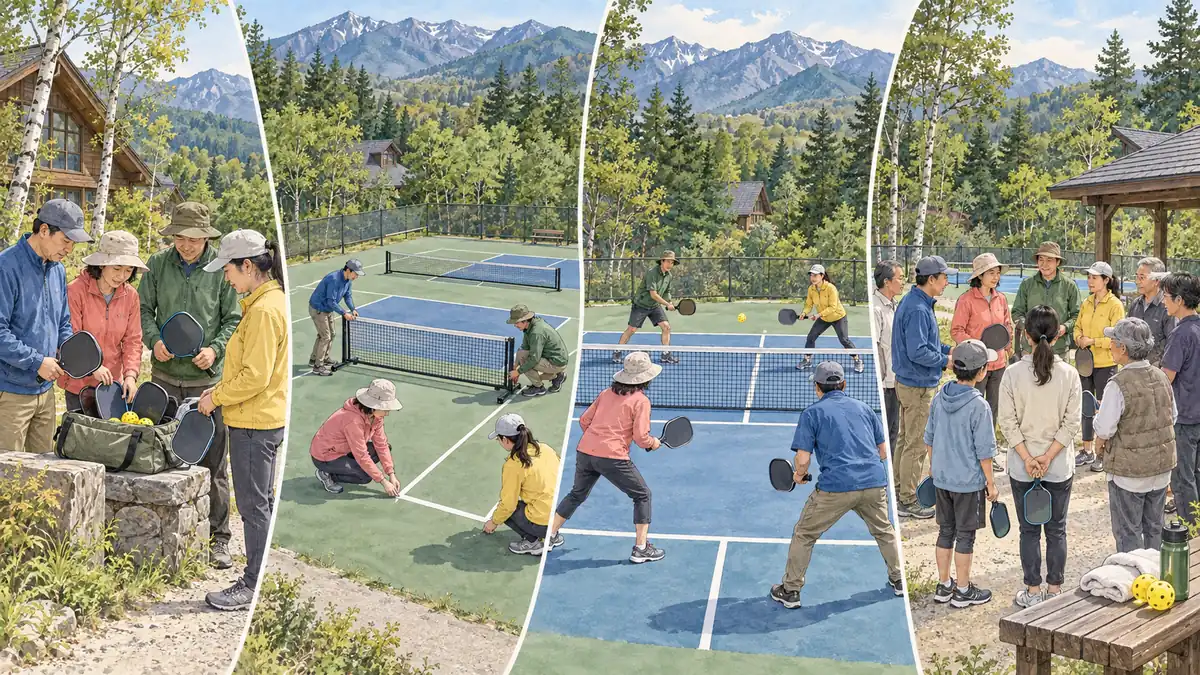
In the villa district of Haramura, Nagano Prefecture, at the foot of the Yatsugatake mountains, a pickleball club has started up. According to a personal blog chronicling the launch, four friends came together, three of whom had never held a paddle. They rented two courts, the post says. There is nothing flashy about it. But this small beginning is typical of the resident-led grassroots clubs quietly multiplying across Japan. In the shadow of headlines about big companies pouring capital into facilities, growth driven by ordinary people is thickening the base of the sport.
The story of PCH, born in a villa district
The club is namedPCH(Pickleball Club Haramura). The name plays on the initials of the Pacific Coast Highway, State Route 1 along the Los Angeles coast, which the founder once looked out over. It transplants a sound suggesting blue sky and sea onto a villa district high in the uplands. This launch record, written on a personal blog, is not an official notice or an association-led project. People who gathered in Haramura to escape the summer heat or to relocate rented two courts as their own place to play and are slowly adding friends. That is all it is.
And yet that is exactly what makes it significant. Pickleball needs little gear, its rules are easy, and you can set your own intensity. The fact that three first-timers could rally from day one speaks louder than anything about how low the barrier to entry is.
Grassroots clubs springing up around the country
Pickleball in Japan is growing in two layers at once. One is the capital layer. Major tennis operators and amusement park companies are building all-weather dedicated facilities and putting the sport at the center of their visitor strategy. The other is the layer of ordinary residents, like Haramura. Municipalities set up free courts that need no booking, or residents rent a corner of a gym or spare space in a villa district, and right-sized communities appear on their own.
競技人口の実体は、大会に出るトップ層ではなく、原村の4人のような「週末に打つ人たち」が支えている。施設が先か、人が先か。日本の場合、人が先に集まり、あとから場所を工面する順番が目立つ。だからこそ、別荘地でもコートは生まれる。
Where urban dedicated facilities compete on membership and utilization, clubs in the provinces and villa districts barely think about the books. Participants show up on their own for exercise and company, and often have no framework of monthly fees or dues at all. It is this layer, hard to capture in statistics, that is actually spreading the base of pickleball in Japan across the map. The small step in Haramura is a miniature of that nationwide current.
Three ways local clubs get started
Lining up cases from around the country, resident-led clubs fall into a few patterns of how they start. Working out where Haramura's PCH fits makes it easier to picture starting one in your own area.
| Type | Getting Started | Securing a venue | Where it fits |
|---|---|---|---|
| Friends-first | A few acquaintances call each other in | Rent an existing court by the hour | Villa and residential districts |
| Municipality-linked | Grows out of a beginner class at a gym | Public facilities and free courts | Suburbs and regional cities |
| Facility-led | A dedicated facility recruits members | Permanent indoor courts | Major metropolitan areas |
Haramura is the first of these, the friends-first type. It needs no capital investment and no organization: paddles, balls and a few companions are enough to get moving. This lightness is the main reason grassroots play spreads in rural areas, villa districts and senior communities.
Why health benefits draw people in
The PCH launch post is colored by hopes about health for older players: more connection with other people, an easier time holding a sensible weight, better sleep and mood. That framing treats pickleball less as a sport of winning and losing than as a habit that lifts the quality of daily life.
Grassroots clubs take root easily in villa districts and areas with many seniors because this health-and-company context works so strongly. For people who have moved in or who stay at a second home, a way to meet neighbors is valuable. Two courts and a few companions are both a place to exercise and a door into a community. As with the grassroots court in the Philippines that a doctor's family opened without any membership system,running it with a low thresholdis what ends up drawing people, a pattern that holds across borders.
How to start one where you live
原村の4人を見て「自分の街でも」と思ったなら、実践の流れは次のとおりだ。既存のテニスコートや体育館の多目的スペースで、時間貸しにピックルボールが使えるかを確認する。ネットはテニス用より低いが、ポータブルネットを持ち込めば済むことも多い。パドルとボール、そしてコート確保の段取りをそろえることが最初の課題になる。
初期費用は一人あたり数千円台から始められる。仲間集めは、別荘地の管理組合、地域のサークル、体育館の利用者など既存のコミュニティを起点にすると早い。自治体が主催するmulti-session beginner coursegrows into a permanent club. There are alsomunicipalities that have set up free courtswhere anyone can play without a booking, and public spaces like these lower the hurdle for a first outing considerably. As in Haramura, it is fine to hit first and expand the venue and the group afterward.
実用的な立ち上げの注意点
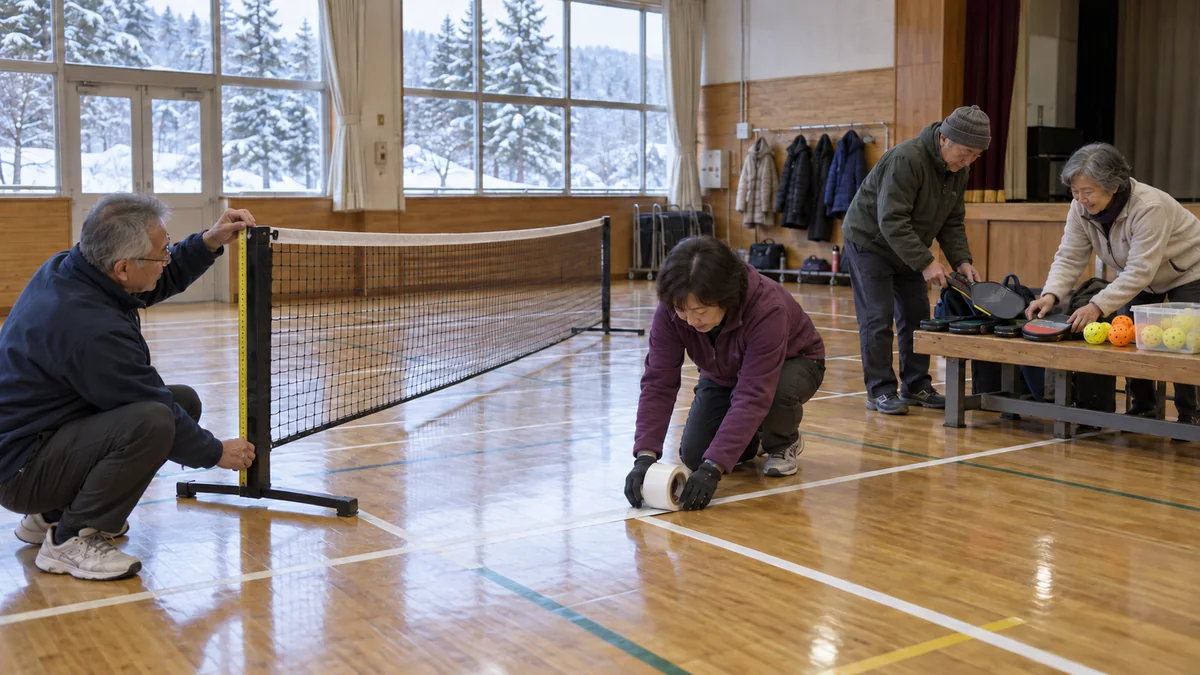
別荘地や地方で仲間内クラブを始める際の実務は単純だが、地域特性で工夫が必要な部分がある。既存テニスコートを使う場合、1面にピックルボールのコートは複数取れるため、少人数なら1面の時間借りで十分回る。ネットの高さや線引きはテープやポータブル設備で対応できる。
標高の高い高原や寒冷地では、屋外シーズンが限られる点も見込んでおきたい。冬場は近隣の体育館を確保できるかが、活動を続けられるかの分かれ目になる。まずは数人で打ち、続けられそうなら管理組合や自治体に常設利用を相談する流れが現実的だ。
草の根の広がりが業界に与える影響
The spread of grassroots clubs is gradually changing the economics of the sport. While dedicated facilities compete for customers in cities, demand for paddles, balls and portable nets spreads across regions and villa districts that have no facilities at all. For manufacturers, that means the market for cheap beginner sets and easily portable gear will start in the provinces.
Coaches and community organizers will also be in short supply. Precisely because it is a sport where beginners can rally from day one, as the three in Haramura did, the role of whoever first explains the rules and etiquette is large. Associations and municipalities setting up beginner classes is also about building somewhere for that grassroots interest to land. Behind the flashy headlines about facility investment, demand for the unglamorous foundation of equipment, coaching and venues is swelling from the ground up.
Summary
PCH, born in the villa district of Haramura, is a small club of just four people and two courts. But that smallness is exactly what reveals the force holding up Japanese pickleball from below. While corporate capital decorates urban facilities, people in the provinces, in villa districts and in senior communities are building their own places to play. People gather first, and the venue is arranged later. As long as that grassroots order holds, the base of the sport will keep widening faster than the number of courts.
Sources
- A pickleball club begins | Fran and Domagk's Silver Life (personal blog)
- Six courts with no membership: grassroots pickleball in the Philippines, opened with a doctor husband | Pickle Times
- Chigasaki's free, no-booking courts, and why a city builds a pickleball base | Pickle Times
- Misato runs a four-session pickleball intro at its gym, because the entrance is what matters | Pickle Times