At a tournament the Australian pro tour held in Melbourne in July, Andi Dikosavljevic swept the three women's events. Singles, women's doubles and mixed doubles: Forbes' Todd Boss, who reported it, wrote that it was “a second triple crown at PPA Australia.” She has won the women's singles at nine of the 15 events the tour has held so far. Japan has just hosted PPA's Asian event in Tachikawa from July 1 to 4, and the question of how long one player can keep winning maps directly onto the design problem facing a domestic tour. Having strong players and having an interesting tour are not the same thing.
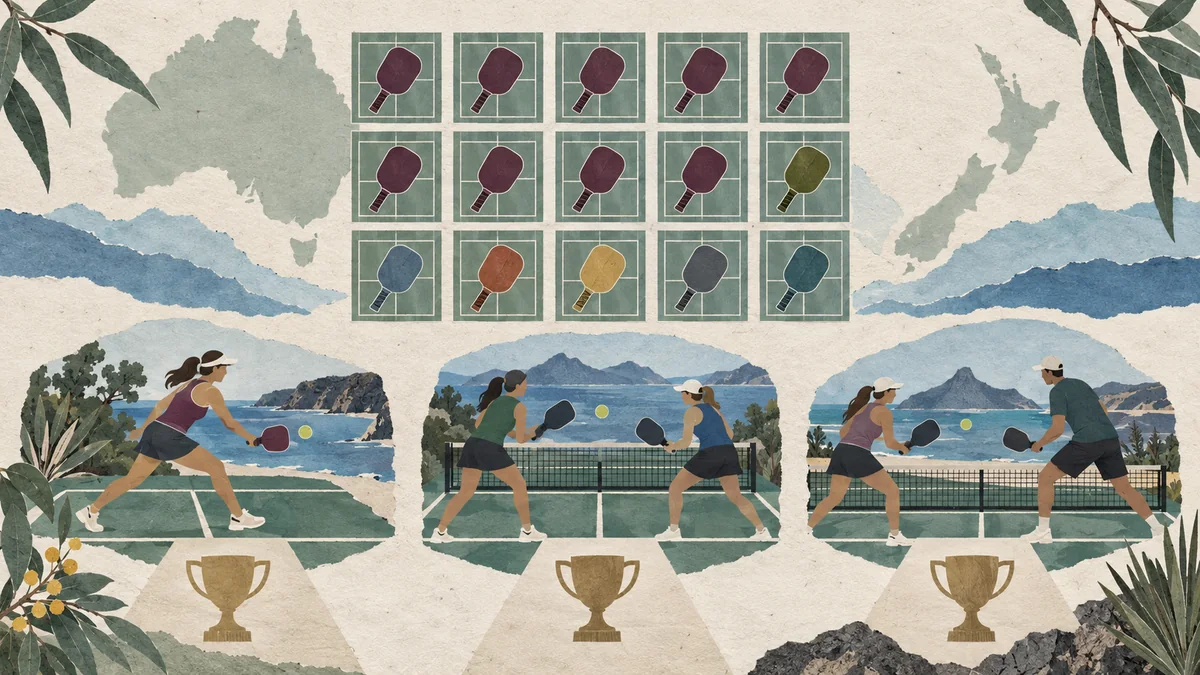
A sweep of the three women's events in Melbourne, a second triple crown on the Australian tour
The event was the fifth stop of the 2026 season. Forbes explains that the field was made up of Australia-based pros who were not on the Major League Pickleball (MLP) schedule. Dikosavljevic beat Mihika Yadav in the women's singles final and, partnering Sarah Burr, took her second title in the women's doubles. She won the mixed doubles with Zachary Grabovic.
In the men's, Harrison Brown beat Sahil Dan in the singles final and, with Lucas Pascoe, put out Mitchell Hargreaves and Grabovic in the doubles. That men's doubles final was the same matchup as the Wellington event in June, showing the same pairs running into each other again and again inside one tour that spans Australia and New Zealand. Brown also took two titles, so one of these two names appears in all five Melbourne events.
How to read nine wins from 15 events
The triple crown itself is only the second on this tour. The first came in May 2026 at a 250-level event in Tweed Heads, New South Wales, where Serena Trulja achieved it, beating second seed Caitlin Hart and top seed Dikosavljevic on her way to a first singles gold.A triple crown has come twice in two and a half months— but that fact does not mean the top of the tour suddenly got deeper in those two months. It shows instead that the number of players who can enter a single event is limited, and that the scale is small enough for a handful of them to enter every discipline.
One player taking the women's singles at nine of 15 events also means somebody else won the other six. Trulja is one of them. The Australian tour sits in the middle of a period of concentration at the top while the players who would break that concentration are coming through at the same time. Read the numbers only pessimistically and you miss that two-layer structure.
Melbourne and the Australian tour's imbalance in numbers
| Item | Details |
|---|---|
| Tournaments | PPA Australia Melbourne (2026 season, stop 5) |
| Women's singles | Andi Dikosavljevic (beat Mihika Yadav in the final) |
| Women’s doubles | Dikosavljevic / Sarah Burr |
| Mixed doubles | Dikosavljevic / Zachary Grabovic |
| Men's singles | Harrison Brown (beat Sahil Dan in the final) |
| Men's Doubles | Brown / Lucas Pascoe (beat Hargreaves / Grabovic in the final) |
| Women's singles, cumulative | Dikosavljevic has won 9 of the 15 PPA Australia events |
| Triple crown record | First: Serena Trulja (May 2026, Tweed Heads) / Second: Dikosavljevic (July 2026, Melbourne) |
Three perspectives on the move
How this result is framed splits clearly depending on who is doing the talking.
Todd Boss, who covers the Australian tour continuously for Forbes, called Melbourne a “burgeoning” tour and treated the triple crown as an achievement while setting Dikosavljevic's nine wins alongside it in the same article. It is a way of writing that keeps praise and structural explanation together.
PPA Tour Australia, which runs the tour, states officially that the 2026-27 calendar will consist of eight or more events across Australia and New Zealand. Events carry grades of PPA125, PPA250 and PPA1500, and the number refers to the ranking points awarded to the winner. Points are managed on a rolling 52 weeks. This is the voice of an organization talking about building the vessel that makes a hierarchy work, not about individual wins.
Sansan, which is putting money into this area in Japan, reported in its own release on the July Tachikawa event that its sponsored player Rika Fujiwara won the women's singles and finished runner-up in the women's doubles with Kyo Sawaki, two podiums. Corporate sponsors have reached the stage of describing their involvement through results, and the same sentence structure as the Australian triple-crown coverage now works in Japanese too.
What Japan can learn from Australia's 15 events before it has to
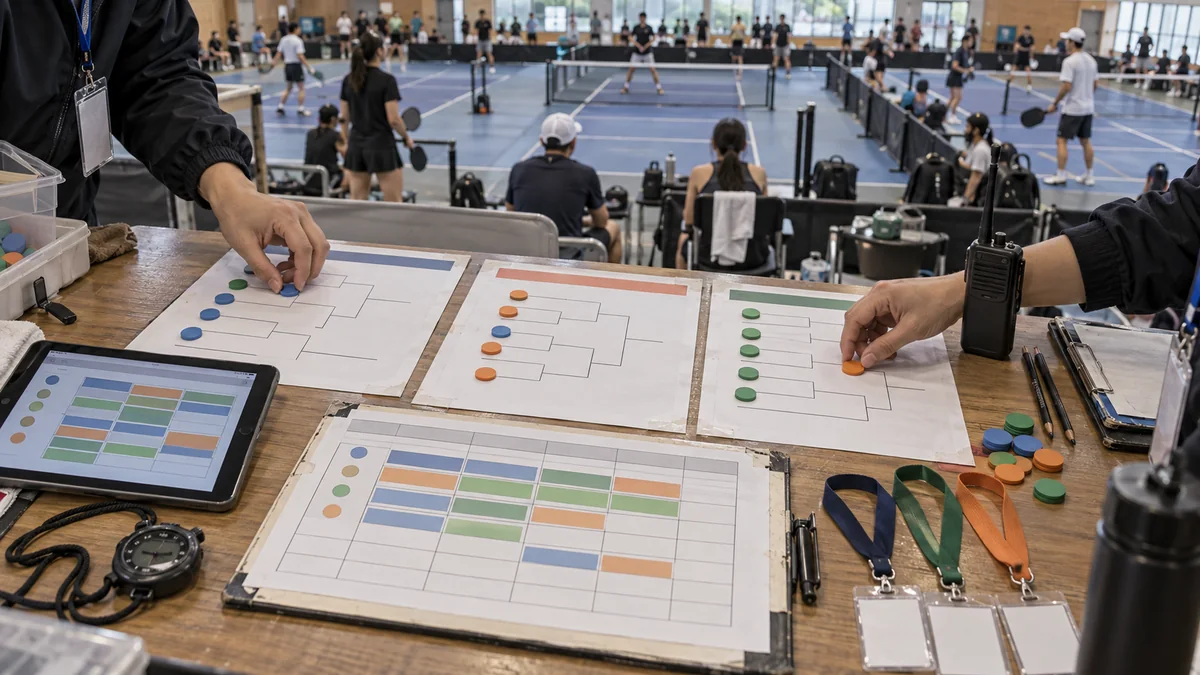
In the survey Pickleball One published in March 2026, Japan has about 330,000 players, 11.89 million people in the interested pool and 13.1% awareness. The potential pool exceeds the playing population by an order of magnitude, and the room for inflow from tennis players has also been pointed out (72.5% of tennis players interested, and the 36x headroom in a 330,000-player market). On the numbers, Japan has a better entrance than Australia.
That is exactly why Australia's 15 events work as material to learn from ahead of time.Concentration at the top is not a weakness of the sport but a by-product of the number of events and the way disciplines are designed— that is the point. With only around eight events a year and one person able to enter three disciplines, whoever can win takes everything. That is not the players' fault. It is a structure organizers create without intending to.
What the July Tachikawa event showed is that Japan has not fallen into this trap yet. Rika Fujiwara took gold by beating Pei Chuan Kao in the women's singles final (Seven straight points from 5-10: 44-year-old Rika Fujiwara storms back for gold at the Pickleball Tokyo Open), but in the women's doubles the Sawaki and Fujiwara pair lost to an overseas pair and finished with silver. The strongest player in the country could not take every title home. That is because players from across Asia came to the same venue, which stings for a Japanese tour in the short term and becomes an asset in the medium term.
At the very top in the United States there is a case of a top pair going 136-1 across three disciplines (136-1 Across Three Doubles Events: Why the Champion Pair Never Cracks). Concentration happens even in deep markets. The difference lies in the cause: whether it is because there is nobody else strong, or because somebody is abnormally strong. The former is hard to sell as a show; the latter sells as a story.
The effect on equipment, facilities and broadcasting
The shape of that concentration spills outside the sport as well. First, sponsorship sales. A tour with a fixed winner becomes, for a company buying exposure, a medium that delivers the same photograph every time. Varying the final matchup is not only a matter of competitive health; it is a matter of inventory variety.
Next, the facility side. An event that produces a triple crown means one player covering several disciplines in a day, which makes court rotation and rest scheduling harder. Even at an 11-court venue, the more the top players double up, the later the finals run. At events with spectators and a broadcast, this hits the quality of the experience directly.
For equipment brands it cuts the other way. In a market where one player keeps winning, that player's paddle easily becomes the de facto standard. The smaller the market, as in Australia, the stronger the effect. Anyone selling equipment in Japan is now at the stage of thinking about contracts with the domestic top players and, at the same time, how to shape paddle choice among the players who have not won yet.
Where to look next
| Item | Details |
|---|---|
| Next event | PPA Australia Gold Coast (August 13-16, 2026, Gold Coast, Queensland, Australia) |
| Tour structure | The 2026-27 calendar has eight or more events in Australia and New Zealand. Rankings run on a rolling 52 weeks (PPA Tour Australia official) |
| Grade | PPA125 / PPA250 / PPA1500. The number is the ranking points awarded to the winner (same source) |
| Tournament format | Four days, Thursday to Sunday. The schedule differs by grade: at a PPA125, Friday is singles, Saturday doubles and Sunday mixed doubles. A PPA250 runs each discipline to the semifinals from Thursday to Saturday and gives Sunday over to the finals as “Championship Sunday” (same source) |
| Japan's most recent international event | PPA ASIA 500 Sansan TOKYO OPEN 2026 Produced by TBS (July 1-4, 2026) |
| Venues | Arena Tachikawa Tachihi / Dome Tachikawa Tachihi (air-conditioned, 11 courts) |
| Prize money and points | $50,000 in prize money, 500 PPA ranking points |
| Results for Japan | Women's singles champion: Rika Fujiwara / Women's doubles runners-up: Rika Fujiwara and Kyo Sawaki |
Enthusiasts who want to follow the Australian tour should watch who takes the women's singles at the Gold Coast in August. Does Dikosavljevic pick up a tenth win, or do Trulja and the chasing pack break her again? That one match is the gauge of whether Australia is coming out of its period of concentration at the top.
Summary
A triple crown is a badge for the player and a thermometer for the tour at the same time. Australia carries nine wins from 15 events, yet it built the vessel first: eight or more events across two countries bound into a single ranking. Japan leads on growth in the playing population, but much of its event count and discipline design is still to be decided.
There are three concrete next moves for facility operators and tournament organizers. One: decide whether to cap how many disciplines a single player may enter, before participant numbers grow. Two: thicken the awards by age group and level so that the set of winners deliberately widens. Three: line up the August Gold Coast dates against domestic events and secure, on the annual calendar, the weeks when Japan's top players can go after international points. Australia's 15 events show in advance what happens when those three are put off.
Source:Forbes/Forbes/PPA Tour Australia/PPA Tour/Sansan/Sansan/PR TIMES (Pickleball One)