7月8日、米ミシガン州の小さな町フェアヘイブンから、ピックルボールの施設ビジネスに新しい選択肢が持ち込まれました。運営会社Pickleball 365が、最小限のスタッフで24時間365日営業できる省人型施設をパッケージ化し、フランチャイズ加盟の募集を開始したのです。アプリで予約し、自動でコートに入り、決済も会員管理も画面の中で完結する——この仕組みを他の起業家に売り渡すという発表でした。日本でも都市部を中心にインドア施設の開業が続いていますが、人件費と長い営業時間、そして稼働率の読みにくさは共通の悩みです。四国ではa 24-hour gym in Matsuyama opened dedicated pickleball courts, so the move toward unstaffed, long-hours operation has already begun in Japan as well. We dig into how far this American “unstaffed plus franchise” model can carry, using the figures disclosed.
Renting out one site's track record as it stands
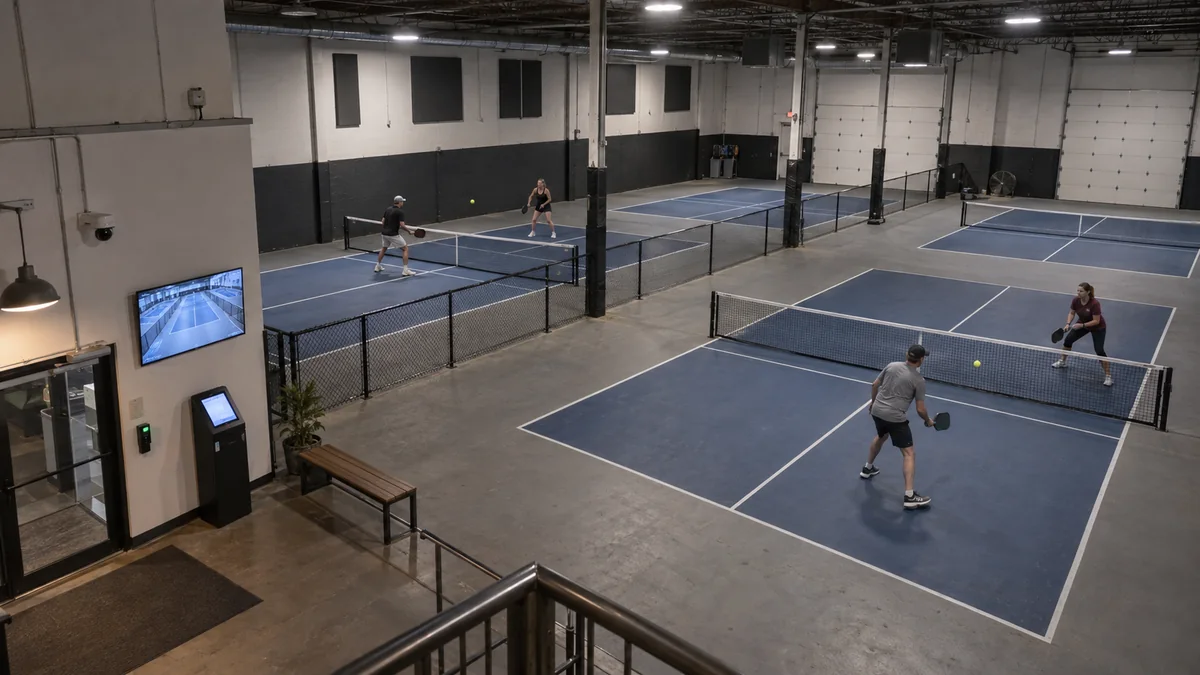
What has been franchised is the model of a single location in Fair Haven that calls itself “Michigan's first fully autonomous pickleball facility.” The operator has standardized the whole system it has run there for 12 months and is looking to replicate it as small sites of three to five courts.
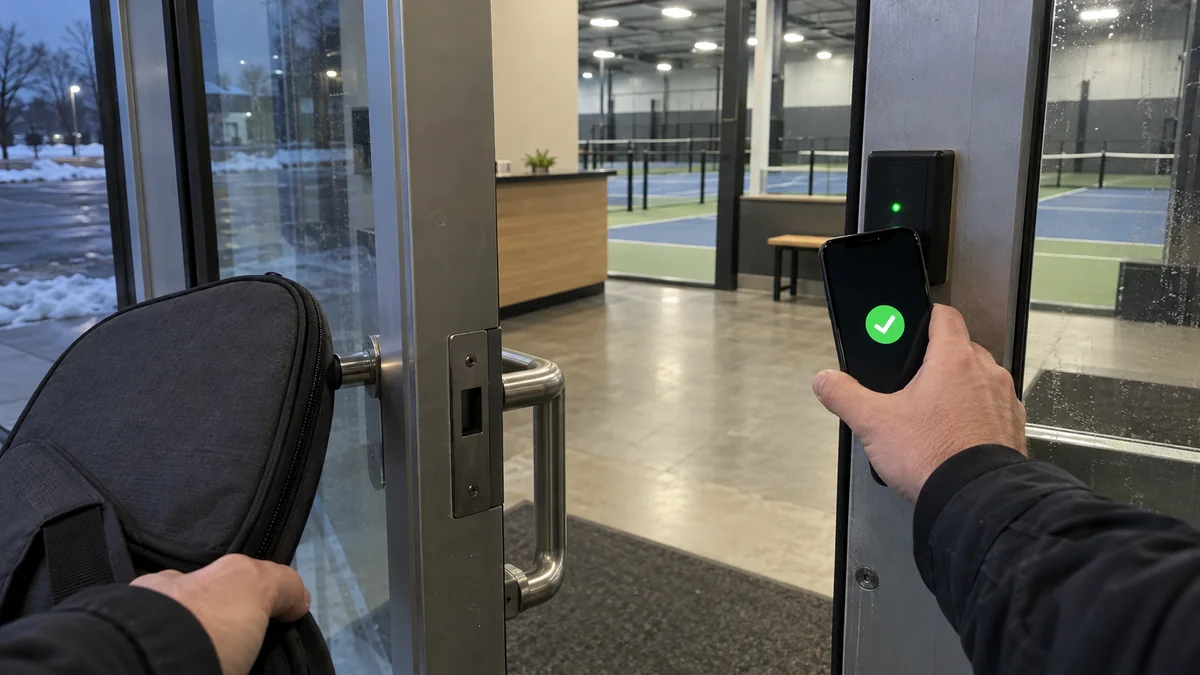
The selling point is thorough reduction of staffing. App booking, automated court entry, integrated payment and membership management, digital scoreboards, instant video replay, league and tournament management tools, and remote monitoring. The idea is to lighten the burdens a conventional indoor sports facility carries — high labor costs, complex operations, limited hours, heavy construction spending, dependence on food and drink — with technology and stacked monthly memberships. CEO Robert Lorinc said, “When Deanna and I opened Pickleball 365, the goal was simple. We just wanted to build the facility players like us actually wanted.”
It ran unstaffed, and utilization is the proof
The operator points to utilization to show that unstaffed operation is not theory. Measured against a 24-hour denominator, average court utilization over the past 12 months was 46%, reaching 57% in the most recent month. At 57%, each court is booked for roughly 13.7 hours a day. More than half of the full 24 hours, overnight included, was in use — turning the supposed weakness of the unstaffed model, empty night hours, into revenue.
Set this lean model against the established large franchises and its outline sharpens. The major North American chains all require upfront investment well over ¥100 million and assume a large dedicated building with staff on site. Pickleball 365 is taking them on head-on with a small box of three to five courts.
| Brands | Total initial investment | Franchise fee | Ongoing fees |
|---|---|---|---|
| The Picklr | About $1.25 million to $2.08 million (about ¥190 million to ¥320 million) | $60,000 (about ¥9.3 million) | 7% royalty plus 3% marketing |
| Pickleball Kingdom | About $870,000 to $2.24 million (about ¥130 million to ¥350 million) | $60,000 (about ¥9.3 million) | Not disclosed |
| Pickleball 365 | Not disclosed (small 3–5 court model) | Not disclosed | Not disclosed |
Note: converted at about ¥155 to the dollar. The figures for The Picklr and Pickleball Kingdom come from each company's 2026 franchise disclosure documents. Pickleball 365 did not publish its investment total or franchise fee in this announcement, so the comparison is kept to the actual figures of the two existing chains set against the “small and lightly staffed” design thinking the company puts forward.
The builders keep repeating: the facility they wanted
Gather the words of those behind the announcement and you see the view of people who have launched a facility business themselves.
- CEO Robert Lorinc — “We wanted to build the facility players like us actually wanted.” He says the frustration he felt as a user was the starting point.
- Co-founder Deanna Lorinc — she says they left no stone unturned on the details of the build, stressing that they designed without compromise.
- The operator's explanation — the target market is “small to mid-sized communities where no good indoor facility exists yet.” The plan is to take the gaps in supply rather than fight in big-city battlegrounds.
Avoiding big cities for small and mid-sized communities suits the unstaffed model. The thinner the population, the heavier labor costs weigh on a staffed site, and simply being open 24 hours becomes a differentiator even where few people live.
Three points for operators in Japan
This move cannot be carried into Japan as it is. Still, for anyone thinking about running courts here, three points deserve examination.
First,Unstaffed operation itself is already proven in Japan. In fitness, RIZAP's chocoZAP has grown to about 1,800 locations nationwide with 1.1 million members on an unstaffed, low-price model, and Anytime Fitness runs more than 1,100 locations in Japan around the clock with minimal staff. Entering and leaving with a single key and running unstaffed through the night already works within Japanese daily life and attitudes to security. The technical and cultural hurdle to putting the same system on pickleball courts should be lower than many operators assume.
Second,Cutting staff pays off through longer opening hours, not through lower prices. A staffed facility has to narrow its hours because of labor costs, but an unstaffed one can sell the early morning and the late night — the only slots working people can reliably free up. How much of Fair Haven's 57% comes from overnight hours has not been published, but since the rate uses 24 hours as the denominator, night-time use appears to be pushing it up. That demand in central Tokyo is genuinely thick shows inthe funding design by which Picklr Toyosu locked in members three months before opening, and adding the value of being open 24 hours on top lifts both revenue per member and utilization.
Third,Going big and going small are separate ways to win. In the United States,investment gathering around 28-court mega-facilities on a different order of scaleis under way as well, but Pickleball 365 took the opposite road: a minimum build of three to five courts that pays back faster. In Japan, where land and construction cost more than in North America and a large floor plate is hard to secure, small and unstaffed may be the more realistic way to open. It is also a message that the door into the facility business in this sport stays open to those without the capital to build something huge.
Pickleball 365 franchise basics
| Item | Details |
|---|---|
| Operator | Pickleball 365 Franchising, LLC (Michigan, USA) |
| Announcement Date | July 8, 2026 |
| Model site | The Fair Haven location (Michigan's first fully autonomous facility) |
| Courts per site | 3 to 5 |
| Hours | 24 hours, open all year |
| Recent utilization | 46% average over 12 months / 57% in the latest month (measured against a 24-hour denominator) |
| Revenue sources | Membership fees, court bookings, leagues, tournaments, lessons, events, sponsorship, merchandise |
| Target market | Small to mid-sized communities without a good indoor facility |
Summary — what to check next
Pickleball 365の発表が示したのは、「省人型で24時間営業する施設は、たった1店の実績でもフランチャイズ商品になる」という一つの答えです。豪華な大型施設だけが競技の受け皿ではなく、省人と小型で回収を早める道が並走し始めました。日本の運営者がここから追うべきは三つです。第一に、同社が今後公表するはずの投資額と加盟条件の実数。第二に、国内の24時間ジムがそうであったように、深夜帯のコート需要が本当に採算に乗るのかという稼働の裏取り。第三に、chocoZAPやエニタイムで実証済みの無人入退館の仕組みを、ピックルボール施設へどう転用するかという具体設計です。まずは自分の商圏で、早朝と深夜に何面が埋まるかを試算してみることが、次の一歩になります。
Sources
- PICKLEBALL 365 LAUNCHES FRANCHISE OPPORTUNITY BACKED BY THEIR PROVEN 24/7 INDOOR PICKLEBALL OPERATING MODEL(PR Newswire)
- Inside Pickleball 365: Michigan’s First Fully Autonomous Facility(Pickleball Innovators)
- The Picklr Franchise FDD, Profits & Costs 2026(Sharpsheets)
- Pickleball Kingdom Franchise FDD, Costs & Fees 2026(Franchise Payback)
- Ranking of 24-hour gym chains by number of locations, 2026 edition (Shuminavi)