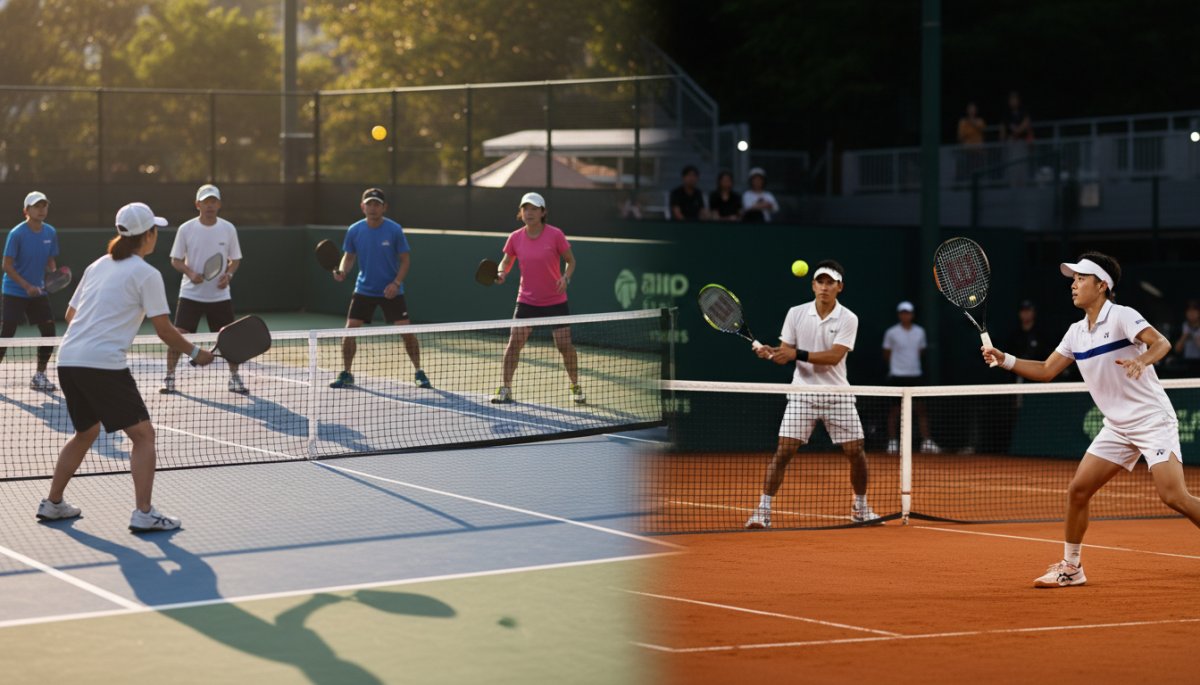
For those curious about the new sport they see on tennis courts. "Pickleball," which spread explosively in America and whose following is growing in Japan too, seems similar to tennis but differs in many points, from court, equipment, and rules to the burden on the body. This article compares the differences between pickleball and tennis from every angle, organizing all at once even down to which is right for you.
Grasp the differences between pickleball and tennis in a list
Before going into the fine explanations, let's cover the differences between the two in a quick-reference table. Reading after grasping the overall picture makes each difference easier to take in.
| Item | Pickleball | Tennis |
|---|---|---|
| Courts | 13.41m×6.10m (nearly the same as badminton) | About 23.77m×8.23m |
| Gear | Paddle (no strings) + perforated ball | Racket (strings) + felt ball |
| Serve | Underhand only | Overhand allowed |
| Scoring | First to 11, only the serving side scores | 15-30-40, set system |
| Time per match | About 15–20 minutes | 1 hour to several hours |
| Burden on the body | Lighter (little movement) | Larger (run over a wide area) |
| Ease of starting | Rallies continue from day one | Months and up to master the basics |
Difference in court size: less than half the area of tennis
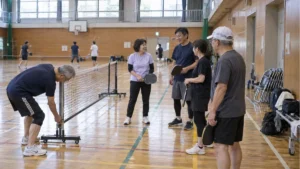
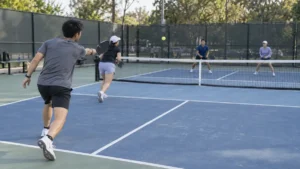
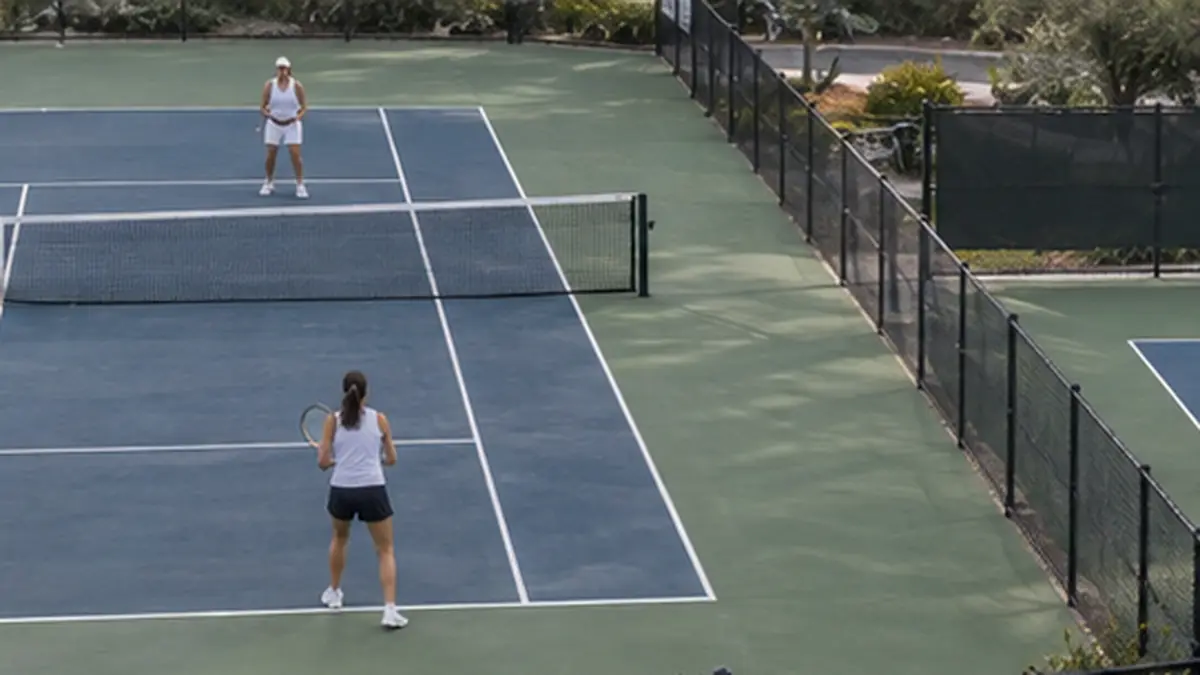
The most eye-catching difference is the court size. A pickleball court is 13.41m×6.10m, nearly the same as a badminton court. It's less than half the area of a tennis singles court (about 23.77m×8.23m). You can set up up to four pickleball courts in one tennis court. For details on the dimensions,the complete guide to court size.
The "strategic depth" a narrow court creates
A narrow court tends to be thought of as just reducing exercise volume, but the reality is the opposite. Since you need to run around less, positioning and shot placement decide the outcome. Because judgment and technique are tested more than fitness, it's not unusual for players in their 60s and 70s to hold their own against younger generations.
Difference in net height
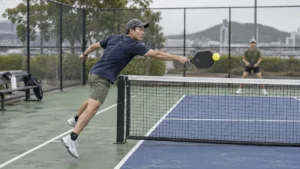
There's a difference in net height too. Tennis is 91.4cm at center, while pickleball is a bit lower at 86.36cm at center (91.44cm at the sides). This difference of a few centimeters affects the battle at the net and the trajectory of shots, creating a distinctive play style.
Difference in equipment: the characteristics of the paddle, racket, and ball
The difference in equipment defines the character of the two sports. The way you hit and the source of power differ fundamentally.
The structure of the paddle and racket
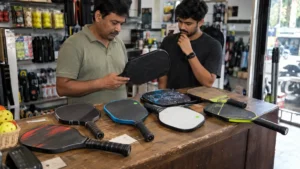
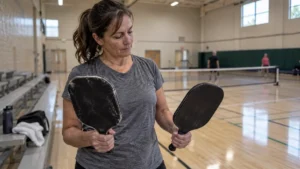
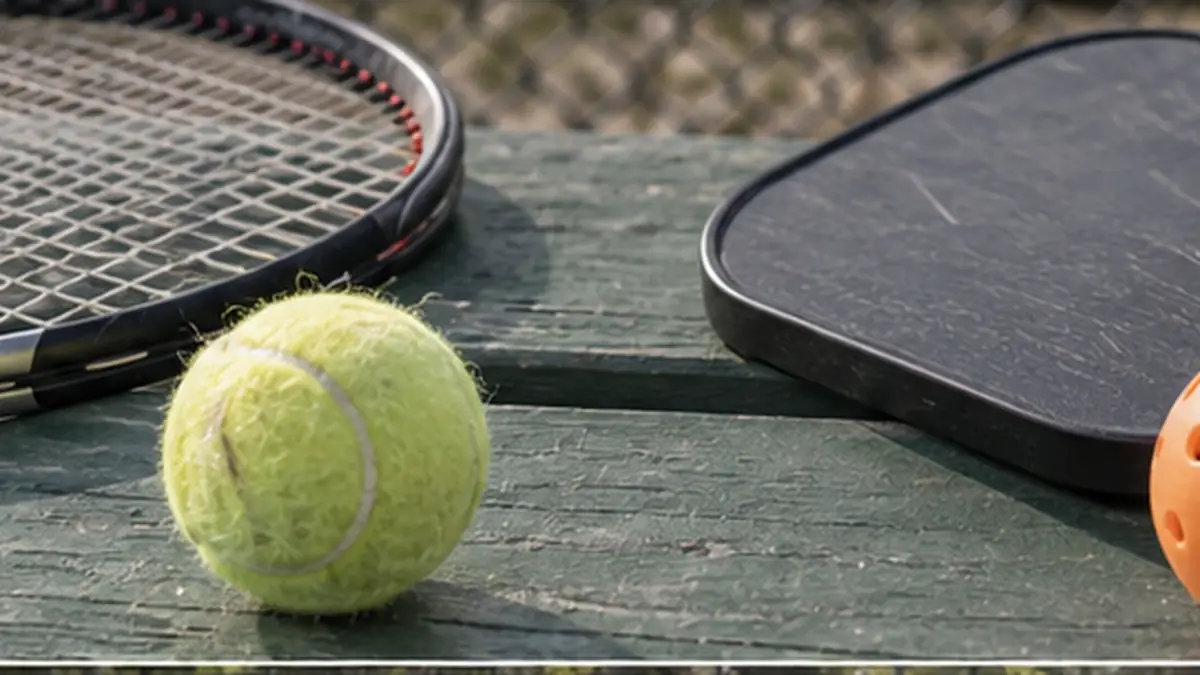
A tennis racket has a structure with strings strung, producing power and spin by flexing on contact. What you use in pickleball is a board-like "paddle" with no strings, hitting the ball with a flat face. At around 170–250g in weight, it's lighter than a tennis racket (about 280–340g). The material uses carbon or fiberglass, and the core uses polymer honeycomb and the like. For details on choosing a paddle,the complete paddle-choosing guide.
Difference in the ball (felt vs. perforated plastic)
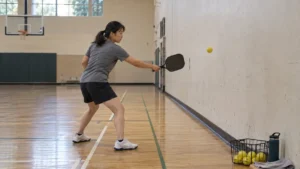
A tennis ball has a structure of air-filled rubber wrapped in felt and bounces high and fast. A pickleball ball is plastic, about 7.5cm in diameter, with 26–40 holes. Since it bounces neither fast nor high, rallies continue easily and even beginners can enjoy hitting right away. There are indoor and outdoor versions; the outdoor version tends to have smaller and more numerous holes (around 40) and be harder, while the indoor version has larger and fewer holes (around 26) and is somewhat lighter.
Difference in rules: the distinctive "kitchen" and scoring system
Pickleball has unique rules not found in tennis. Knowing these differences reveals that it's a more strategic competition than it looks.
Non-volley zone (kitchen)
The biggest feature is the "non-volley zone (kitchen)" 2.13m in front of the net. Within this area, no-bounce volleys are prohibited. After one bounce, you can step in and hit. Because of this rule, tactics of rushing the net with hard hits to put it away don't work, and the delicate shot of dropping it low and soft at the opponent's feet becomes important,dinkwhich becomes important. For details on faults,Explanation of the fault rulesplease refer to.
The underhand serve and double-bounce rule
The serve is basically underhand, catching the ball below the waist, and you can't do a high-speed overhand serve like in tennis. Furthermore, there's the "double-bounce rule," where after the serve both receiver and server need to let it bounce once before hitting. Only after these two bounces is the volley unlocked, so the one-sided advantage of serve-and-volley is suppressed and rallies continue for a long time.
Difference in the scoring system
Tennis uses the 15-30-40 counting method with a set system, and a match can run for several hours if long. Pickleball is a simple additive system of first to 11 (win by a 2-point margin), and only the side with serving rights can score. Since one match ends in about 15–20 minutes, you can enjoy several matches back to back.GlossaryCovering the basic terms here speeds up your understanding.
Source Japan Pickleball Association (general incorporated association), "Official Rules"Created from
Exercise intensity and burden on the body
The level of physical demand differs greatly between the two. Tennis, with all-out strokes and wide-ranging footwork, is highly draining, with a corresponding burden on the knees and shoulders. Pickleball, with its narrow court and short travel distance, has a light burden on the joints and, characteristically, doesn't tire you easily even after long play.
In America it's especially popular among those 50 and over and has taken root as an exercise and social program for seniors. That said, it isn't a simple competition; the battle of technique and brains, such as the exchange in front of the kitchen and drop shots, is if anything dense. Those with knee concerns can be reassured by also checkingThe explanation of form to avoid hurting your kneestogether.
Difference in learning difficulty: ease of starting and depth
Both are deep competitions, but there's a clear difference in the height of the entry point. Tennis takes time to master the basic form of strokes, and the reality is that rallies don't continue easily between beginners. It's said to require 1–2 years of continuation to reach an intermediate level.
Pickleball, with an easy-to-handle paddle and a slow ball, lets you enjoy rallies from day one. On the other hand, there are many techniques to master, such as the dink,the third shot drop,and positioning, and advanced players' matches become high-level strategic battles. The ideal balance of "easy to start, hard to master" is the reason it's supported by a wide range of people.
Why tennis players get hooked on pickleball
Former tennis and soft-tennis players are moving to pickleball one after another. Behind this are how easy it is to keep up and how gentle it is on the body.
Easy to keep up, short in time and low in cost
One match is short, so even busy working people can enjoy it in spare time. The equipment doesn't break easily and the economic burden is small, and with indoor courts you're not swayed by the weather either. Since rallies continue, conversation and laughter increase, and a doubles-centered "enjoy together" culture has taken root.
Gentle on the body, easy to make a lifelong sport
There are many voices saying that people who left tennis after hurting their knees or Achilles tendons were able to keep going with pickleball. The small burden on the joints and its ease of continuing even as you age make it ideal as a lifelong sport.
Source Play Pickleball Japan "What is it that gets tennis and soft-tennis players hooked on pickleball?"Created from
Things to watch out for when switching from tennis
The more tennis experience you have, the more your "tennis feel" gets in the way at first. Knowing the differences in advance makes your improvement much faster.
Keep the swing small, carry it with the face
Keeping tennis's big swing leads to repeated overs and outs. The paddle is basically about the sense of pushing out with the face, and the dink especially is more the image of "placing" than "hitting." Using your wrist and elbow compactly keeps it consistent.
Get used to the underhand serve and the kitchen
Since you can't use a high-speed overhand serve, drop the idea of putting it away all at once with the serve. Getting into your body the rule that you can't dive into the kitchen in front of the net, and getting used to the timing of waiting for one bounce, is the first hurdle after switching.

Editor's Note
Tennis players tend to enter from a state of "having power but making many mistakes." For the first few times, hold back your strength and prioritize control. Once you get used to the underhand serve and the timing of the kitchen in 1–2 weeks, your experience suddenly turns into a weapon.
Popularity trends worldwide
Pickleball is spreading rapidly around the world. In America, the playing population has expanded about fivefold in the past five years, and it's reported that about 24.3 million people played in 2025 (per SFIA). It's been chosen as the fastest-growing sport in the US for four straight years, and multiple pro tours have been established.
Its spread in Asia is also remarkable, and in Vietnam it developed into a nationwide sport within a few years. In Japan too, the following is growing thanks to the advantage of being able to make use of existing tennis and badminton courts. Being able to enjoy it with family and friends is also boosting its spread.
How to make use of a tennis court to start pickleball
One reason pickleball spread this far is that you can use existing tennis courts and badminton courts as-is. Even without a dedicated facility nearby, with a little contrivance you can start today.
You can lay out up to 4 courts in one tennis court
Within one tennis court, you can take up to four pickleball courts. At many facilities, you overlay pickleball lines with tape or simple lines on top of the tennis lines, place a portable net, and play. You can also repurpose the tennis net by lowering it, but matching it to the regulation 86.36cm gets you closer to the true feel.
You can start with minimal equipment
All you need is three things: paddle, ball, and net. A ball is a few hundred yen each, and there are affordable portable nets too, so the initial cost is on the lower side compared to tennis. As long as you're mindful of using different balls indoors and outdoors, it takes shape right away for recreation among friends. Even in areas where securing a court is difficult, enthusiasts who use private-rental gym slots are increasing.
A guide to exercise volume and calorie burn
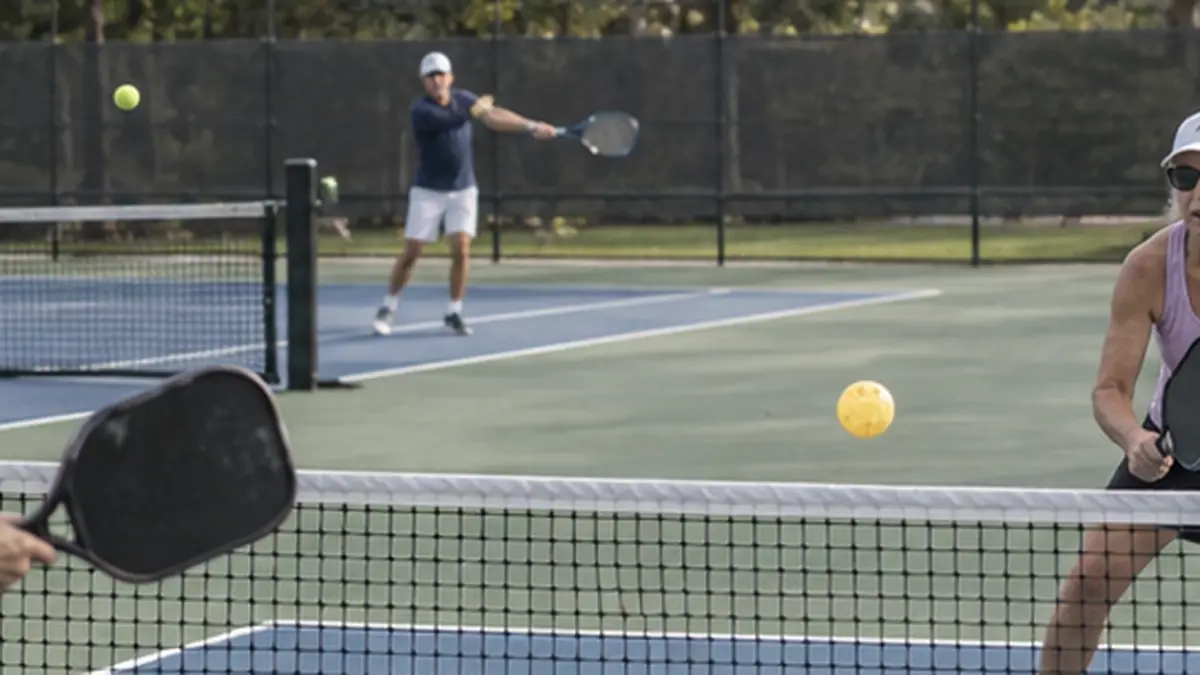
"Narrow court = not exercise" tends to be thought, but since stopping and changing-direction movements continue, you use your whole body more than it looks. Calorie burn for one hour of play depends on intensity but is said to be between walking and light jogging, and there are plenty of moments where you get winded even in doubles. In addition to stimulating the cardiopulmonary function and lower body, you also use your head for shot judgment, so a distinctive strength is that it easily combines exercise and a change of pace. Since there isn't the large draining of tennis, it stays at an intensity easy to keep up many times a week.
Which is right for you? How to choose by type
Finally, let's organize which suits you by purpose and lifestyle. Trying both and choosing is ideal, but use this as a guide when in doubt.
| This kind of person | Suits | Reason |
|---|---|---|
| Want to keep exercising moderately for a long time | Pickleball | Gentle on the joints, enjoyable in a short time |
| Want to run hard and break a sweat | Tennis | High exercise volume and refreshing |
| Want to enjoy hitting from day one | Pickleball | Rallies continue easily |
| Want to socialize lively with companions | Pickleball | Conversation increases with the doubles culture |
| Have concerns about the knees or shoulders | Pickleball | Small burden, easy to restart |
FAQ
Which is easier, pickleball or tennis?
Pickleball is ahead on ease of starting. Since the paddle is easy to handle and the ball is slow, you can enjoy rallies from day one. However, mastering it requires strategy and delicate touch, and there's plenty of depth in both competitions.
Can I play pickleball on a tennis court?
You can. Drawing lines with tape on top of the tennis lines and placing a portable net makes play possible. You can set up up to four pickleball courts in one tennis court.
Does tennis experience help in pickleball?
It helps. However, you need to make your swing smaller and get used to the underhand serve and the kitchen (non-volley zone) rule. Holding back your power at first and prioritizing control turns your experience into a weapon all at once.
Does pickleball have less exercise volume than tennis?
Your travel distance is on the smaller side, but since stopping and changing-direction movements continue, you use your whole body more than it looks. Characteristically, the burden on the joints is light, and it stays at an intensity easy to keep up for a long time.
How is a pickleball ball different from a tennis ball?
A pickleball ball is plastic, about 7.5cm in diameter, with 26–40 holes. Since it bounces slower and lower than a felt-wrapped tennis ball, rallies continue easily.
Summary: Find the racket sport that suits you
Pickleball and tennis are both attractive sports, but their characters differ greatly. Tennis's appeal is the refreshing feel and depth of hitting powerfully on a wide court. Pickleball's strength is enjoying strategic placement on a compact court and its inclusiveness that lets you participate regardless of age or fitness.
For those who have retired from tennis or are concerned about lack of exercise, pickleball is precisely an easy-to-start option. For those curious about the difference from badminton,The comparison article with badmintonis also for you. First experience it at a nearby facility and find the racket sport that suits you.
Related Articles Worth Reading
- A Thorough Comparison of Pickleball and Badminton | Rules, Court and Gear
- Pickleball Glossary | 50 Essential Terms Worth Knowing
- A complete guide to pickleball court size | Regulation dimensions and setup tips
- What are the pickleball foul rules that beginners tend to stumble on?
- Pickleball dink mastery guide | Basic technique and tactical points
Related Articles