AI-assisted officiating and match data analysis are coming to pickleball tournaments in Vietnam. Stupa Sports, a sports technology company, announced a partnership with Ho Chi Minh City-based D-Joy Pickleball to supply AI officiating (VAR), real-time match analytics and broadcast 3D graphics to the tournaments the club runs. It starts with a September tour stop and carries through to a large event in November. Machines are taking on not only what happens on court but the operations and presentation around it, which makes this a picture of where the work may sit a few years from now for Japanese readers who run facilities or host tournaments.
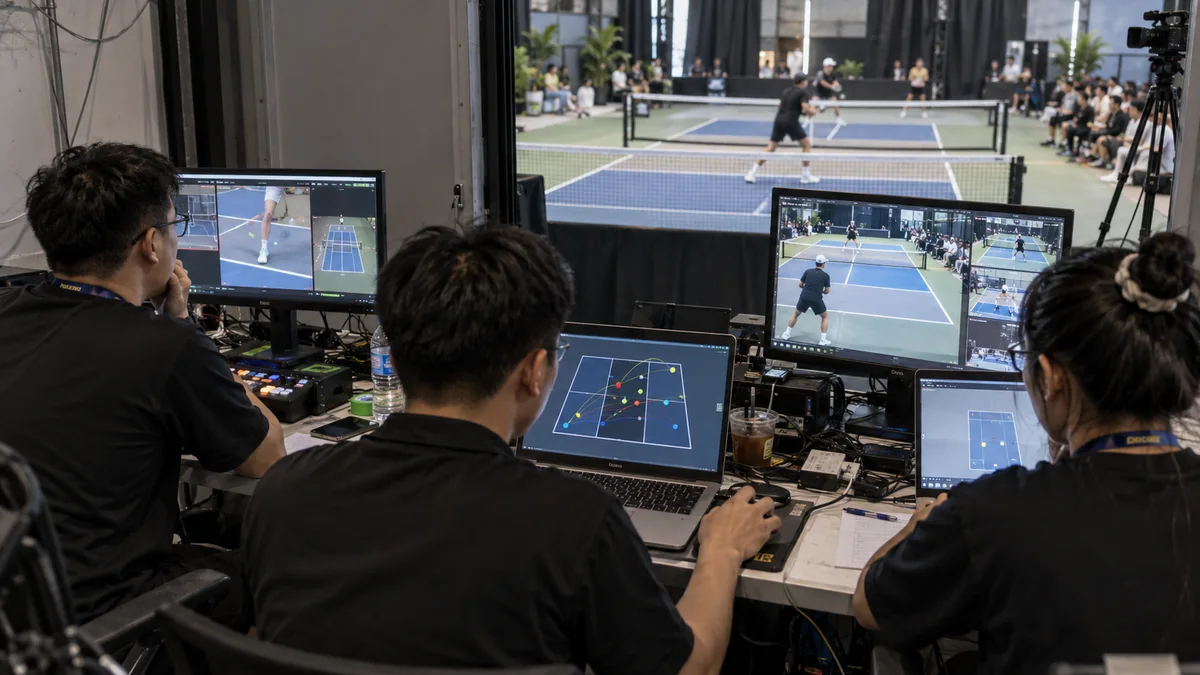
What Stupa brings to D-Joy's tournaments
The announcement lists three main pieces: AI officiating and VAR to support calls, match analytics that turn play into numbers, and a system that feeds broadcast 3D graphics linked to the match data. Rather than taking over the stream outright, its distinguishing feature is tying officiating, analysis and broadcast material into one system. Stupa describes itself as an AI-centered sports technology platform, and here it has brought that full set onto the pickleball court.
What the AI officiating and VAR actually call
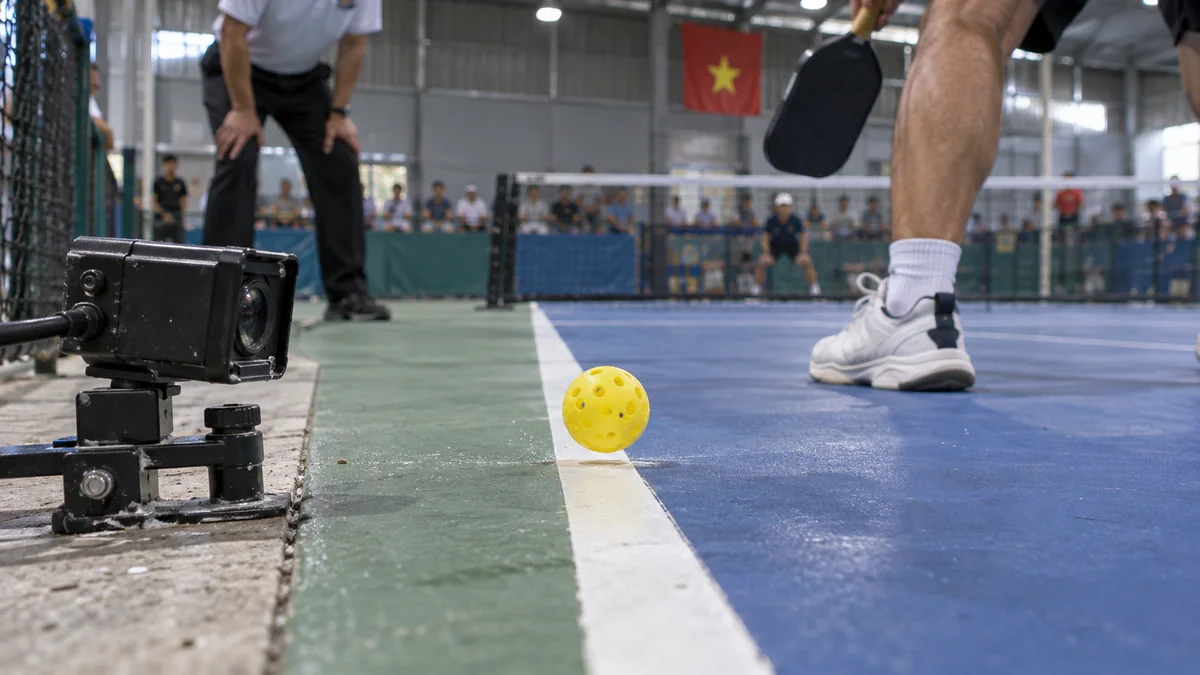
On the officiating side, the centerpiece is VAR supporting line calls and decisions about how the match proceeds. The thinking is close to the automated line calling already established in tennis and badminton: verifying whether a tight ball was in or out using video and data. A pickleball court is small, and one or two centimeters at the edge of the kitchen (non-volley zone) or the baseline often decides the match. If machines can cover exchanges too fast for the eye alone, less time is lost to matches stopping for protests. As a way of supplementing a short supply of officials, this reads as starting where the effect lands most easily.
What the match data tracks
The analytics platform is said to record serves and returns, how rallies are built, accuracy shot by shot, the pattern of errors, how points are distributed and winning patterns. The point is not only to cut highlights. For players it gives a numerical record of how their game falls apart; for organizers it supplies the raw material for the story a broadcast tells. With data in hand, not just who won but why becomes visible, and viewers understand more of what they are watching.The DUPR and Courtly partnership in India, which built a setup where a single match logged in an app feeds straight into an official rating, aimed at rating players; Stupa's move here leans toward running tournaments and presenting them. Two efforts putting data to different uses have started running side by side in the same region.
Why Vietnam, and why now
There is a reason the partnership is set in Vietnam, and in Ho Chi Minh City specifically. Over the past year or two, the number of players and courts there has grown fast, turning it into a market with dense activity in equipment, tournaments and broadcasting. A Vietnamese paddle brand's second-generation model,the Wika QD V2 shown in Hanoi, is one sign that equipment making is localizing too. Players grow, equipment develops, and what comes next in that order is the quality of tournament operations, which is where technology finds room.
The tour and the Masters become the proving ground
提携が最初に適用される大会は、D-Joy Pickleball Tourの第3戦(Leg 3、会期9月9〜13日)。そして11月24〜29日のD-Joy Vietnam Masters 2026へ引き継がれる。短い間隔で規模の違う二つの大会を続けて回すことで、ツアー戦で運用を詰め、旗艦大会で仕上げる段取りに見える。両社はMOU(基本合意書)を結び、関係を2027年まで延ばすとしており、単発のデモではなく複数大会での継続運用を前提にしている。
Why Stupa is targeting Southeast Asia
ストゥーパの共同創業者兼CEOは発表の中で、ピックルボールが世界的な競技として速く進化しており、審判・分析・観戦体験のあり方を形づくるうえで技術が重要な役割を果たすという趣旨を述べている。D-Joyのトーナメントディレクター、ホアン・ハイ・トゥイ氏はこの提携をクラブにとっての「重要な節目」と位置づけた。台湾がプロリーグAEPL has been launched, and across Asia the professionalization and commercialization of pickleball are advancing at once. Building a track record in operations technology early makes it easier to hold a favorable position once the region becomes a real market. Vietnam looks like one foothold for that.
What changes for Japanese organizers and players
From here, consider it against conditions in Japan. Playing numbers are rising, and lining up enough officials to match the number of tournaments is not easy. Regional events sometimes rely on players calling their own lines or taking turns in the chair, and arguments over tight calls become a burden on the organizers. The VAR operation running ahead in Vietnam is worth watching as an early case of whether machines can fill that shortage.
How far machines can cover the shortage of officials
In practice, AI officiating does not replace every call. Machines are good at the parts with a black-and-white answer, such as whether a ball at the line was in or out. Hindrance, recounting the score and rulings on conduct still need human judgment. What Japanese organizers can take from this is not a plan to automate everything but a division of labor: hand the contested one or two centimeters to the machine and put people on match flow and dealing with players. Someone is still needed to confirm the machine's call, so this does not automatically mean fewer staff. Even so, freeing officials from the push and pull over calls makes it easier to keep a match moving with limited people.
How streaming and data move attendance and revenue
The other implication is that streaming and data are starting to connect directly to attendance and revenue. Footage with 3D graphics makes it easier for a tournament to work as streaming content even on a weekday with few spectators. When shot accuracy and rally construction come out as numbers, there is more to show a sponsor and more of a story to tell viewers. For Japanese facility operators, it opens a path to layering streaming advertising, data licensing and paid viewing on top of hourly court rental income. Operators who have thought about recouping capital investment purely through court fees are at the point where the frame needs widening.
Where deployments trip up
Expectations aside, these systems do not run simply because you install them. They work only once camera positions and counts, network conditions and the operating rules for whoever finalizes a call are all in place. VAR that stops at “the machine ruled” will actually stall the match unless it is settled who reviews the footage, when, and how the result is communicated to players. Data too has no value merely collected; someone has to translate it into a form that reaches players and spectators. The two Vietnamese tournaments will be where that operational design gets worked out on site. Anyone weighing a similar setup in Japan is better off drawing up a division-of-labor chart between people and machines before comparing equipment specs. On top of that, consent and rights, meaning how far player footage and data may be recorded and published, should be turned into rules early.
Confirmed tournament dates and partnership facts
現時点で公表され、確認できた範囲の事実を整理する。
| Item | Details |
|---|---|
| The two partners | Stupa Sports × D-Joy Pickleball |
| D-Joy's base | Ho Chi Minh City, Vietnam |
| Technology deployed | AI officiating (VAR) / match data analytics / broadcast footage with 3D graphics |
| First tournament covered | D-Joy Pickleball Tour Leg 3 (September 9-13, 2026) |
| Next event | D-Joy Vietnam Masters 2026 (November 24-29, 2026) |
| Contract type | MOU (memorandum of understanding) / relationship extended to 2027 |
Figures not listed here, such as deployment cost, the number of courts covered and spectator numbers, could not be confirmed in the announcement, so this article leaves them out. Read it on the assumption that more will be added as follow-up reports appear.
Summary, and the next step for Japanese organizers
The Stupa and D-Joy partnership shows pickleball moving from a stage of showcasing good play to one of designing operations and the spectator experience. Competition over tournament operations technology has already started in Asia, and the two Vietnamese events are its trial run. How well time spent on calls, the number of disputes and streaming viewership can be demonstrated will become the basis for choosing where the technology goes next. What Japanese tournament hosts and facility operators can do right now is write out, for the next event they run, which calls tend to cause arguments and which numbers they would want to show on a stream. Splitting the calls to hand to a machine and the match flow people will handle onto a single sheet of paper, before shopping for equipment, is the foundation for bringing the technology in when the time comes.