Pickleball Kingdom, the indoor pickleball chain out of the United States, has opened its first club outside the country, in Gurugram, India. The official announcement is dated July 22, 2026 and describes eight indoor courts, two of them designated "King Court" and built with spectators in mind. Running the site is not the brand itself but BAQ Wizards, a local venture led by three people. With US-style indoor clubs now starting to move in Japan as well, reading this first club through the question of whose capital built it, and how quickly, feeds straight back into facility building at home.
Pinning down the date: a source article with no fixed date, and the July 22 announcement
起点になったPickleball News Asiaの記事は、掲載日を「4 days ago」という相対表記でしか出していない。本記事を書いている時点から逆算すれば7月23日ごろの掲載にあたるが、これは推定の域を出ない。日付として確定できるのはPR Newswireで配信された公式発表のほうで、ダテラインに「GURUGRAM, India, July 22, 2026」と明記されている。したがって本記事の事実関係は、相対表記の二次媒体ではなくthe official announcement dated July 22and the operator's own pages.
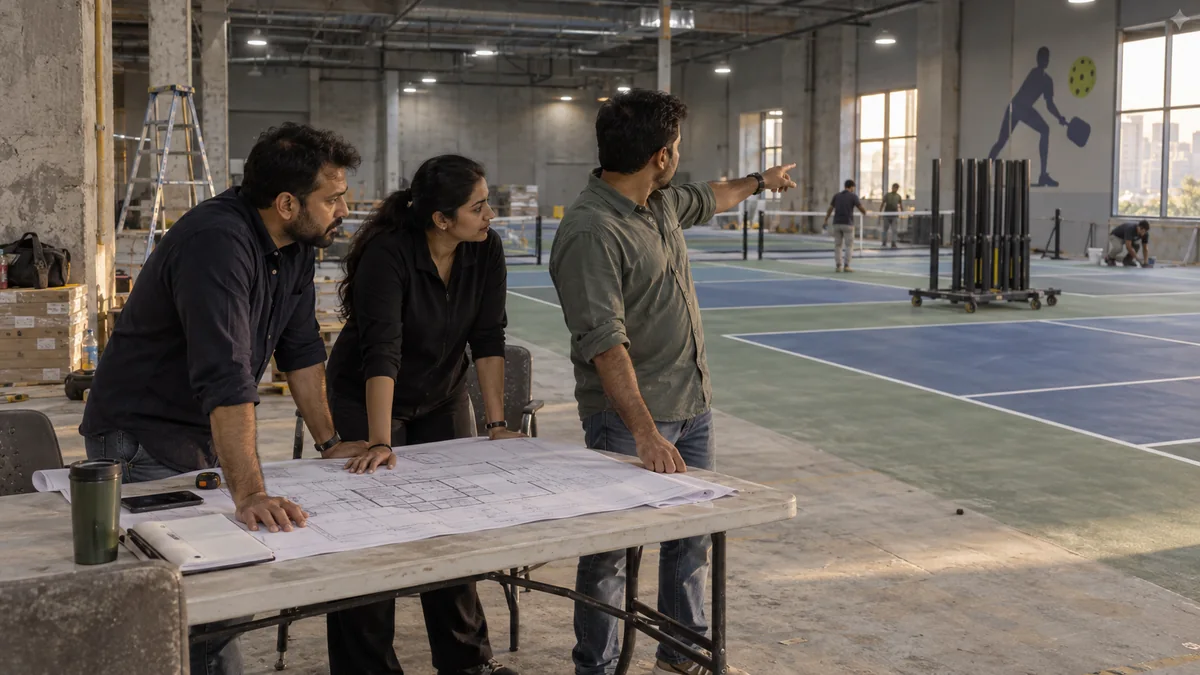
According to that announcement, the club sits on Darbaripur Road in Sector 70, Gurugram, Haryana (354/2, Darbaripur, Gurugram, Haryana 122101). All eight courts are indoors, designed for play year-round. Alongside coaching from pros, daily open play, court bookings, leagues, tournaments and community events, there is a free beginners' class called "Pickleball 101." Neither the announcement nor the original article mentions membership fees or court rates.
The partnership was announced in November 2025, and the doors opened about eight months later
The move into India was not decided on the spur of the moment in 2026. On November 12, 2025, the company issued an announcement from Phoenix naming BAQ Wizards as its India development partner. Founder and CEO Ace Rodrigues said at the time that India had been the first choice for international expansion from day one, and he repeated the point in the July 22 opening announcement. The company explains why India came before Japan in terms of "energy, an active culture and a love of community." It is not an explanation backed by numbers, but the order of events at least matched the words.
The timeline is the part to watch. From naming the partner to opening the doors tookroughly eight months. For a facility with eight indoor courts, that is on the fast side. The November 2025 announcement also states that more than 400 locations had already been awarded inside the United States. That line is easy to misread: awarded means the franchise rights have been handed over, not that 400 clubs are trading. In the US, the shells left behind by a collapsed craft store chain have been turned into eight-court venues (8 courts in a shuttered craft store, how America's vacant shops turn into courts), and what sets the pace at which those rights get used is the supply of buildings. That is what makes it significant that India's first club was announced as an opening rather than an award.
India's numbers: six times the courts, and a court built from around 500,000 yen
An October 2025 article from IBEF, the Indian government-backed investment information body, lines up comparable figures. What follows picks out only the numbers whose source can be identified, from that article and from Pickleball Kingdom's own announcements. Rupee figures are converted at about 1.7 yen to the rupee.
| Item | Figure | As of / source |
|---|---|---|
| Courts in operation | about 200 courts | Early 2024 (IBEF) |
| Courts in operation | More than 1,200 courts | First half of 2025 (IBEF) |
| Playing population | About 60,000 players | 2024 (IBEF) |
| Playing population outlook | 1 million players | 2028, AIPA estimate (cited by IBEF) |
| Cost to build one court | 300,000 to 500,000 rupees (about 510,000 to 850,000 yen) | IBEF |
| Locations awarded in the United States | More than 400 (awarded) | November 12, 2025, company announcement |
| Courts at the Gurugram club | Eight indoor courts (including two King Courts) | July 22, 2026, company announcement |
The Japanese figures are worth setting alongside them. An online survey of roughly 30,000 people carried out by Pickleball One in March 2026 put the domestic playing population at about 330,000, some seven times the roughly 45,000 of a year earlier. Awareness stood at 13.1%, and 72.5% of tennis players said they were interested. No nationwide estimate has been published by an official body, so this is a private estimate and should be read as one. In 2024 and 2025, then, India (about 60,000) and Japan (about 45,000) were in the same bracket. The paths split after that: India grew its player base while multiplying its courts six-fold, whereas in Japan the players came first.
"We are not opening a club, we are building a movement," said the three local partners
At the opening, Bhanu Gulati of BAQ Wizards said, "We are not opening a club, we are building a movement," describing pickleball as a game for everyone across ages, communities and cities. Anuj Duggal said the fun, the buzz and the big smiles on show had been genuinely encouraging. The third partner, Qudrath Ali, said that bringing Pickleball Kingdom to India means breathing new life into sport in the country, and added that he wants people one day to look back and say Indian pickleball started here.
The brand puts it slightly differently. Rob Streett, president and chief global officer, called the opening a turning point in the company's global expansion and handed the credit to the local side: what Bhanu, Anuj and Qudrath have built here, he said, sets a new standard for indoor sport in India. A franchisor putting its franchisees' execution rather than its own design expertise front and centre is also speaking to the next partner. The company has in fact said it is looking for additional business partners in India.
For operators in Japan, the lesson is not the court count but who built it
What readers in Japan can take from this news is not the eight-court scale. It is that the party that built those eight indoor courts was neither a foreign company operating directly nor a major developer, but a venture run by three people who put their names to it. In Japan, The Picklr in Toyosu launched on a funding model that signed members up three months before opening (US Picklr's 7-court indoor venue in Toyosu, and the funding design that locked in members 3 months before opening), and there are cases like Sansan where a company's core marketing budget carries the courts. In each case it is the side with the capital standing at the entrance.
Gurugram is the reverse: the brand supplies the name and the operating format, while the local side carries the risk on land, construction and staffing. The court construction cost IBEF cites for India, about 500,000 to 850,000 yen per court, looks like a level that includes simple outdoor builds. Indoor facilities in Japan face different requirements for climate control, lighting and flooring, and urban rents are in another league. The picture of three individuals building the same eight courts is still hard to draw in Japan.
The realistic translation is to adopt the same structure with fewer courts. India already has a case of a man running a barbershop who worked backwards from a shortage of courts and built the market itself (In an Era Short on Courts, a Barber Builds a Market from Scratch in India). Borrow the name, borrow the operating playbook, and set the court count and the location to your own scale. If a small or midsize operator in Japan is going to partner with an overseas brand, the point to negotiate is less the opening terms than the minimum number of courts at which a franchise is granted.
What is being exported is the operating recipe, not the building
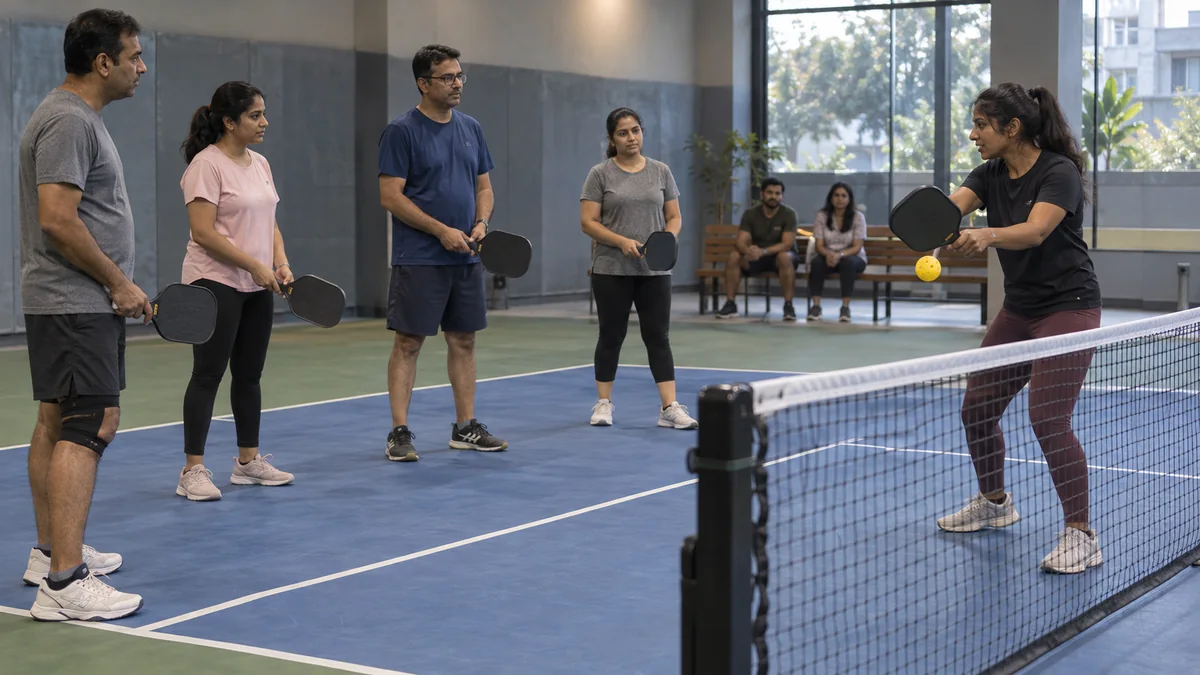
Break down what Pickleball Kingdom sells and the operating template sits at the centre, ahead of the court spec. Free introductory classes draw beginners in, daily open play builds the habit of coming back, and leagues and tournaments stretch the time members spend on site. The King Court, a showcase court built around spectating, is also a device for giving members the role of audience so that events work at all. The higher the share of beginners in the market it lands in, the better this sequence works.
On that reading, Japan's position of 13.1% awareness and 11.89 million people with some interest is not a bad fit for the format. The harder questions are the number of coaches who can run free introductory classes, and the customer base to fill courts during weekday daytime hours. How often does the Gurugram club run Pickleball 101, and what share of those beginners converts to paying members? If those numbers surface a few months after opening, they will be the most valuable material available to anyone trying the same format in Japan.
Gurugram location at a glance
| Item | Details |
|---|---|
| Club name | Pickleball Kingdom Gurugram |
| Location | 354/2, Darbaripur Road, Darbaripur, Sector 70, Gurugram, Haryana 122101 (India) |
| Courts | 8 indoor courts (including 2 King Courts) |
| Operating company | BAQ Wizards(Bhanu Gulati、Anuj Duggal、Qudrath Ali) |
| Official announcement date | July 22, 2026 (PR Newswire release) |
| What is offered | Coaching, daily open play, court bookings, leagues, tournaments, community events |
| Intro program | Pickleball 101 (free beginner class) |
| Membership and court fees | Not disclosed in the official release or the original report |
| Official page | pickleballkingdom.com/gurugram-india/ |
| Franchise inquiries | The company has announced it is looking for business partners in India (pickleballkingdom.com/india/) |
次に確かめるべき3つの数字
The eight courts in Gurugram are one instance of a US-style indoor club starting to be exported to Asia, no more and no less. What will actually carry weight as evidence are the numbers still to come. Three things to follow: how membership moves after opening, the conversion rate from Pickleball 101 into paying members, and when and in which city India's second location opens. The second site in particular will show in one stroke whether this model depends on a wealthy enclave like Gurugram or travels anywhere.
For anyone in Japan who runs a facility, or is about to, the suggestion is to approach overseas brands by asking first about the minimum court count in their franchise terms. If the only terms on offer assume eight courts, that partner isn't ready for you yet. If the conversation can start at four or six courts, there is room for the math to work even with Japanese rents. That gets you an answer faster than watching announcements out of Gurugram.
Source:Pickleball News Asia/PR Newswire (July 22, 2026)/PR Newswire (November 12, 2025)/IBEF/PR TIMES (Pickleball One)